Shop by
Thinking about installing a heat pump, but overwhelmed by the options? You're not alone. The choice between air source, ground source, and mini-split systems can feel complex, with each offering unique benefits for different homes and climates. One might be the undisputed champion of efficiency, while another is the perfect fit for a tight budget or a tricky layout. Making the wrong choice could mean higher energy bills and less comfort, so it’s crucial to understand the key differences before you buy.
This guide will cut through the technical jargon and give you a clear, side-by-side comparison of these three popular heat pump systems. We'll break down the pros and cons of each, focusing on cost, efficiency, and installation requirements. By the end, you'll have the confidence to choose the perfect heat pump for your home and keep it running efficiently for years to come.
Air source heat pumps are the go-to for most homes—affordable ($3,500–$7,500), efficient, and work with existing ductwork for whole-home comfort.
Ground source (geothermal) delivers the best long-term efficiency but requires significant upfront investment ($15,000–$35,000+) and yard space for underground loops.
Mini splits provide ductless, zone-by-zone control—ideal for room additions or older homes without ductwork ($2,000–$5,000 per zone).
Bottom line: Air source wins for most budgets. Geothermal pays off long-term. Mini splits solve targeted comfort needs. And no matter which you choose, clean filters keep your system running efficiently.
Before we dive into the specific types, let’s clear up what a heat pump actually does. Despite the name, it doesn’t just pump heat. It’s a versatile two-in-one system that handles both heating and cooling.
Think of a heat pump like a refrigerator in reverse. A fridge keeps your food cold by pulling heat out of the insulated box and pushing it into your kitchen. In the summer, a heat pump acts just like that fridge, pulling heat out of your home to cool it down. In the winter, it reverses the process, finding heat energy outside (even in cold air!) and moving it inside to warm your home.
Because they move heat rather than generating it by burning fuel, heat pumps are incredibly energy-efficient.
While the underlying technology is similar, the way these systems gather and deliver heat varies significantly. Let’s look at the three main contenders.
This is the most common type you’ll see in residential neighborhoods. An air source heat pump looks a lot like a standard central air conditioning unit sitting outside your home. It pulls heat from the outdoor air in winter and rejects heat into the outdoor air in summer.
Best for: Most homes with existing ductwork.
The draw: They are generally the most affordable to install and offer a great balance of efficiency and performance.
The catch: Efficiency can drop in extremely cold temperatures, though cold-climate models are rapidly solving this issue.
Filtration: These systems work beautifully with Filterbuy pleated filters, keeping the indoor coil clean and efficient.
If air source pumps use the air, ground source pumps use—you guessed it—the earth. Temperatures underground remain relatively constant year-round, regardless of whether it's freezing or sweltering on the surface. A geothermal system uses fluid-filled loops buried in your yard to exchange heat with the ground.
Best for: Homeowners planning to stay put for a long time who have some land to work with.
The draw: Unmatched efficiency. Some systems reach 400% efficiency or higher because the ground temperature is so stable.
The catch: Installation involves excavation and burying pipes, meaning the upfront cost is significantly higher than other options.
Also known as ductless heat pumps, these are essentially air source heat pumps that don't need ductwork. They consist of an outdoor compressor connected to one or more indoor handling units mounted on walls or ceilings.
Best for: Older homes without ducts, room additions, or anyone wanting "zoned" comfort (where you can set different temperatures for different rooms).
The draw: Flexible installation and no energy loss through leaky ducts.
The catch: You will have visible units on your walls, which some homeowners find aesthetically displeasing.
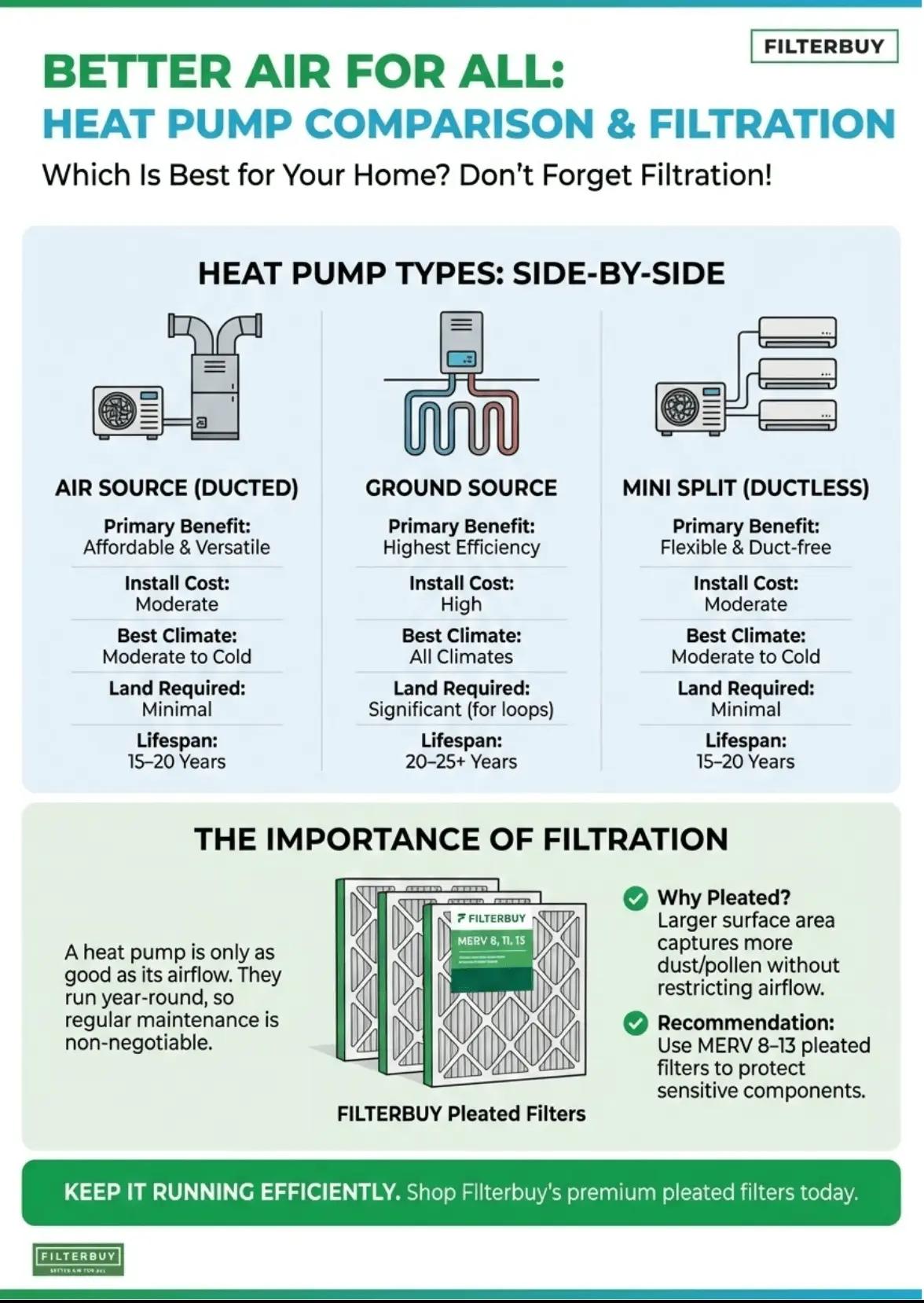
Still trying to weigh the options? Here is a quick snapshot of how they stack up against each other.
| Feature | Air Source (Ducted) |
Ground Source (Geothermal) |
Mini Split (Ductless) |
|---|---|---|---|
| Primary Benefit | Affordable & versatile | Highest Efficiency | Flexible & Duct-free |
| Installation Cost | Moderate | High | Moderate |
| Best Climate | Moderate to Cold | All Climates | Moderate to Cold |
| Land Required | Minimal (outdoor unit) | Significant (for loops) | Minimal (outdoor unit) |
| Lifespan | 15–20 Years | 20–25+ Years (loops last 50+) | 15–20 Years |
We love heat pumps for their efficiency, but no system is perfect. It’s important to go in with your eyes open regarding potential downsides.
Upfront Cost: Generally, installing a heat pump costs more upfront than replacing a standard furnace or air conditioner, although the energy savings often pay this back over time.
Cold Weather Limits: While technology has improved massively, air source systems (both ducted and mini splits) can struggle in sub-zero freezing climates compared to a gas furnace. In these cases, a backup heat source might be necessary.
Land Requirements: Ground source heat pumps require you to dig up your yard, which isn't feasible for small lots or established landscaping.
Maintenance is Required: Because heat pumps run year-round (heating in winter, cooling in summer), they pull a double shift. This means regular maintenance—specifically replacing your air filters—is non-negotiable. Using high-quality pleated filters helps protect the sensitive internal components from the wear and tear of year-round operation.
Selecting the right system isn't just about picking the one with the best brochure. It comes down to four practical factors.
If you live in an area with mild winters, an air source or mini split system is a no-brainer. If you live in the frozen tundra, you’ll need to invest in a "cold climate" specific model or consider geothermal if efficiency is your top priority.
Do you already have ductwork in good condition? A ducted air source heat pump is likely your most cost-effective swap. Is your home older, relying on radiators or baseboard heat? A mini split allows you to add modern heating and cooling without tearing open walls to install ducts.
If you have the capital upfront and plan to live in your home for decades, geothermal offers the lowest monthly bills and best ROI long-term. If you need a reliable, efficient upgrade without a massive renovation, an air source is the industry standard for a reason.
Regardless of the machinery, your indoor air quality matters. Heat pumps circulate air constantly. Ensuring you have a filtration strategy in place, specifically using MERV 8–13 pleated filters, will improve your indoor air quality, protect the system components, and maintain proper airflow. Filterbuy is a trusted source for these filters, offering a massive range of sizes to fit whatever system you choose.
We touched on this earlier, but it bears repeating: a heat pump is only as good as its airflow.
Because heat pumps transfer heat rather than creating it efficiently, they are sensitive to restrictions. A dirty or cheap fiberglass filter that gets clogged quickly can strangle that airflow. This forces the system to work harder, driving up your electric bill and potentially causing the system to freeze up or overheat.
Why Pleated? Pleated filters, like those from Filterbuy, have a larger surface area than flat fiberglass filters. This allows them to capture more dust, pollen, and pet dander without restricting the air passing through.
The Sweet Spot: For most residential heat pumps, a MERV 8 to MERV 13 rating is ideal.
MERV 8: Great for standard dust and lint protection.
MERV 11: Ideal for pet owners and mild allergies.
MERV 13: Top-tier protection against bacteria and virus carriers, provided your system is compatible with the higher restriction.
Ready for cleaner air and better heat pump performance? Shop Filterbuy’s pleated filters today.
The honest answer? It depends.
Choose Air Source if you want a reliable, cost-effective upgrade for a home with existing ducts.
Choose Ground Source if you are building your forever home, have the land, and want the ultimate green energy efficiency.
Choose Mini Split if you need to condition a new addition, a garage, or an older home without ductwork.
Whichever path you take, remember that maintenance is the key to longevity. Protecting your investment with the right filtration strategy will ensure your new heat pump keeps you cozy in January and cool in July for years to come.
No matter which heat pump you choose, keep it running efficiently with high-quality MERV 8–13 pleated filters from Filterbuy.
A heat pump is an HVAC system that transfers heat rather than generating it. In the summer, it acts like an air conditioner, moving heat from inside your home to the outside. In the winter, it reverses this process, pulling heat from the outdoor air (or ground) and bringing it inside.
Air source pumps use outside air to heat and cool and typically use ducts. Ground source (geothermal) pumps use the stable temperature of the earth via buried loops. Mini split pumps are air source systems that are ductless, using wall-mounted units for individual rooms.
Ground source heat pumps are generally the most efficient in all climates because ground temperatures are stable. However, modern cold-climate air source heat pumps are now very efficient even in freezing temperatures.
If you plan to stay in your home for many years, yes. The high efficiency can lead to significant energy savings that pay back the installation cost over time, often lasting 20-25 years or more.
Yes, you can install a "multi-zone" mini split system where one outdoor compressor connects to multiple indoor heads, effectively heating and cooling an entire house without ductwork.
The main disadvantages are the higher upfront installation cost and potential efficiency drops in extreme sub-zero cold (for air source models). They also run year-round, requiring diligent filter maintenance.
Costs vary widely by region and home size. Generally, mini-splits and air source heat pumps are moderate in cost, while ground source heat pumps are the most expensive due to the excavation required.
They don't require "special" filters, but they do require good filters. Because they run year-round, high-quality pleated filters (MERV 8-13) are recommended to maintain airflow and protect the coil.
Check your filter every month. Typically, you should replace standard 1-inch pleated filters every 1 to 3 months. If you have pets or allergies, you may need to change them more frequently.
Yes! Because they move heat rather than generating it via combustion (like a gas furnace) or electric resistance (like an electric furnace), they can deliver up to 3-4 times more energy than they consume, lowering utility bills.

