The moment a wildfire starts near you, you'll get an instant alert and simple tips to reduce your smoke exposure.
30xSmaller than a human hair
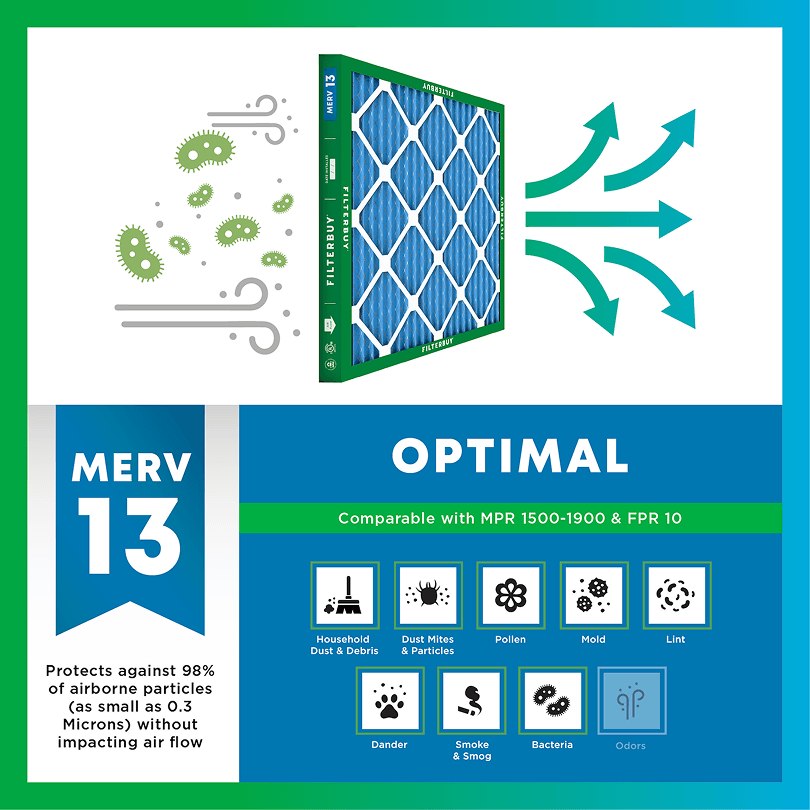
Fine enough to reach deep into the lungs. A MERV 13 is built to capture it.
It Doesn't Stay Local
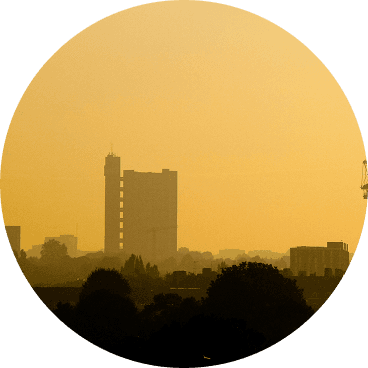
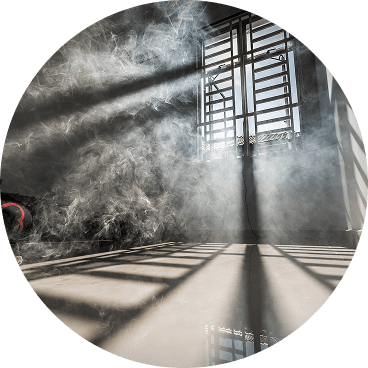
Smoke rides the wind far downwind — you can get smoky air with no fire nearby.
Simple steps to reduce indoor exposure.
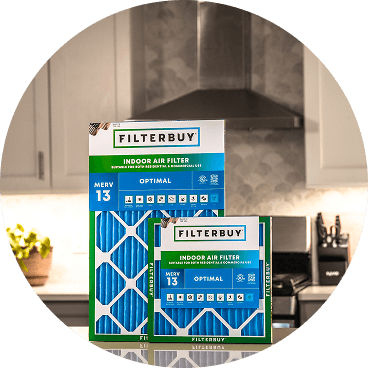
During smoke events, the EPA recommends upgrading to a MERV 13 filter — or the highest-rated filter your system can handle — to help reduce the fine particles smoke brings indoors. MERV 13 is the level most home HVAC systems can run while still capturing PM2.5, the fine particulate that makes up the bulk of wildfire smoke.

Over 70,000 wildfires burn in the U.S. every year.
Wildfire smoke can travel 1,000+ miles, affecting states that aren't even near the blaze.
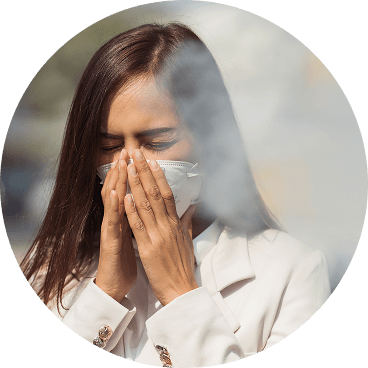
Exposure to wildfire smoke can worsen asthma, trigger heart issues, and lead to ER visits.
Indoor air can hold more fine particles during wildfire events unless it's properly filtered.
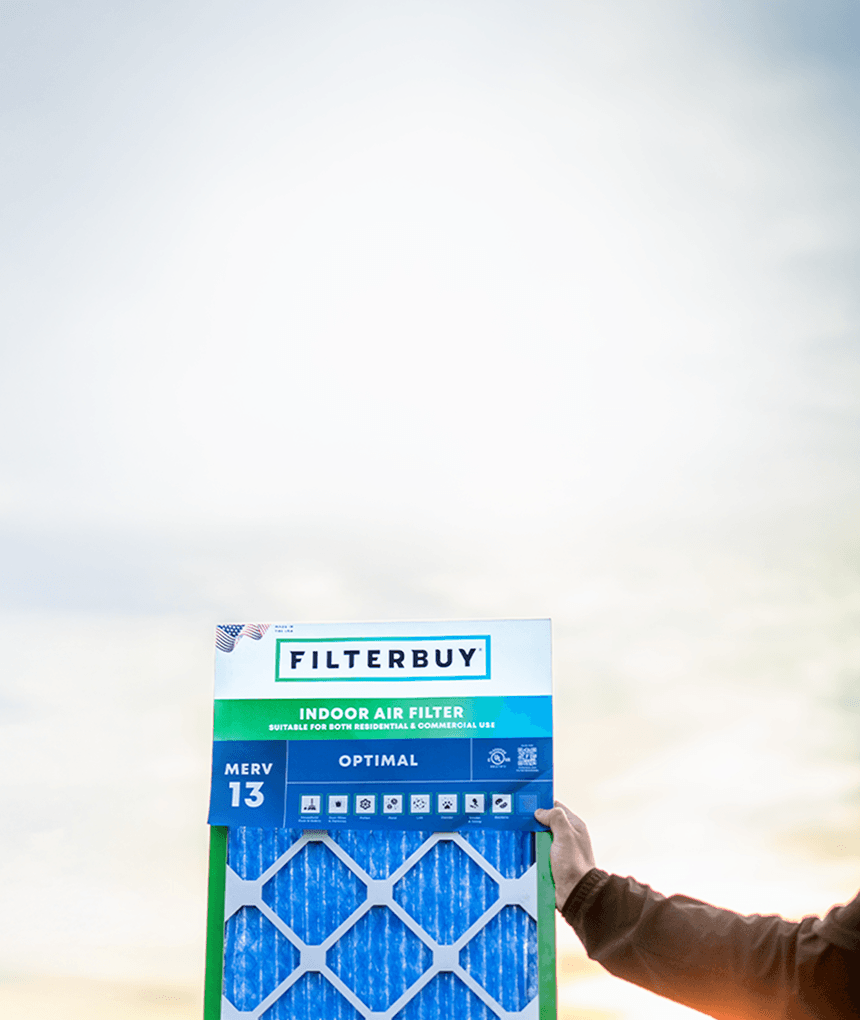
The EPA advises using MERV 13 filters or portable HEPA air cleaners during wildfire smoke events.
Use the live wildfire smoke tracker and upgrade your air filters today to protect your lungs and your home.
Shop Filters For Smoke Protection
By Michelle Wan, Brand Manager and Air Quality Writer | Reviewed by David Clark, Licensed HVAC Technician | Published August 21, 2026 | Updated August 21, 2026
Norfolk has little direct wildfire risk and a great deal of inherited smoke risk. Three sources send haze over the city: peat fires in the Great Dismal Swamp, regional spring debris burns, and long-range plumes from Canada and the West. Check the AirNow Fire and Smoke Map to see which you have, then close the house, run the HVAC fan continuously, and fit a MERV 13 filter.
Almost all of Norfolk's smoke starts somewhere else, so local fire activity tells you little about local air quality.
The Great Dismal Swamp burns peat rather than timber, so its fires last for months and produce low, persistent smoke instead of a plume that passes.
The Fire and Smoke Map layers NOAA smoke polygons over monitors and corrected sensors, making it the screen to check first.
Smoke loads a filter far faster than household dust, so one smoke week can use up a filter rated for three months.
Check the AirNow Fire and Smoke Map first. It is the only source putting fire detections, smoke plumes, and ground-level particle readings on one screen, and three others fill the gaps. The EPA publishes guidance on using AirNow during a smoke event.
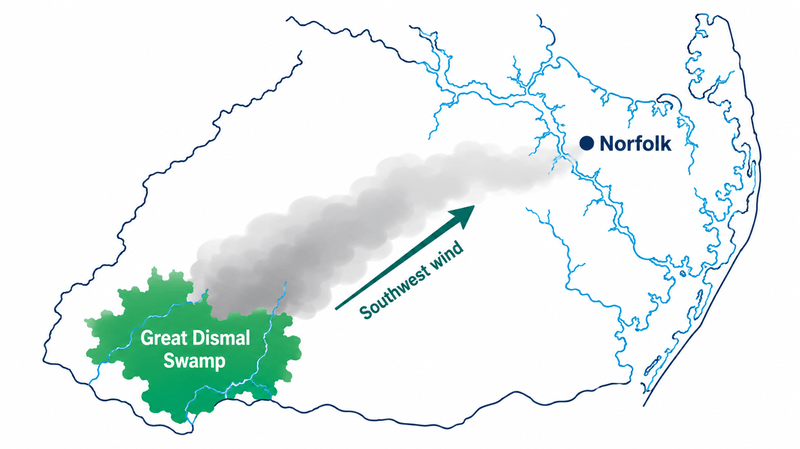
Smoke reaches Norfolk through three corridors that behave nothing alike. Work out which is delivering today's haze, and you know roughly how long it will stay.
The Great Dismal Swamp National Wildlife Refuge is a 112,000-acre peat wetland less than 25 miles southwest of downtown Norfolk, and any wind out of the southwest puts the city directly downwind. Two centuries of drainage ditching dried out its peat soil and left it easy to ignite. Peat does not burn the way a pine forest burns. It smolders below the surface for months, and the U.S. Fish and Wildlife
Virginia's spring fire season runs February 15 through April 30, when dormant vegetation meets low humidity and wind. The Department of Forestry enforces the 4 PM Burning Law, which bars open-air burning within 300 feet of woods or dry grass before four in the afternoon.
Smoke from Canadian and Western wildfires travels on upper-level winds and arrives with no visible fire in the Mid-Atlantic. During recent Canadian episodes, the NOAA facility in Norfolk pushed into Code Orange while the nearest flames burned thousands of miles away. Neighboring cities sit in the same corridor, so the Virginia Beach wildfire and smoke map usually tracks Norfolk closely.
Norfolk is hard to read because the city rarely gets a visual trigger. Most wildfire coverage is written from the fire side, and at Filterbuy we see the other end, where a household decides whether any of this is worth acting on.
Norfolk haze comes from marine layer, swamp peat smoke, or long-range transport, and each calls for a different response. The map settles it, but a few signals narrow the field before you reach for your phone.
A first read, not a diagnosis. Smell fades with exposure, and high smoke can sink after sunset. When signals disagree, use the monitor.
The Air Quality Index converts fine particle concentration into a 0 to 500 scale across six categories. Anything at or below 100 is generally satisfactory, and above 100, the air turns unhealthy for sensitive groups first, then for everyone. During a Norfolk smoke event, the pollutant driving that number is almost always PM2.5. The Filterbuy guide to which MERV rating matches today's AQI walks through the pairing.
Source: U.S. Environmental Protection Agency Air Quality Index. Values at or below 100 are generally considered satisfactory.
Norfolk has three overlapping smoke seasons because the corridors run on different clocks. Knowing which is active tells you when to keep spares on hand.
Peat and long-range transport seasons overlap. Norfolk can receive smoke from both sources in the same week.
Close the house and filter the air inside it. That is the whole strategy, and the only part of a smoke event you control. Work through these steps when the map turns orange, then check the CDC list of who is most at risk from wildfire smoke if anyone in the house has asthma or heart disease.
Close the envelope. Shut windows and doors, and set all fresh-air intakes to recirculate.
Run the fan continuously. Switch the thermostat fan from Auto to On so air keeps moving through the filter.
Install a high-efficiency filter. Fit the highest rating your system and filter slot accept, which in most Norfolk homes means MERV 13.
Add a portable cleaner. Put a portable HEPA cleaner in the bedroom, where you spend the most hours.
Stop adding indoor particles. Skip candles, wood fires, gas logs, aerosols, and frying.
Inspect the filter every two weeks. Replace it when the media looks dark.
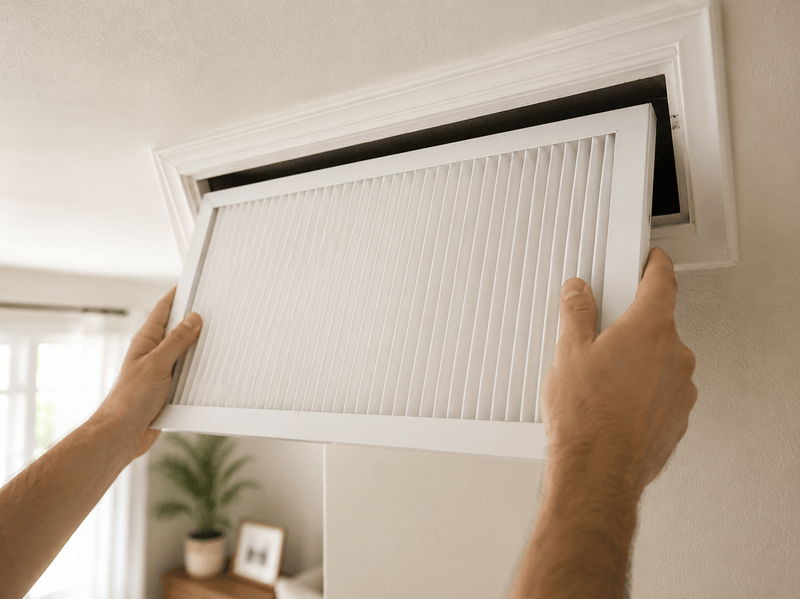
The EPA guidance on preparing for smoke and heat recommends MERV 13 or higher during smoky periods and notes that most systems accommodate one, provided it gets replaced frequently. MERV 13 captures the fine particulate that makes smoke hazardous, at a resistance a residential blower can handle.
MERV 13 is not equivalent to True HEPA. Confirm system compatibility with a licensed HVAC technician before upgrading.
MERV 13 is not the same thing as True HEPA, and should never be described that way. True HEPA media is built for sealed portable enclosures rather than furnace slots, which is why the two work best as a pair. Our side-by-side on MERV 13 compared with True HEPA for smoke explains the difference. The upgrade can also be seasonal, and returning to your usual rating after a smoke stretch is fine.
Filterbuy manufactures pleated filters in MERV 8, MERV 11, and MERV 13 across more than 600 sizes and builds custom sizes to order, so an older Norfolk home with a nonstandard return is not stuck at a lower rating. Common sizes such as 20x20x1 MERV 13 pleated filters ship free.
Norfolk is the clearest example we see of a city that has to think about wildfire smoke without ever having a wildfire. After manufacturing filters for over a decade and serving more than two million households, the pattern we keep seeing is that people react to what they can see out the window instead of what the monitor is reading. The households that come through a smoke week comfortably are the ones that already had a clean MERV 13 in the return before the sky changed color.
David Heacock, Founder and CEO, Filterbuy
The 2008 South One Fire burned 4,884 acres over 121 days, the longest-duration wildfire on record in Virginia.
Source: The Interagency South One Fire success story.
The 2011 Lateral West Wildfire burned for 111 days and consumed more than 6,500 acres of peat, producing smoke visible from space.
Source: the Fish and Wildlife Service Lateral West Wildfire account.
Ditching and drainage of the swamp caused peat subsidence and increased the risk of fire.
Check the Fire and Smoke Map, because detections and plumes change hourly. Active fire inside Norfolk city limits is rare, and the haze you notice almost always started somewhere else.
Yes, set it to recirculate. Central air, window units, and mini-splits keep filtered air moving, but any fresh-air intake pulls smoke straight indoors. Avoid evaporative coolers and single-hose portable units, since both draw outside air.
Most residential systems handle MERV 13 without trouble. Older or low-capacity systems are sometimes rated no higher than MERV 11, so check the manual or ask a licensed technician before upgrading.
Inspect every two weeks and replace when the media looks dark brown or black. Smoke loads a filter far faster than dust, so a heavy week can exhaust one rated for three months.
Keep one spare MERV 13 sealed in the closet before smoke season starts. A peat fire southwest of the city can hold the air over Norfolk for weeks, and a Canadian plume arrives with a day of warning, so a spare turns the problem into a five-minute swap. Shop Filterbuy air filters or build a custom size in a few clicks.
PM2.5: Fine particulate 2.5 microns or smaller, the main hazard in smoke because it reaches deep into the lungs and bloodstream.
MERV: Minimum Efficiency Reporting Value, the ASHRAE 52.2 scale for particle capture from 0.3 to 10 microns.
NOAA Hazard Mapping System (HMS): The NOAA product behind the fire detections and smoke plumes on the Fire and Smoke Map.
Subscribe to wildfire smoke alerts for Norfolk, VA, to get a heads-up before the next event reaches your area.