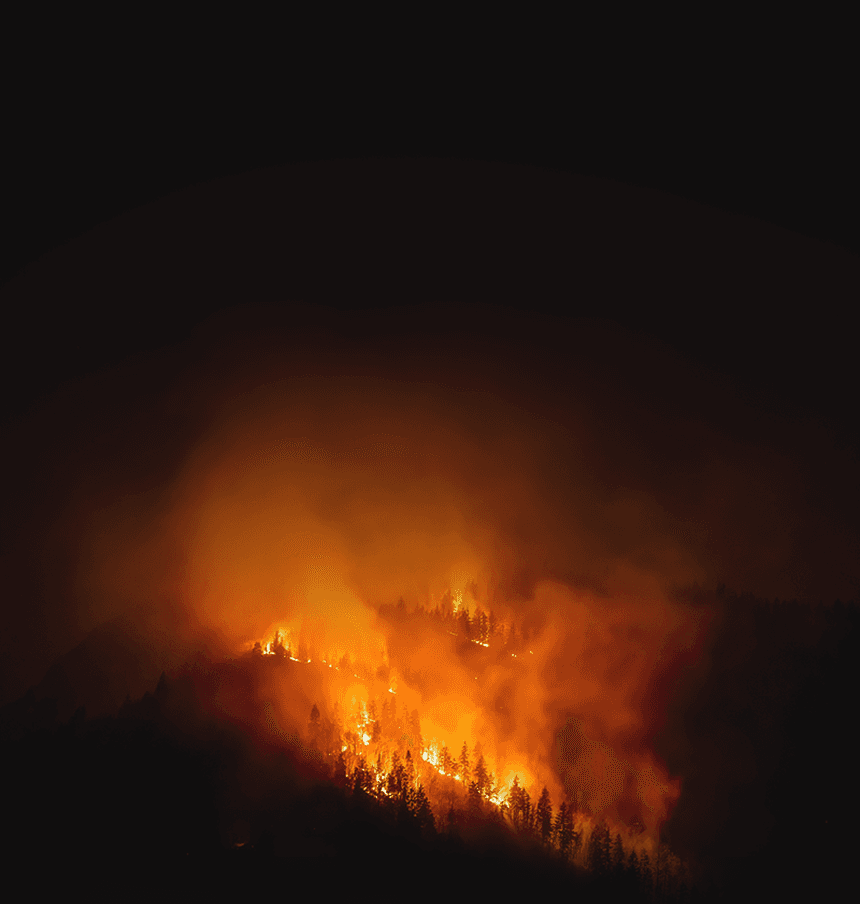
The moment a wildfire starts near you, you'll get an instant alert and simple tips to reduce your smoke exposure.
30xSmaller than a human hair
Fine enough to reach deep into the lungs. A MERV 13 is built to capture it.
It Doesn't Stay Local
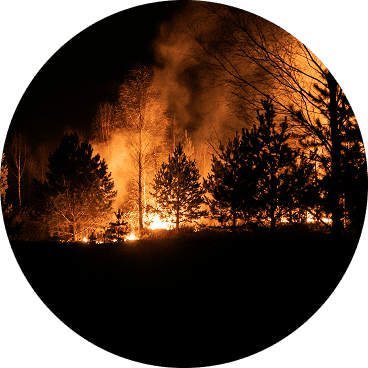
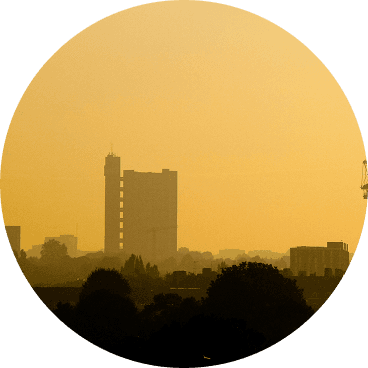
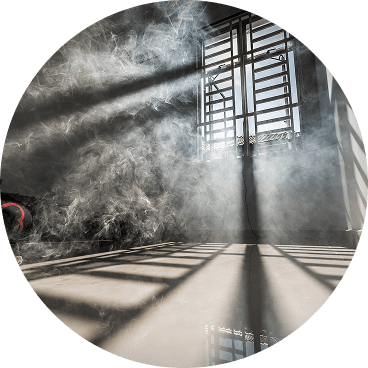
Smoke rides the wind far downwind — you can get smoky air with no fire nearby.
Simple steps to reduce indoor exposure.
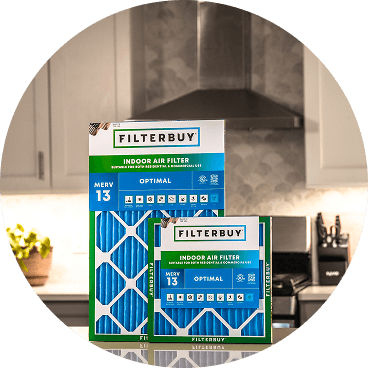
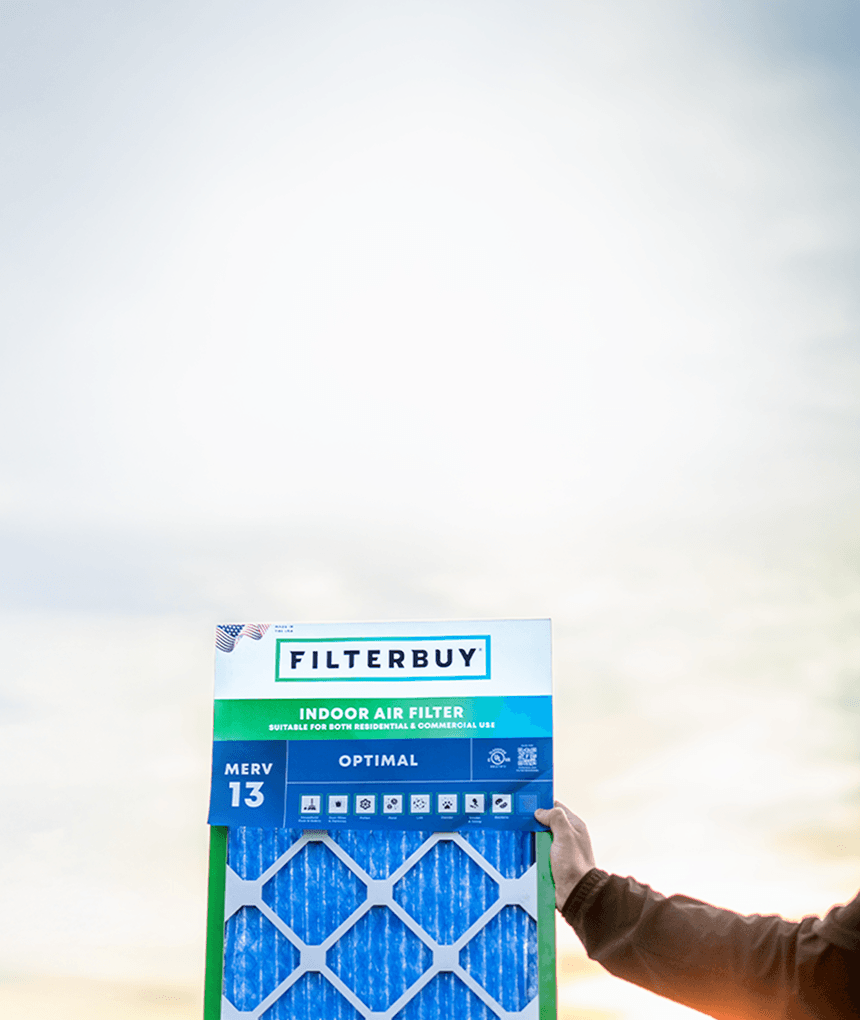
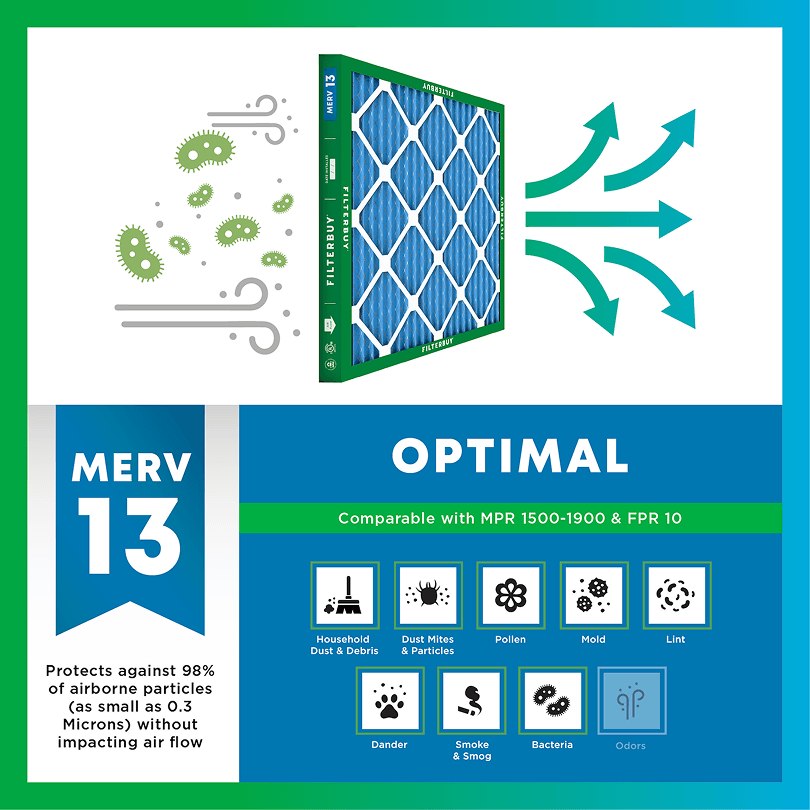
During smoke events, the EPA recommends upgrading to a MERV 13 filter — or the highest-rated filter your system can handle — to help reduce the fine particles smoke brings indoors. MERV 13 is the level most home HVAC systems can run while still capturing PM2.5, the fine particulate that makes up the bulk of wildfire smoke.
Over 70,000 wildfires burn in the U.S. every year.
Wildfire smoke can travel 1,000+ miles, affecting states that aren't even near the blaze.
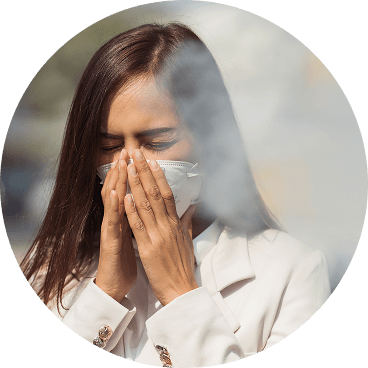
Exposure to wildfire smoke can worsen asthma, trigger heart issues, and lead to ER visits.
Indoor air can hold more fine particles during wildfire events unless it's properly filtered.
The EPA advises using MERV 13 filters or portable HEPA air cleaners during wildfire smoke events.
Use the live wildfire smoke tracker and upgrade your air filters today to protect your lungs and your home.
Shop Filters For Smoke Protection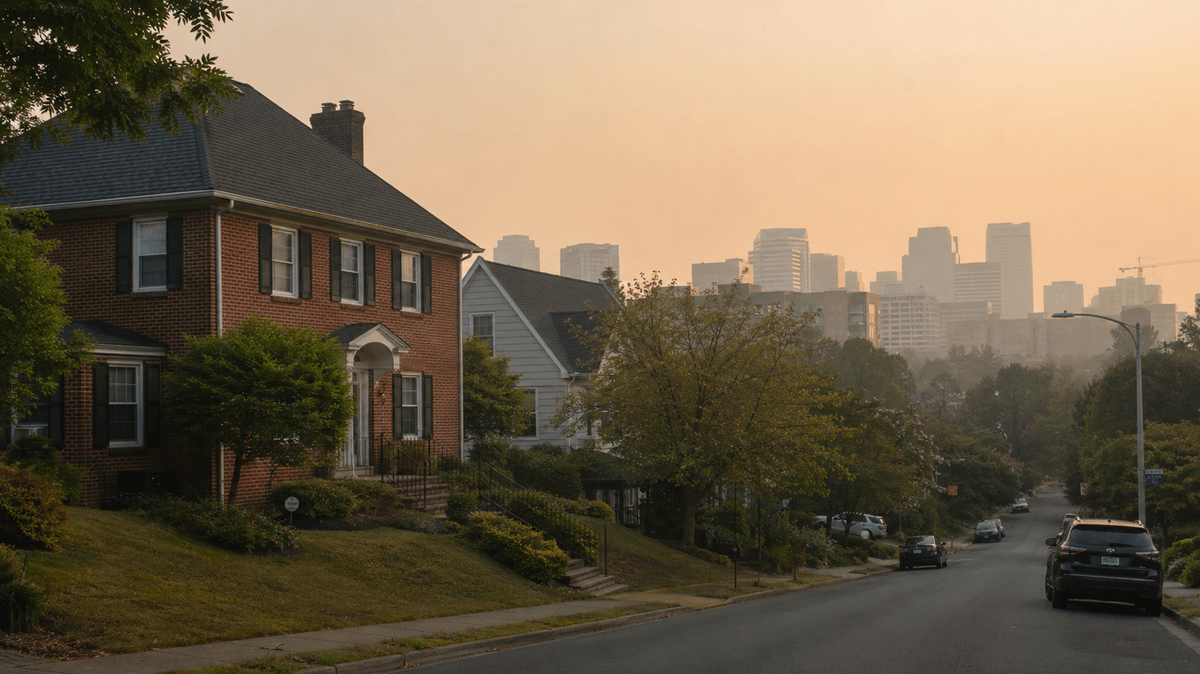
By Michelle Wan, Brand Manager & Air Quality Writer
Reviewed By: David Clark, Licensed HVAC Technician
Published: August 16, 2026 | Updated: August 16, 2026
Arlington seldom burns, but it regularly breathes smoke from fires 500 to 2,000 miles away. Check the ground-level AQI layer above first, because that is the air on your street; satellite plumes often sit thousands of feet overhead. At Code Orange (AQI 101+) or worse, close the windows, set your HVAC fan to "On" with recirculation, and run a MERV 13 filter. If you rent, as most of Arlington does, the renters section replaces that last step.
Arlington's smoke is imported, not local. The July 17, 2026 Code Purple event that moved Arlington's summer camps indoors came from fires roughly 1,000 miles away in Canada and northern Minnesota.
That event was forecast as a full category low. Virginia DEQ forecast Code Red 24 hours out, and it arrived as Code Purple.
Virginia's PM2.5 monitors are mostly not real-time. DEQ reports that most samplers collect a 24-hour filter sample once every three days, so the live number is often modeled or borrowed from a neighboring station.
The standard "upgrade your filter" advice misses most of Arlington. Roughly 59% of households rent, and 72% of the stock is multifamily, so the defense reorders around portable air cleaners, a sealed room, and a letter to the property manager.
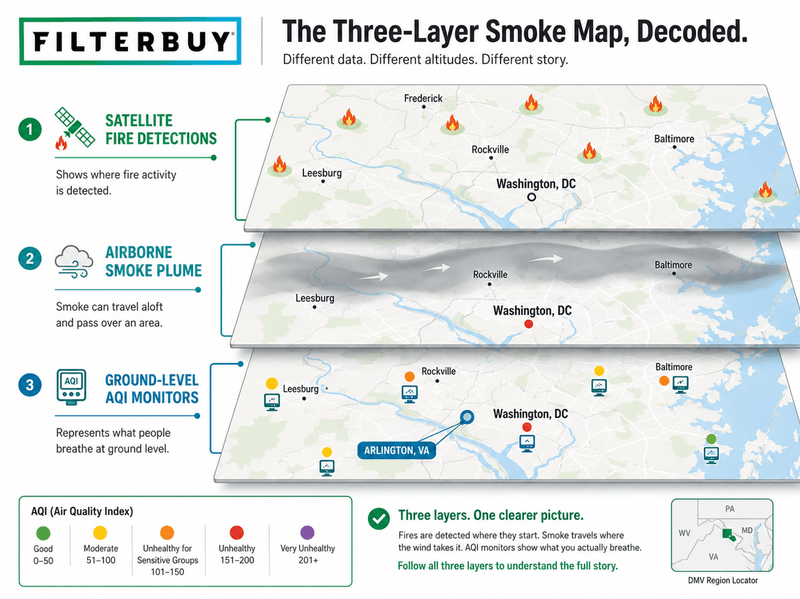
Read the map in three layers, in this order: ground-level AQI, then smoke plumes, then active fire detections. Only AQI measures the air you are breathing right now; plumes show what is arriving next, and fire detections show the source.
The mistake Filterbuy fields the most questions about is treating a satellite plume as a ground measurement. NOAA's Hazard Mapping System detects smoke anywhere in the vertical column, including plumes riding 10,000 feet up that never reach street level, which is how a map looks smoky over a clear Code Green afternoon. Our guide to reading a wildfire smoke map covers every marker.
Rarely, Arlington is 26 square miles of dense development with virtually no wildland-urban interface, so the hotspots affecting its air sit hundreds or thousands of miles away, arriving on the cross-border pattern that repeats most summers. Virginia averages roughly 700 wildfires a year, 60% in spring under the 4 PM Burning Law, but that is a rural, debris-burning problem.
The live PM2.5 number attached to Arlington is often modeled or borrowed from a neighboring station rather than measured locally. Virginia DEQ maintains 36 monitoring sites statewide but reports that most PM2.5 samplers collect a 24-hour filter sample once every three days, weighed in a lab rather than streamed to a dashboard.
That makes the reading regional, not useless. Confirm it where you live, because Filterbuy customers routinely describe smelling smoke on days the dot reads clean. Our outdoor versus indoor monitor comparison covers closing that gap.
Arlington's worst smoke day in years arrived a full category worse than forecast. DEQ forecast Code Red on July 16; conditions overran it overnight and were upgraded to Code Purple by morning, with a Code Maroon pocket over Loudoun and Fairfax. The county moved all parks programming indoors.
Anyone who planned Friday around Thursday's number was working from a category that no longer applied by sunrise. The filter already in your return vent is the only defense that does not depend on a forecast being right.
No. Filters capture particles, and ozone is a gas, so no pleated filter removes it. An N95 has the same blind spot.
This matters here because July 17 was two pollution events. While smoke held Arlington at Code Purple, ground-level ozone spiked to Code Red the same afternoon, DC's first Code Red ozone day since 2023. A Filterbuy MERV 13 running full tilt was handling one of the two pollutants in the air.
Ozone rewards timing instead: it peaks mid-afternoon and falls after sunset, so move the run or practice to early morning. Indoors, it sits far below outdoor levels because the gas breaks down on surfaces. Check which pollutant is driving the number first, because the two look identical on a color-coded map.
Close windows and switch the HVAC fan to "On" at AQI 101, add a portable HEPA cleaner at 201, and stay indoors above 301.
Per EPA AirNow and Metropolitan Washington Council of Governments alert conventions.
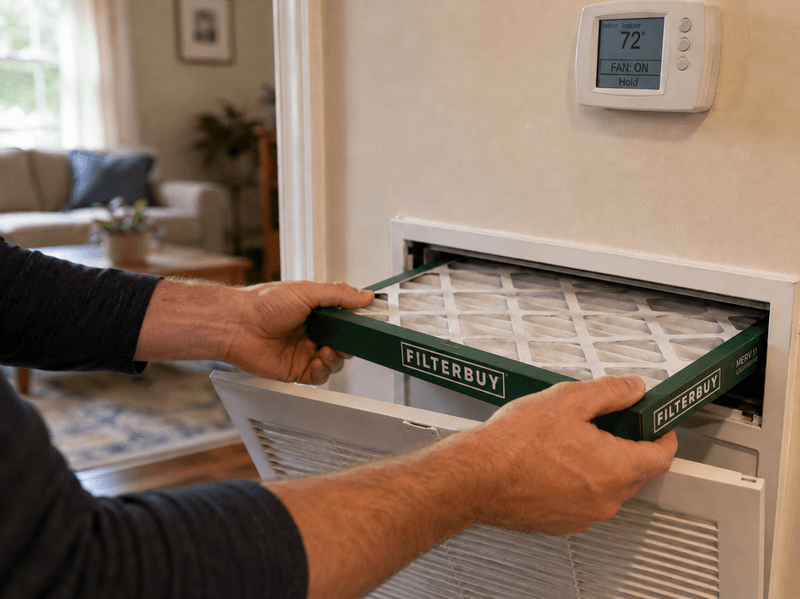
Close the house, run the HVAC blower continuously through a MERV 13 filter, and add a portable HEPA cleaner to one room. These five actions follow EPA guidance. Step 3 assumes you control your own system, which most Arlington households do not.
Close and seal. Windows, doors, and any fresh-air damper. Older Arlington bungalows and garden apartments leak more than you think.
Set the thermostat fan to "On," not "Auto." On "Auto," the blower runs only during a cooling call. The step most people miss.
Install a MERV 13 and check it weekly. Heavy smoke loads a filter far faster than normal.
Add a portable HEPA cleaner to one bedroom. Door closed, unit sized to the room: your clean room at Code Purple.
Skip indoor combustion. No candles, no fireplace, no vacuuming without a HEPA bag.
Close windows, skip indoor combustion, run one sealed room with a portable HEPA cleaner, and send the property manager a filtration request citing ASHRAE Guideline 44. None of that needs landlord approval.
Every piece of smoke guidance, Filterbuy's own included alongside the EPA's and the CDC's, opens by telling you to upgrade your HVAC filter. That assumes you own the system. Roughly 59% of Arlington households rent, and 72% of the stock is multifamily, so a Rosslyn or Ballston high-rise may have no accessible return grille at all.
In-unit filter grille? The five smoke-defense steps apply as written. Measure the frame before smoke season, not during.
PTAC or in-unit heat pump? That slim or washable filter is not rated for PM2.5. A portable HEPA cleaner in the bedroom does more than anything you can do to the unit itself.
Does building controls the air handling? Your leverage is the property manager: ASHRAE Guideline 44 covers multi-unit residential buildings by name.
MERV 13 is the benchmark for wildfire smoke in a home HVAC system. Smoke is dominated by PM2.5, much of it below 1 micron, and under ASHRAE Standard 52.2, only MERV 13 and above carry a capture requirement in that range.
Minimum capture efficiencies per ASHRAE Standard 52.2. "No requirement" means the standard sets no minimum for that particle range at that MERV level.
After a decade of manufacturing filters in the USA, Filterbuy can tell you odd return-grille sizes in pre-1950 housing are a recurring reason people cannot buy a MERV 13 off a shelf. Arlington has a lot of that stock, so we build custom sizes to order.
The households that struggle most once smoke rolls in are almost always the ones running a filter that was already overdue before the smoke ever showed up. I tell homeowners the same thing every fire season: check the rating on what's in your return vent right now, because a clogged or low-rated filter lets far more of those fine particles circulate through the home than most people realize.
David Clark, Licensed HVAC Technician
700,288 children in the Washington-Baltimore-Arlington metro breathe unhealthy air. The metro earned a D for particle pollution and an F for ozone, 49th worst nationally, per the American Lung Association's 2026 "State of the Air" report card.
60% of the wildfire smoke PM2.5 Americans breathe originates in another state, 87% in another county. Climate Central found per-person exposure ran four times higher in 2020–2024 than 2006–2019.
MERV 13 filters must capture at least 50% of particles in the 0.3–1.0 micron range, where most smoke mass sits. That ASHRAE Standard 52.2 threshold is why MERV 13 is the level named in ASHRAE's wildfire response guidance.
Check the AQI layer on the map above or Virginia DEQ's daily forecast. Below 100 is fine for most people. At 101–150, children, older adults, and anyone with asthma or heart disease should limit exertion. At 151+, everyone cuts back. At 201+, stay indoors.
Smoke travels thousands of miles aloft and descends when a front pushes it surfaceward. Arlington's June 2023 and July 2026 events both originated in Canada and the Upper Midwest.
Yes, if you control it. Set the fan to "On" so it filters continuously and recirculates rather than pulling in outside air.
Inspect it weekly rather than waiting out a normal 60-to-90-day interval, because heavy smoke loads a filter fast and a clogged filter restricts airflow.
No, because they do not filter PM2.5. A properly fitted N95 does; see our N95, KN95, and P100 comparison. CDC guidance covers which symptoms warrant a doctor's call.
Smoke arrives faster than a filter ships, and Arlington's last Code Purple day escalated overnight. If the filter is yours to change, get a Filterbuy MERV 13 on the shelf before the next one. Better Air For All™
Find your filter size · Shop MERV 13 filters · Set up auto-delivery
Michelle Wan is Filterbuy's Brand Manager and Air Quality Writer, covering AQI trends, wildfire smoke, and indoor air quality across Filterbuy's resource library.
Reviewed by David Clark, a licensed HVAC Technician, who verified this page's filtration and airflow guidance.
Subscribe to wildfire smoke alerts for Arlington, VA, to get a heads-up before the next event reaches your area.