The moment a wildfire starts near you, you'll get an instant alert and simple tips to reduce your smoke exposure.
30xSmaller than a human hair
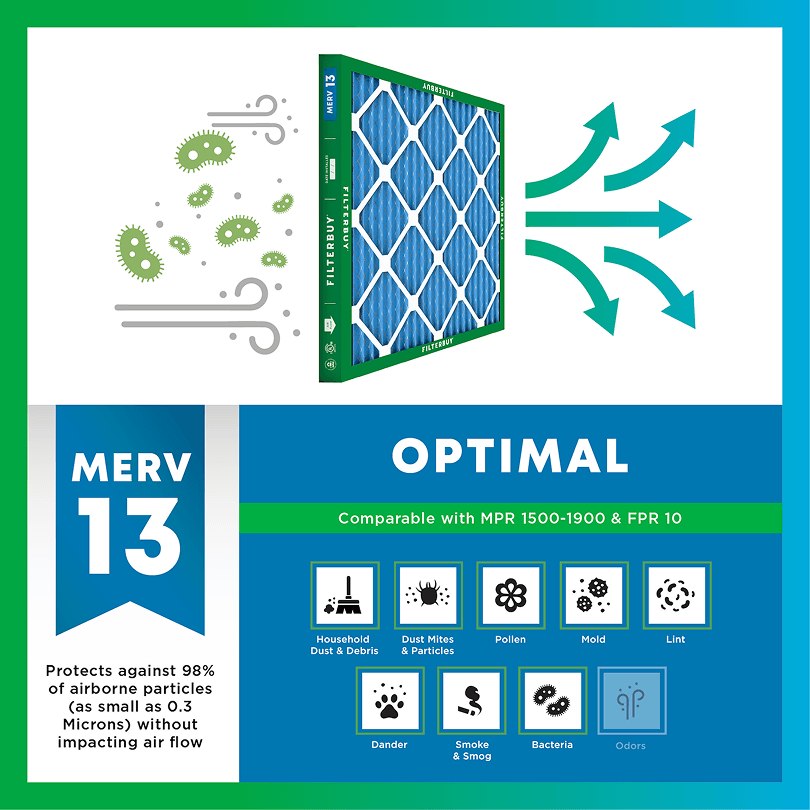
Fine enough to reach deep into the lungs. A MERV 13 is built to capture it.
It Doesn't Stay Local
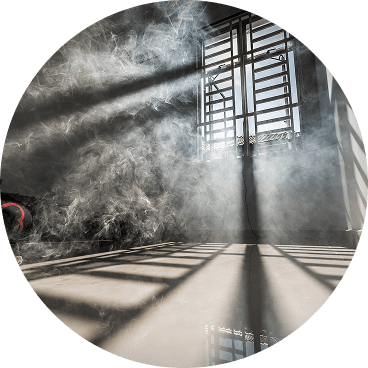
Smoke rides the wind far downwind — you can get smoky air with no fire nearby.
Simple steps to reduce indoor exposure.
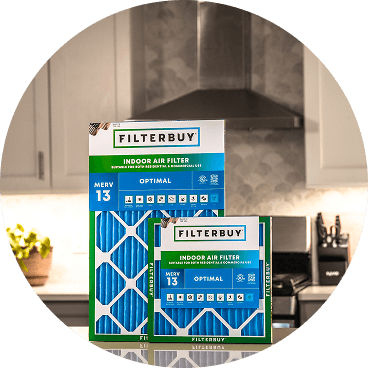
During smoke events, the EPA recommends upgrading to a MERV 13 filter — or the highest-rated filter your system can handle — to help reduce the fine particles smoke brings indoors. MERV 13 is the level most home HVAC systems can run while still capturing PM2.5, the fine particulate that makes up the bulk of wildfire smoke.
Over 70,000 wildfires burn in the U.S. every year.
Wildfire smoke can travel 1,000+ miles, affecting states that aren't even near the blaze.
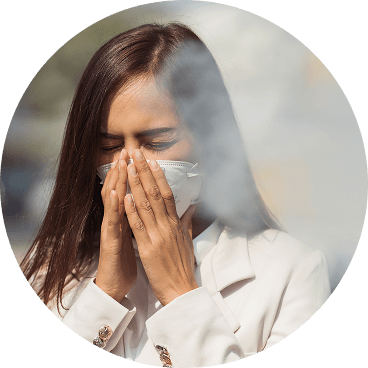
Exposure to wildfire smoke can worsen asthma, trigger heart issues, and lead to ER visits.
Indoor air can hold more fine particles during wildfire events unless it's properly filtered.
The EPA advises using MERV 13 filters or portable HEPA air cleaners during wildfire smoke events.
Use the live wildfire smoke tracker and upgrade your air filters today to protect your lungs and your home.
Shop Filters For Smoke Protection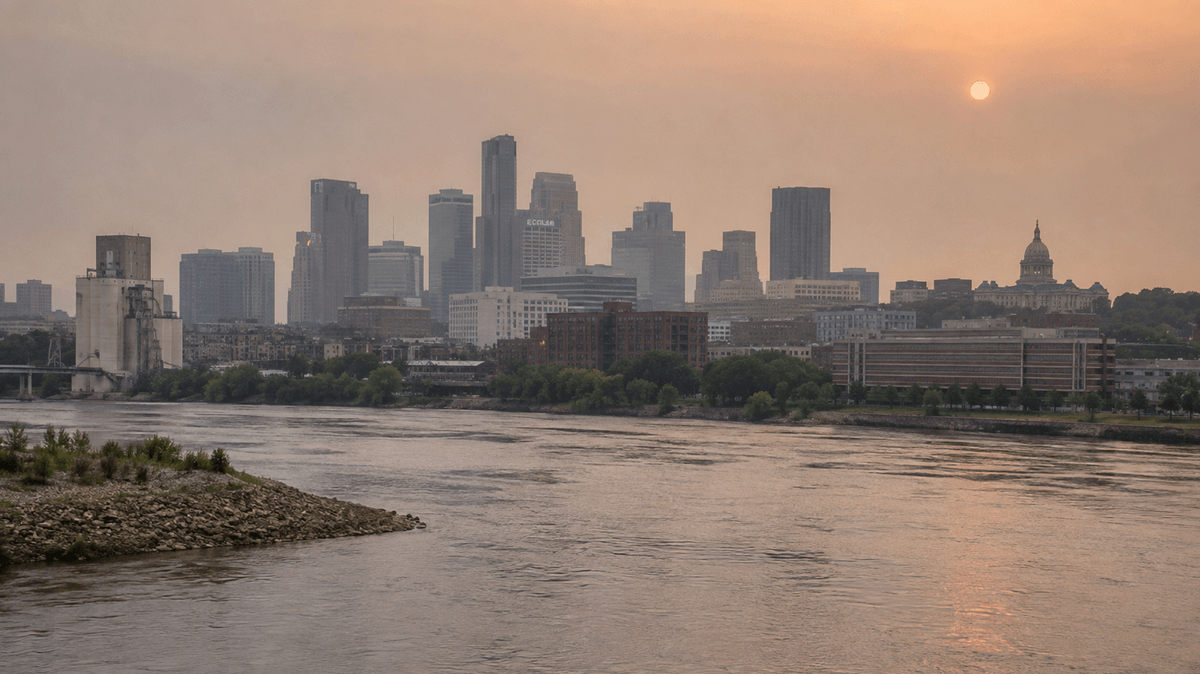
By Michelle Wan · Reviewed by David Clark, Licensed HVAC Technician Published: August 3, 2026 · Updated: August 3, 2026
Wildfire smoke reaches St. Paul from fires burning 200-plus miles north, and the local AQI can swing from green to red in hours. Most maps only show what you're breathing now. The more useful signal sits upwind: in the record July 2026 outbreak, West Duluth's monitor spiked roughly twelve hours before smoke settled over the Twin Cities.
St. Paul's wildfire smoke originates hundreds of miles north, so the fastest read on today's conditions is a map layering local PM2.5 data over satellite fire and plume tracking. Watching monitors upwind in Duluth and east-central Minnesota buys you hours of lead time. Once the AQI passes 100, close the windows, switch your HVAC to recirculate, run the fan continuously, and get a MERV 13 filter in the slot.
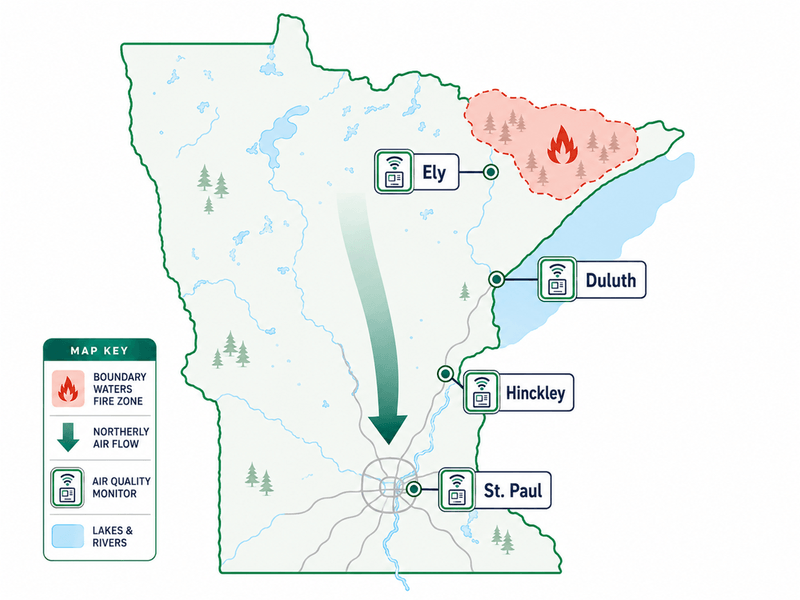
St. Paul's smoke arrives from the north. The July 2026 fires started in the Boundary Waters on July 7 and reached the metro eight days later.
A Twin Cities monitor recorded 342.8 µg/m³ of PM2.5 in July 2026, a metro record by a wide margin, per the Minnesota State Climatology Office.
No single map answers every question. Monitors show what you're breathing now; plumes show what's coming.
MERV 13 plus a continuously running HVAC fan is the EPA's baseline whole-home defense.
Smoke loads a filter faster than dust. Inspect weekly during an alert.
Use Filterbuy's live map above for this hour's reading. As of July 27, 2026, the Boundary Waters wildfires were roughly 53% contained, with about 72,500 acres burned across the U.S. and Canada. The Forest Service reopens 41 BWCAW entry points on July 30. Metro smoke has eased since mid-July, but Upper Midwest fire season runs into fall.
St. Paul sits roughly 230 miles southwest of the Boundary Waters fire complex, downwind on the northerly flow behind a passing cold front. That geography is why a fire nobody in Ramsey County can see still closes ball fields in Highland Park.
The mid-July stretch reset what "bad" means here. On July 15, the densest plume pushed south through the Arrowhead, and the Minnesota Pollution Control Agency (MPCA) raised alerts to the maroon "Hazardous" category, a level the Twin Cities had never seen.
Sources: Minnesota DNR State Climatology Office; Yale Climate Connections analysis of EPA PM2.5 records, which begin in 1999.
MPCA's Ryan Lueck flagged the compounding problem: the smoke arrived alongside extreme heat, and the body handles both stressors at once worse than either alone. The State Climatology Office called it Minnesota's worst outbreak in at least 50 years.
Check monitor readings for what you're breathing now, and satellite plume layers for what's arriving next. Smoke in the sky is not smoke at ground level. Each source below answers a different question.
Monitor readings show ground-level conditions now. Satellite plume layers show what is arriving next.
Open each: AirNow Fire and Smoke Map · MPCA current conditions · NOAA Hazard Mapping System · InciWeb Superior National Forest · Filterbuy St. Paul AQI map
We list the federal and state sources above Filterbuy's own map on purpose. On a smoke day, the government monitors are ground truth; our map is where you go once you know the number and need to act.
Roughly half a day, if you watch the right monitors. During the July 2026 event, West Duluth hit its record hourly PM2.5 reading at 10 a.m. on July 15; smoke did not reach the Twin Cities until late that evening. Enough time to close the house, swap a filter, and cancel practice.
Watching upwind monitors is the most useful habit for a St. Paul homeowner in fire season. The north-to-south ladder on a northerly flow:
Ely and the Arrowhead: closest to the source fires, first to spike.
Duluth and Two Harbors: the Lake Superior corridor.
Hinckley and east-central Minnesota: the last stop before the metro.
St. Paul: MPCA's local sites are Harding High School and Ramsey Health Center.
That half-day lead came from one documented event, not a formula. Wind direction, front timing, and plume height change the math, and smoke sometimes arrives from the south instead. Treat it as a habit, not a guarantee.
Every AQI page tells you what the number is right now. Almost none tell you what it is about to be. That gap is the whole reason this page leads with the monitors north of the metro instead of the one in your neighborhood. By the time St. Paul's number moves, your decisions are already behind it.
Michelle Wan, Brand Manager & Air Quality Writer, Filterbuy
Stop bringing outside air in, then filter the air you have. These steps follow current U.S. Environmental Protection Agency (EPA) guidance.
Close the house. Shut windows and doors, then close your HVAC's fresh-air intake or set the system to recirculate.
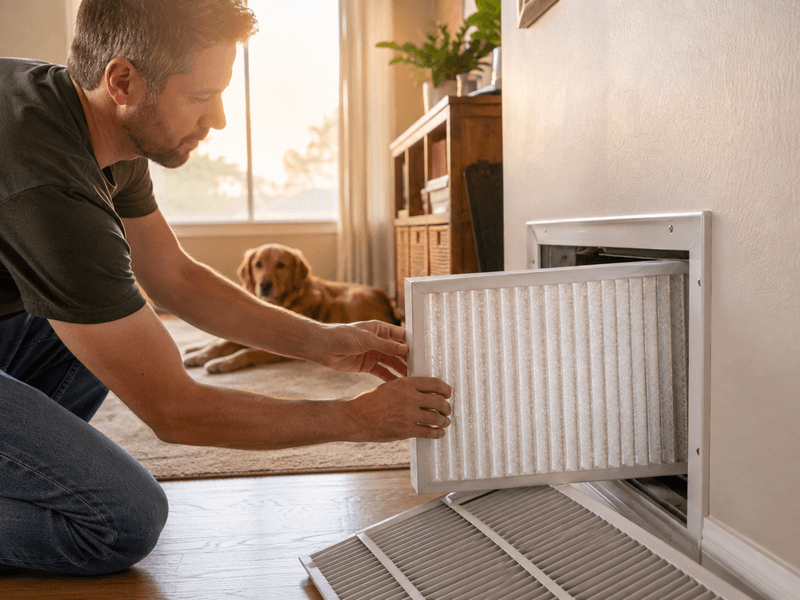
Install a MERV 13 filter, or the highest rating your system safely handles. MERV 13 is the EPA's minimum for wildfire smoke particles.
Move the thermostat fan from "Auto" to "On." A filter only cleans air that passes through it, and your central system moves far more air than a portable unit.
Set up one clean room. Add a portable HEPA cleaner where you spend the most time. EPA guidance: smoke CADR of at least two-thirds the room's square footage, and no ozone.
Don't add smoke of your own. Skip candles, gas-range frying, and vacuuming while AQI is high.
Inspect the filter weekly, not monthly. Replace it when the media looks dark or smells like smoke.
If your home has no central air, do not seal it shut in a heat wave. The July 2026 smoke arrived during an extreme heat warning, and EPA guidance is explicit: if it is too warm to stay inside with windows closed and you have no air conditioning, go elsewhere. Cool the house overnight, close it in the morning, and spend the hot hours in an air-conditioned library or community center. Heat kills faster than smoke.
For what each option catches, see MERV 13 vs. HEPA and running an air purifier in wildfire season.
Filterbuy has made filters in the USA for over a decade and served more than two million households, and the lesson that repeats is boring: the filter you need on the worst day is the one you bought on a clear day.
Wait for the outdoor AQI to drop below 100 and hold, then air the house out. Smoke behaves differently from ozone: an ozone reading falls on its own after sunset, while particles that got inside can linger indoors for days after the map turns green. Green outside is the start of cleanup, not the end.
Then do two things. Open windows or the HVAC fresh-air intake to flush the house, even briefly. And change the filter. One that ran through a smoke event is loaded, and a loaded filter restricts airflow without capturing much. On Filterbuy auto-delivery, pulling the next shipment forward a cycle costs nothing.
The Minnesota Department of Health lists children under 18, adults 65 and older, pregnant people, anyone with heart, lung, or diabetic conditions, and outdoor workers as most at risk. If someone in your household is in one of those groups, treat orange (AQI 101–150) as your cue to move activity indoors, not red. When you do go out, a well-fitted N95 blocks smoke particles; cloth and surgical masks do not.
In Minnesota, the thing homeowners miss isn't the filter. It's the HRV. Most tight-built homes up here run a heat-recovery ventilator on a timer, and during a smoke event that unit is quietly pumping outdoor air inside no matter how good the filter in your furnace is.
David Clark, Licensed HVAC Technician
Five sources beyond the maps, for decisions a map cannot make for you.
MPCA air quality forecast and EnviroFlash signup: Minnesota's next-day AQI outlook. Sign up for email alerts so a metro warning reaches you before the haze does.
Minnesota Department of Health wildfire smoke guidance: Symptoms, risk groups, and Minnesota's outdoor air quality guidance for schools and child care. Gives you a defensible AQI threshold instead of a judgment call.
EPA guide to creating a clean room: The federal how-to behind the steps above, for protecting one room when you can't seal the house.
EPA research on DIY air cleaners: Tested box-fan designs using MERV 13 filters. Our Corsi-Rosenthal box build guide walks through the same design.
Superior National Forest alerts and closures: Closure orders, campfire restrictions, fire danger, and BWCAW entry-point openings. Check before any trip north.
Three findings from federal, state, and national sources behind the guidance above.
High-efficiency filter + continuous fan: ~50% drop in indoor PM2.5
Low-efficiency filter + continuous fan: ~24% drop
Source: EPA: Strategies to Reduce Exposure Indoors, citing Fisk and Chan (2017)
National rank: 39th worst, grade F
Hennepin County: 4.5 unhealthy PM2.5 days per year (2022–2024)
Minnesota children breathing unhealthy air: ~723,000
Source: American Lung Association State of the Air 2026, Minnesota
2023: Minnesota recorded 22 air-quality alerts covering 52 days—the highest total on record at the time. Fourteen alerts reached the red AQI category.
2025: Minnesota experienced 15 summer days with red AQI conditions and nine additional days with orange AQI conditions, making it likely the state’s smokiest year in five decades or more.
Sources: MPCA 2023 Air Quality Alert Record and Minnesota DNR 2025 Smoke Summary
Only on recirculate, with a high-efficiency filter and the fan running. Window and single-hose portable units have minimal filtration and can pull smoky air in. More: do air conditioners filter wildfire smoke?
Not entirely. Pleated filters capture particles; odor is gas-phase and needs activated carbon. See Filterbuy's best MERV rating for wildfire smoke.
When St. Paul's AQI climbs past 100, close the house and let a MERV 13 filter do the work. Filterbuy makes filters in the USA in 600+ sizes, ships free and factory-direct, and auto-delivery means the next one arrives before you need it.
See the live Minnesota AQI map here
Michelle Wan is Filterbuy's Brand Manager and Air Quality Writer. She covers AQI trends, wildfire smoke, and indoor air quality across Filterbuy's resource library, translating MERV ratings, filtration, and HVAC efficiency into plain-English guidance for homeowners, and she fronts much of the brand's educational video content. She works directly with Filterbuy's U.S. manufacturing team across its Alabama, Florida, Pennsylvania, and Utah factories. Michelle earned her B.A. in Sociology from the University of California, Santa Cruz, in 2021.
David Clark is CEO of Filterbuy HVAC Solutions and a Licensed HVAC Technician. He reviewed this article for technical accuracy.
AQI (Air Quality Index): The EPA's 0–500 scale: 0–50 Good, 51–100 Moderate, 101–150 Unhealthy for Sensitive Groups, 151–200 Unhealthy, 201–300 Very Unhealthy, 301+ Hazardous.
PM2.5: Fine particles 2.5 micrometers or smaller, measured in micrograms per cubic meter (µg/m³). The main pollutant in wildfire smoke.
MERV: Minimum Efficiency Reporting Value, the 1–16 scale for how well a filter captures particles. MERV 13 is the EPA's minimum for smoke.
HEPA: Filtration capturing at least 99.97% of particles at 0.3 microns. Used in portable air cleaners.
CADR: Clean Air Delivery Rate, a portable air cleaner's rated output.
MPCA: Minnesota Pollution Control Agency, which runs the state's air monitors and issues alerts.
Subscribe to wildfire smoke alerts for St. Paul, MN, to get a heads-up before the next event reaches your area.