
Connecticut Live Wildfire Smoke Map
Get Alerts For Wildfires In Your Area
The moment a wildfire starts near you, you'll get an instant alert and simple tips to reduce your smoke exposure.
What's In The Smoke
30xSmaller than a human hair
Fine enough to reach deep into the lungs. A MERV 13 is built to capture it.
How Far It Travels


It Doesn't Stay Local
Smoke rides the wind far downwind — you can get smoky air with no fire nearby.
What To Do During A Smoke Event
Simple steps to reduce indoor exposure.
- Stay In, Close UpShut windows and doors to keep smoke out.
- Set Fan To "On"Keeps air cycling through your filter, not just when heating or cooling.
- Recirculate AirSwitch off fresh-air intake so you're not pulling smoke in.
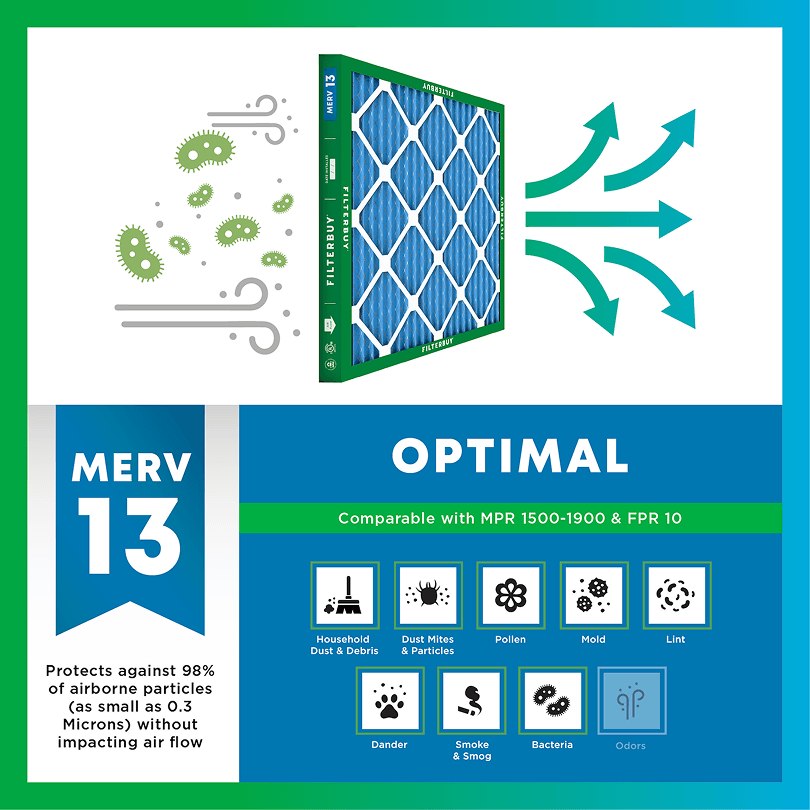
- Run A MERV 13Built to capture the fine PM2.5 in smoke.
- Add A PurifierExtra filtration for the room you use most.
- Wear an N95 if OutsideFits snug to block fine particles — a cloth mask won't.


The Best Air Filter For Wildfire Smoke
During smoke events, the EPA recommends upgrading to a MERV 13 filter — or the highest-rated filter your system can handle — to help reduce the fine particles smoke brings indoors. MERV 13 is the level most home HVAC systems can run while still capturing PM2.5, the fine particulate that makes up the bulk of wildfire smoke.
- Captures PM2.5 particles
- Blocks ash, soot, and smoke odor
- Keeps your indoor air safe—even when the outdoor air is dangerous
- Meets the EPA's recommended rating for filtering fine wildfire smoke particles.

Wildfire Smoke FAQs
Facts About Wildfires
Over 70,000 wildfires burn in the U.S. every year.
Wildfire smoke can travel 1,000+ miles, affecting states that aren't even near the blaze.
Exposure to wildfire smoke can worsen asthma, trigger heart issues, and lead to ER visits.
Indoor air can hold more fine particles during wildfire events unless it's properly filtered.
The EPA advises using MERV 13 filters or portable HEPA air cleaners during wildfire smoke events.
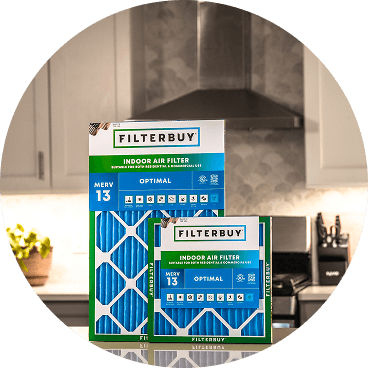
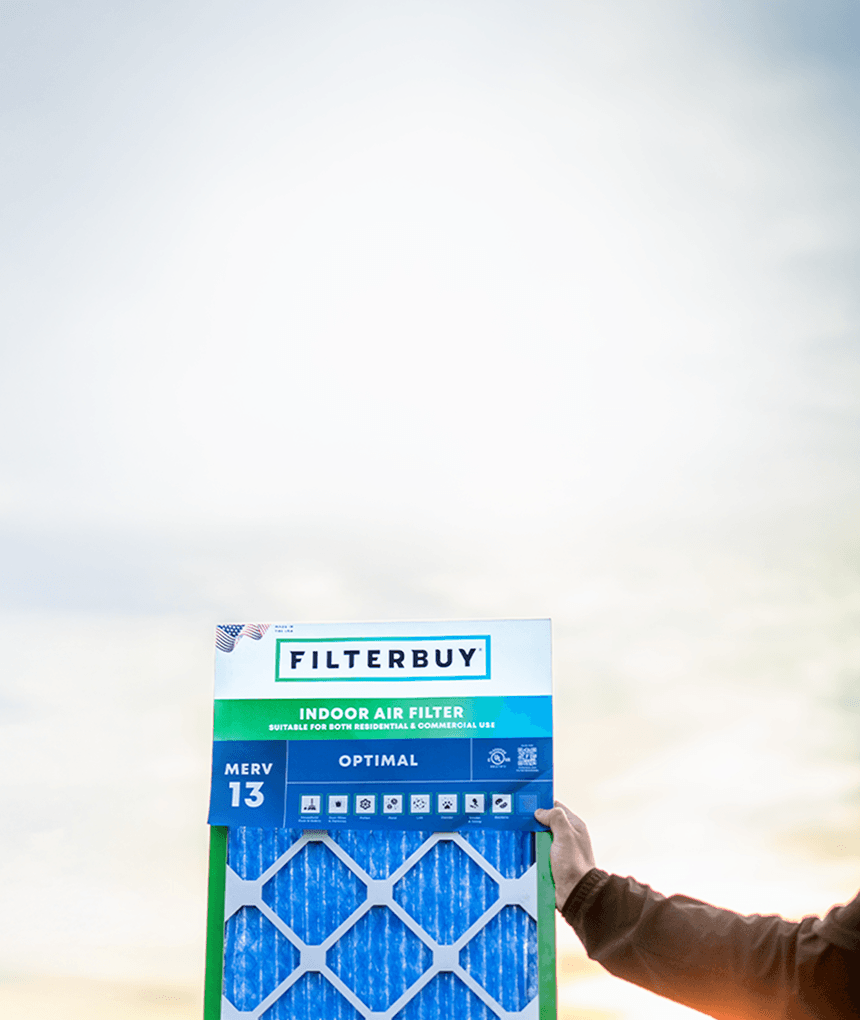
Don't Wait Until The Smoke's Inside.
Use the live wildfire smoke tracker and upgrade your air filters today to protect your lungs and your home.
Shop Filters For Smoke Protection
Is Smoke Heading Your Way? Current Live Forest Wildfire and Smoke Map Today in Connecticut | Real-Time Fire & Evacuation Tracking
If you can smell smoke in the air or notice a haze settling over Connecticut, your indoor air quality is already being affected. As air filtration manufacturers who've spent over a decade obsessing over what people breathe inside their homes, we know firsthand that wildfire smoke doesn't stay outside — fine particulate matter from distant forest fires infiltrates your HVAC system and circulates through every room.
We built this real-time wildfire and smoke tracking resource for Connecticut because we've seen it happen with our own customers: smoke events spike, air quality drops, and families don't realize their indoor air has become just as compromised as the air outside. Below you'll find live fire and smoke maps, air quality readings, evacuation resources, and expert guidance from our team on protecting your home's air when smoke conditions hit — all sourced from NOAA, AirNow, and the National Interagency Fire Center.
TL;DR Quick Answers
Is smoke heading your way? How can you track current live forest wildfire and smoke conditions in Connecticut today?
Yes — wildfire smoke can reach Connecticut at any time during fire season, even from fires burning thousands of miles away. The fastest way to check is the EPA's AirNow Fire and Smoke Map at fire.airnow.gov, which shows real-time smoke plumes, active fire locations, and AQI readings for your Connecticut county.
What most people don't realize — and what we've learned firsthand, manufacturing millions of air filters:
Smoke doesn't need a local fire to impact your home. The 2023 Canadian wildfires pushed hazardous smoke into Connecticut from over 1,500 miles away.
Even with windows closed, indoor PM2.5 reaches 55–60% of outdoor levels during smoke events (EPA data).
Your HVAC filter is your home's primary defense against smoke infiltration — not your windows and doors.
Three immediate steps if smoke is active:
Check the live map on this page for current Connecticut conditions.
Inspect your HVAC filter — if it's basic fiberglass or visibly dirty, replace it with MERV 8 or higher.
Set your thermostat fan to "ON" to continuously scrub indoor air through your filter.
Bookmark this page for real-time tracking — we built it because after a decade of manufacturing filters and helping customers through smoke events, we know that the gap between seeing smoke outside and protecting your air inside is where families are most vulnerable.
Top Takeaways
Closing windows isn't enough. EPA data confirms indoor PM2.5 reaches 55–60% of outdoor levels during smoke events — even with everything sealed. Your HVAC filter is the real barrier.
Wildfire smoke is no longer a West Coast problem. The 2023 Canadian wildfires turned Connecticut skies orange and spiked ER visits across the Northeast. Smoke travels thousands of miles. Your indoor air is in the impact zone.
Your HVAC filter is your most underestimated protection. A basic fiberglass filter lets smoke pass right through. A pleated filter rated MERV 8 or higher actively captures fine particulate. The difference is dramatic — we've seen it firsthand, manufacturing millions of filters.
Preparation beats reaction. Know your MERV rating. Stock a replacement. Bookmark this page. Families who plan fare best — not the ones who scramble after the sky turns orange.
Five minutes of action today protects your family for months. Pull out your HVAC filter and check it right now. It's the single most impactful step you can take before the next smoke event hits Connecticut.
How Wildfire Smoke Reaches Connecticut
Smoke and ash clouding the air in Connecticut due to wildfires in Canada, the western US, and even other states in the northeast are a regular occurrence pushed into the state by upper-level wind patterns. Once it gets there, it contains fine particulate matter (PM2.5), which is small enough to get beyond the normal defenses of your body and deep into your lungs. From our experience manufacturing millions of air filters, we can tell you that these microscopic particles are also small enough to slip through standard low-rated HVAC filters and circulate through your home for hours.
Current Live Wildfire and Smoke Map for Connecticut
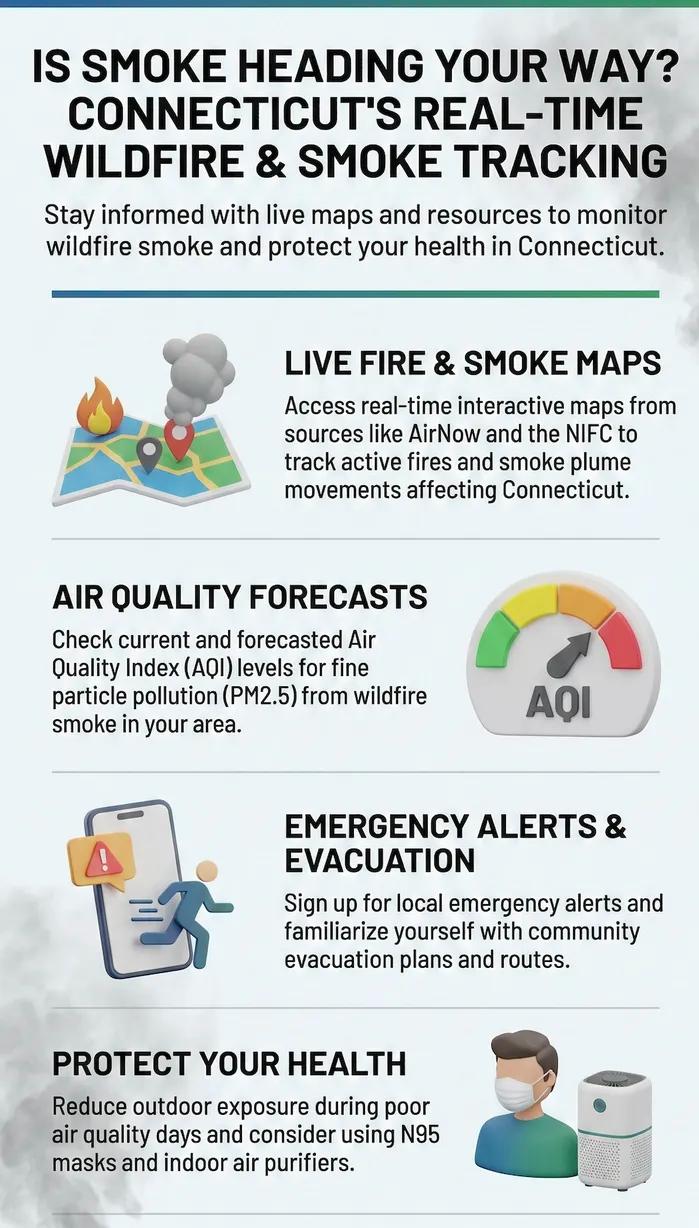
The interactive map below pulls real-time data from federal tracking sources, including the National Interagency Fire Center (NIFC), NOAA's Hazard Mapping System, and the EPA's AirNow fire and smoke map. Use it to monitor active fire locations, smoke plume trajectories, and whether particulate matter is currently moving toward your area of Connecticut.
Check this map regularly during the active fire season. Smoke conditions can change within hours as wind patterns shift, and what looks like a clear day in the morning can turn hazy by afternoon.
Understanding Air Quality Index (AQI) Readings During Smoke Events
When wildfire smoke moves into Connecticut, your local AQI reading is the most reliable indicator of how dangerous outdoor — and potentially indoor — conditions have become. Here's what the levels mean for your family:
Green (0–50) — Good: Air quality is satisfactory with minimal risk.
Yellow (51–100) — Moderate: Sensitive individuals such as children, elderly family members, and those with asthma should limit prolonged outdoor exposure.
Orange (101–150) — Unhealthy for Sensitive Groups: Most people may begin noticing irritation. Close windows and ensure your HVAC filter is rated MERV 8 or higher.
Red (151–200) — Unhealthy: Everyone should reduce outdoor activity. Your HVAC system becomes your primary defense — a high-rated filter is essential at this stage.
Purple (201–300) — Very Unhealthy: Stay indoors. If your home feels smoky inside, your current filter likely isn't capturing fine particulate matter effectively.
Maroon (301+) — Hazardous: Emergency conditions. Seal your home as much as possible and run your HVAC system continuously with a MERV 11 or higher filter to actively scrub indoor air.
After working with customers through multiple smoke events across the country, we've seen how quickly indoor air quality deteriorates when homes rely on low-rated filters during these conditions. The difference between a basic fiberglass filter and a properly rated pleated filter during a smoke event is dramatic — and measurable.
Connecticut Fire and Evacuation Tracking Resources
Beyond smoke monitoring, staying informed about active fires and potential evacuations is critical during fire season. These are the most reliable real-time resources for Connecticut residents:
InciWeb (Incident Information System) — inciweb.wildfire.gov — tracks active wildfire incidents nationwide with detailed status reports.
CT DEEP (Department of Energy and Environmental Protection) — portal.ct.gov/deep — provides Connecticut-specific fire alerts, burn bans, and environmental advisories.
NOAA National Weather Service — weather.gov — issues red flag warnings and fire weather alerts for Connecticut counties.
AirNow — airnow.gov — real-time AQI monitoring with hyperlocal readings across Connecticut.
Ready.gov — ready.gov/wildfires — federal evacuation planning guidance and emergency preparedness checklists.
Bookmark these alongside this page so you have everything you need in one place when conditions change.
How Wildfire Smoke Affects Your Indoor Air Quality
Here's what most people don't realize during a smoke event — and what we see confirmed through customer feedback every fire season: closing your windows and doors isn't enough. Particles of smoke are extremely minute, and they find their way into your housethroughy cracks, holes, and above all via the air duct of the HVAC system. Once the filters are used inside, your system keeps pumping that polluted air in every room unless your filter is made to trap fine particulate matter.
We witnessed a huge number of customers upgrading their filters due to the smoke events in the 2023 Canadian wildfires that filled our Northeast with the smoke our Northeast and made many customers aware that their indoor air smelled like smoke even when they kept their windows closed. This experience helped reaffirm our long held knowledge on the manufacturing side that your HVAC filter is your final barrier in the event of a smoke event and that most of the homes are currently running filters that are not designed to run them.
Protecting Your Home During Wildfire Smoke Conditions
When smoke conditions hit Connecticut, these steps make an immediate difference in your indoor air quality:
Check your current HVAC filter. If it's a basic fiberglass filter or hasn't been changed recently, it's doing very little to stop smoke particles. Replace it with a pleated filter rated MERV 8 or higher — MERV 11 to 13 offers the best balance of particle capture and airflow for most residential systems.
Run your HVAC fan continuously. Set your thermostat fan to "ON" instead of "AUTO" so air is constantly cycling through your filter even when the system isn't actively heating or cooling. This turns your HVAC system into a whole-home air scrubber.
Seal obvious gaps. Check around windows, doors, and any visible gaps where outside air enters. Even temporary measures like towels at door bases help during acute smoke events.
Monitor your indoor air quality. If you have a portable air quality monitor, use it. You may be surprised how quickly PM2.5 levels rise indoors during a smoke event — especially in older homes with less sealed construction.
Change your filter more frequently during extended smoke events. Smoke particles load filters faster than normal household particulate matter. We recommend checking your filter weekly during active smoke conditions and replacing it when it appears visibly grey or clogged.
These aren't theoretical recommendations. They come directly from what we've learned manufacturing filters and hearing from customers who've lived through smoke events firsthand.
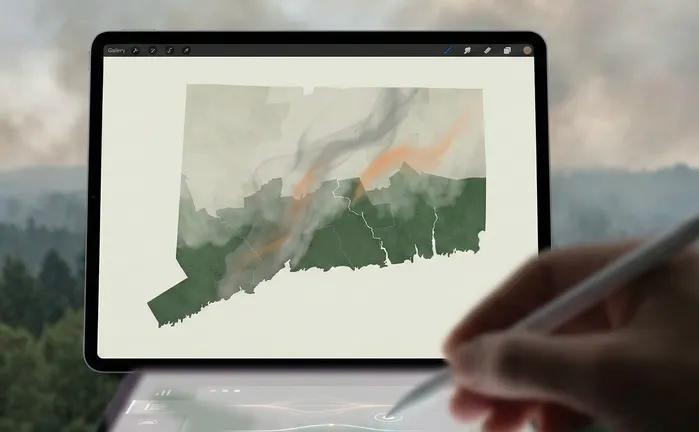
"After manufacturing air filters for over a decade and helping millions of customers through smoke events, we've learned one thing that surprises most homeowners — your HVAC filter is doing more to protect your family during a wildfire smoke event than your closed windows and doors ever will."
7 Essential Resources Every Connecticut Household Needs to Track Wildfire Smoke and Protect Indoor Air
At Filterbuy, we're obsessed with what you breathe — and during wildfire smoke events, knowing what's heading your way is just as important as having the right filter in your HVAC system. After helping millions of customers navigate smoke events across the country, we've identified the most reliable federal and state resources that every Connecticut family protector needs bookmarked and ready. These are the same tools our team monitors when advising customers on when to upgrade their filters and take action to defend their indoor air.
1. EPA AirNow Fire and Smoke Map — Your First Line of Defense for Real-Time Smoke Tracking
This is the tool we recommend first to every customer who contacts us during a smoke event. The AirNow Fire and Smoke Map gives you a real-time view of active wildfire smoke plumes and air quality conditions across Connecticut on one interactive map. When we see smoke patterns shifting toward the Northeast, this is where we look — and where you should too. 🔗 https://fire.airnow.gov
2. NOAA Hazard Mapping System — Trace Smoke Plumes Back to Their Source Before They Reach Your Home
Understanding where smoke originates helps you anticipate how long conditions will last and how severely your indoor air could be affected. NOAA's satellite-based system tracks smoke plumes across North America in near real time, showing you the full picture of what's moving toward Connecticut — the kind of visibility that helps you make proactive decisions about your home's air protection. 🔗 https://www.ospo.noaa.gov/products/land/hms.html
3. National Interagency Fire Center (NIFC) — Know Which Fires Are Producing the Smoke Affecting Your Air
Not all fires impact Connecticut equally, and knowing which specific wildfires are generating smoke headed your way makes a difference in how you prepare. The NIFC tracks every active wildfire nationwide with containment updates — so you can gauge whether conditions are improving or whether it's time to swap in a higher-rated filter and seal up your home. 🔗 https://www.nifc.gov/fire-information
4. Connecticut DEEP — Your State-Level Source for Local Fire Alerts and Air Quality Advisories
When smoke conditions hit Connecticut specifically, this is where official state guidance comes from. CT DEEP issues burn bans, fire weather alerts, and environmental advisories tailored to your state. We always tell our Connecticut customers to pair this resource with their indoor air quality awareness — because when the state issues an advisory, your HVAC filter is already working overtime. 🔗 https://portal.ct.gov/deep
5. EPA AirNow Connecticut — Check the PM2.5 Levels in Your County That Your Filter Is Fighting Against
This is where air quality monitoring gets personal. AirNow provides granular PM2.5 particulate readings by Connecticut county and individual monitoring station. From our experience on the manufacturing side, we can tell you that when PM2.5 levels climb above 100, a basic fiberglass filter doesn't stand a chance — this resource helps you see exactly when conditions demand better filtration. 🔗 https://www.airnow.gov/state/?name=connecticut
6. National Weather Service Connecticut — Get Ahead of Smoke Events Before They Impact Your Home
Preparation beats reaction every time — that's something we've learned from over a decade of manufacturing filters and watching customers scramble during sudden smoke events. NWS issues red flag warnings and fire weather alerts for individual Connecticut counties based on wind forecasts, giving you hours or even days of advance notice to check your filter, stock a replacement, and prepare your home. 🔗 https://www.weather.gov/okx/
7. Ready.gov Wildfire Preparedness — Build the Emergency Plan That Protects Your Family's Greatest Assets
Your family, your home, and your HVAC system are your greatest assets — and having an emergency action plan in place before fire season starts is how you protect all three. Ready.gov provides comprehensive evacuation planning, supply kit checklists, and home protection guidance from the federal government. Don't wait until smoke is in the air to figure out your plan. 🔗 https://www.ready.gov/wildfires
Supporting Statistics: What Federal Data Confirms — And What We've Seen Firsthand Manufacturing Millions of Air Filters
We don't need a study to know wildfire smoke infiltrates homes. We've heard it from thousands of customers who called us confused about why their house smelled like a campfire with every window sealed shut. But when federal research validates what we've been seeing for years, it's worth paying attention.
1. Your Closed Windows Aren't Enough — EPA Data Confirms What Our Customers Already Know
The statistic: The U.S. EPA reports that indoor PM2.5 levels reach 55–60% of outdoor concentrations during smoke events — even with all doors and windows closed and no portable air cleaners running. In older homes, infiltration can hit 100%.
What we've seen firsthand:
After a decade of manufacturing filters, customer calls during smoke events always follow the same pattern: "I closed everything up, but my house still smells like smoke."
PM2.5 particles are roughly 30 times thinner than a human hair — small enough to penetrate gaps, cracks, and HVAC systems running basic fiberglass filters.
When we test filter performance against particles this size, the gap between a standard flat-panel filter and a pleated filter rated MERV 8 or higher is dramatic.
That gap is the difference between your family breathing 60% of outdoor smoke concentration — or significantly less.
🔗 Source: U.S. EPA — Strategies to Reduce Exposure Indoors https://www.epa.gov/wildfire-smoke-course/strategies-reduce-exposure-indoors
2. Wildfire Smoke Contributes to 40,000 U.S. Deaths Annually — And Rising
The statistic: A 2025 study in Nature found wildfire smoke contributes to approximately 40,000 deaths per year in the U.S. Projections show that number could exceed 70,000 annually by mid-century. Health impacts persisted for up to three years after smoke exposure in affected counties.
What we've seen firsthand:
After the 2023 Canadian wildfire smoke events that blanketed Connecticut and the Northeast, we didn't just see a temporary spike in filter orders — we saw a sustained behavioral shift.
Families who never thought twice about their filter started asking specific questions about MERV ratings and PM2.5 capture efficiency.
Once people experience a smoke event inside their own home, they never look at their HVAC filter the same way again.
40,000 annual deaths makes the urgency impossible to ignore — and it's exactly why we believe every home deserves a filter built to handle what wildfire smoke throws at it.
🔗 Source: Nature — Wildfire Smoke Exposure and Mortality Burden in the USA Under Climate Change https://www.nature.com/articles/s41586-025-09611-w
3. The 2023 Canadian Wildfires Spiked Northeastern ER Visits — We Saw It in Real Time
The statistic: The EPA confirmed that smoke from the 2023 Canadian wildfires — the event that turned Connecticut skies orange — caused a measurable increase in daily asthma-related emergency department visits across the Northeast.
What we experienced as a manufacturer:
Our order data shifted in real time as smoke moved across the Northeast. Connecticut and surrounding states saw a sharp increase in customers ordering higher-rated filters — many for the first time ever.
Our customer service team fielded calls describing headaches, irritated eyes, and persistent indoor smoke odor — despite every window being shut.
Families in Connecticut who had never considered wildfire smoke a local threat were suddenly living through it inside their own homes.
That event reinforced what we've always believed: during a smoke event, your HVAC filter isn't just a maintenance item — it's the most important piece of health protection equipment in your home.
🔗 Source: U.S. EPA — Increasing Impacts of Wildfire Smoke https://www.epa.gov/wildfire-smoke-course/increasing-impacts-wildfire-smoke
Final Thought: Why an Air Filter Manufacturer Built a Wildfire Smoke Tracking Page for Connecticut
Most wildfire smoke pages give you a map and AQI numbers. That's useful — but nobody is connecting the dots between what's happening outside and what's actively circulating through your HVAC system right now.
After manufacturing filters for over a decade and serving millions of customers through smoke events, we realized the biggest gap isn't information about the smoke itself. It's understanding what that smoke is doing inside your home — and what your filter is or isn't doing about it.
That's the gap we're uniquely positioned to fill. Not as meteorologists. Not as emergency management professionals. As the people who manufacture the last line of defense between wildfire smoke and your family's lungs.
What We've Learned on the Front Lines of Smoke Events
Most homes are running the wrong filter for smoke. Basic fiberglass filters capture large dust particles. Wildfire PM2.5 passes right through them.
Closing windows is step one — not the solution. Without proper filtration actively scrubbing your indoor air, you're sealing smoke inside and recirculating it through every room.
Expensive HVAC systems don't guarantee protection. The families who fare best during smoke events are the ones who had a properly rated filter installed before the smoke arrived and knew to run their fan continuously.
This is no longer a West Coast problem. The 2023 Canadian wildfire season proved Connecticut and the entire Northeast are now in the impact zone. The data suggests it's going to happen more frequently.
Our Recommendation for Every Connecticut Household
Treat wildfire smoke preparedness the same way you treat hurricane or winter storm preparedness — plan for it before it happens.
At the center of that plan is one simple question most families have never asked themselves:
What filter is in my HVAC system right now — and is it rated to protect my family if smoke rolls in tomorrow?
Three Steps You Can Take Today
Bookmark this page. Check the live map when conditions change so you're never caught off guard.
Check your current HVAC filter. Look at the MERV rating. If it's below MERV 8 or it's a basic fiberglass panel, it won't stop smoke particulate.
Keep a replacement filter on hand. During a smoke event, filters load faster than normal. Having a rated replacement ready means you're protected when it matters most.
That small step — one we've seen thousands of families take after their first smoke event — is the single most impactful thing you can do to protect your indoor air when wildfire smoke heads your way.
Because at Filterbuy, we're not just obsessed with air filters. We're obsessed with making sure every family breathes cleaner air — especially when conditions outside make that harder than it should be.
Next Steps: Protect Your Connecticut Home From Wildfire Smoke
Tracking smoke is step one. Protecting your indoor air is what actually keeps your family breathing cleaner. Here's exactly what to do next based on your situation.
If Smoke Is Active Right Now
Check the live map above. Confirm AQI readings for your county and whether conditions are worsening.
Close all windows and doors. Reduces infiltration — but doesn't eliminate it.
Pull out your HVAC filter and inspect it. If it's a flat fiberglass panel, visibly grey, or older than 60 days — it's not stopping smoke particles.
Switch your thermostat fan to "ON." Keeps air cycling through your filter continuously, turning your HVAC into a whole-home air scrubber.
Seal visible gaps. Rolled towels at door bases and closed fireplace dampers help during acute events.
Watch for symptoms. Headaches, irritated eyes, scratchy throat, and indoor smoke odor mean your filter isn't capturing fine particulate effectively.
If You're Preparing Before the Next Event
Check your filter's MERV rating. It's printed on the frame. Below MERV 8? Upgrade to a pleated filter. MERV 11–13 offers the best smoke protection for most residential systems.
Confirm your filter size. Check the dimensions on your current filter so you can order the correct replacement without guessing.
Stock at least one extra filter. Smoke events load filters faster than normal. A backup means you're never waiting on delivery during an emergency.
Bookmark this page. Conditions change within hours. Having your tracking resources ready eliminates the scramble.
Sign up for AirNow alerts. EnviroFlash delivers AQI forecasts and smoke alerts for your Connecticut county directly to your inbox. 🔗 https://www.enviroflash.info
Create a clean air room. Pick one room with minimal windows and doors. Run your HVAC with a high-rated filter or portable air cleaner to make it your indoor sanctuary.
Quick-Reference: MERV Ratings During Smoke Events
MERV 1–4 (basic fiberglass): No smoke protection. Captures large dust only. Replace immediately during smoke conditions.
MERV 5–7 (basic pleated): Minimal protection. Still allows the majority of fine smoke particulate through. Not recommended for smoke events.
MERV 8–10 (standard pleated): Minimum recommended for smoke. Captures a meaningful percentage of PM2.5 and works in most residential systems.
MERV 11–13 (high-performance pleated): Best for wildfire smoke. Highest PM2.5 capture while maintaining proper airflow in standard residential HVAC systems.
Pro Tip from our manufacturing team: The biggest mistake homeowners make during smoke events isn't choosing the wrong filter — it's not checking their filter at all. Five minutes of inspection today could make the difference between filtered air and recirculated smoke.
Ready to Protect Your Home?
Find your exact filter size at Filterbuy.com
Over 600 sizes available — including custom sizes — with fast, direct-to-door delivery from our American manufacturing facilities. When smoke is heading your way, the last thing you should worry about is whether your filter can handle it.
Frequently Asked Questions
How does wildfire smoke reach Connecticut if the fires are hundreds of miles away?
Wildfire smoke travels on upper-level wind patterns and can cross thousands of miles before reaching your community. We saw this firsthand during the 2023 Canadian wildfire season when smoke from fires over 1,500 miles away blanketed Connecticut for days.
What concerns us most as air filter manufacturers isn't the visible haze — it's the invisible PM2.5 particulate that arrives with it.
PM2.5 particles are small enough to infiltrate homes through gaps, cracks, and HVAC air intakes.
They're the primary driver of health effects associated with wildfire smoke.
You don't need a local fire to have a serious indoor air quality problem.
Can I just close my windows to keep wildfire smoke out?
Closing windows is an important first step — but not the complete solution most people assume.
The EPA reports indoor PM2.5 still reaches 55–60% of outdoor levels with everything sealed shut.
In older homes without air conditioning, infiltration can reach 100%.
What we hear from customers during every smoke event: "I closed everything up, but my house still smells like smoke."
Smoke particles are so fine they enter through openings you can't see. Your HVAC filter is the critical last line of defense. If it's a basic fiberglass panel, those particles are passing right through and recirculating through every room.
What MERV rating filter do I need for wildfire smoke protection?
Based on our manufacturing experience and testing, here's what we recommend:
MERV 1–4 (basic fiberglass): Captures large dust only. No smoke protection.
MERV 5–7 (basic pleated): Minimal fine particle capture. Not recommended for smoke events.
MERV 8–10 (standard pleated): Minimum recommended for smoke. Captures a meaningful percentage of PM2.5.
MERV 11–13 (high-performance pleated): Best residential option. Highest PM2.5 capture with proper airflow.
Important: Don't jump to the highest MERV rating without checking your system's specs. Some older HVAC systems can't handle the airflow restriction. MERV 11–13 hits the sweet spot for most homes.
How often should I change my filter during a smoke event?
More frequently than normal. Under typical conditions, we recommend every 60–90 days. During active smoke, that timeline compresses significantly.
Check your filter weekly during sustained smoke conditions.
Smoke particulate loads filters much faster than normal household dust.
If your filter looks visibly grey after just a few days of heavy smoke, it's already saturated.
Keep a backup filter on hand. We've seen thousands of customers learn the hard way when they couldn't get a replacement delivered during a major event.
Is wildfire smoke more dangerous than regular air pollution?
Research suggests yes. A Nature Communications study found wildfire PM2.5 caused up to 10 times more respiratory hospitalizations per unit of exposure compared to non-wildfire PM2.5.
Why this matters for your filtration:
Not all PM2.5 is equal. Wildfire smoke contains a complex mix of organic compounds and ultrafine particles with potentially greater toxicity.
The filter that handles your everyday indoor air may not be adequate when wildfire smoke enters the equation.
We've seen customers with no prior respiratory issues experience headaches, eye irritation, and breathing difficulty during smoke events — even indoors.
Upgrade your filter rating before smoke season. Don't wait until symptoms appear.
Should I run my HVAC system during a smoke event or turn it off?
Run it — with the right filter and the right settings.
Set your thermostat fan to "ON" instead of "AUTO." This keeps air cycling through your filter continuously.
Your HVAC system with a properly rated filter is actively removing particulate every time it cycles.
Turning it off means smoke particles already inside your home just sit in your air with nothing to capture them.
This is one of the most common questions our customer service team receives. Many homeowners instinctively want to shut everything down. That's counterproductive. Your HVAC system is your whole-home air scrubber — but only if it's running with the right filter.
What should I do if I smell smoke inside my house with windows closed?
If you can smell smoke indoors, your air is already compromised. Act immediately:
Check your HVAC filter. Replace it with the highest-rated pleated filter your system can handle.
Set your fan to "ON." Continuous circulation is the fastest way to scrub particulate from indoor air.
Seal entry points. Gaps under doors, open fireplace dampers, and bathroom exhaust fans are common infiltration pathways.
Create a clean air room. Designate one room with minimal windows and doors as your family's shelter space.
This is the exact scenario we hear about most from customers. Every major smoke event, our phones light up with families describing indoor smoke odor despite having everything locked tight. It's the moment most people realize their HVAC filter matters far more than they ever thought.
Does Connecticut actually need to worry about wildfire smoke?
Yes — and the data proves it.
The 2023 Canadian wildfire season was a turning point for Connecticut and the entire Northeast.
The EPA documented measurable increases in asthma-related ER visits across the region during that event.
Smoke doesn't respect state lines or geographic distance.
What we saw as a national manufacturer: Before 2023, most of our smoke-related inquiries came from Western states. After the Canadian wildfire events, Connecticut and Northeast orders surged — customers who had never considered wildfire smoke a local concern. That shift hasn't reversed. Connecticut families are now part of the wildfire smoke conversation, and being prepared with the right filter is no longer optional.
Don't Wait Until Smoke Is in the Air — Protect Your Connecticut Home's Indoor Air Quality Today
Now that you know how to track wildfire smoke heading your way in real time, take the next step and make sure your HVAC filter is ready to defend your family when conditions change. Find your exact filter size and upgrade your protection at Filterbuy.com — because the best time to prepare for a smoke event is before it arrives.