
Tip: Ensure you buy the exact air filter size for your system. Certain brands have precise dimensions that only fit their specific models. See related filters
Actual Size: 20.75x20.25x5.25"
 Free Delivery
  Factory-Direct Low Prices, Made in the USA
 Hassle-Free Returns & Free Exchanges
RESIDENTIAL AND/OR COMMERCIAL USE
Change Every 3 Months
Tip: Ensure you buy the exact air filter size for your system. Certain brands have precise dimensions that only fit their specific models. See related filters
Actual Size: 20.75x20.25x5.25"
Free Delivery Factory-Direct Low Prices, Made in the USAHassle-Free Returns & Free ExchangesRESIDENTIAL AND/OR COMMERCIAL USE
Change Every 3 Months
Tip: Ensure you buy the exact air filter size for your system. Certain brands have precise dimensions that only fit their specific models. See related filters
Actual Size: 20.75x20.25x5.25"
Free Delivery Factory-Direct Low Prices, Made in the USAHassle-Free Returns & Free ExchangesRESIDENTIAL AND/OR COMMERCIAL USE
Change Every 3 Months
At Filterbuy, we don't cut corners—we craft high-quality air filters right here in the USA and ship them to your doorstep for free. No delays, no gimmicks—just clean air, made easy. With thousands of five-star reviews and filters built for real life & every HVAC system, it's no wonder why over 4 million families trust Filterbuy.

Proudly Made In The USA

Fast, Free Shipping on Every Order

Premium Materials That Go The Distance

85,000+ 5-Star Reviews From Happy Customers

Save Up to 70% Per Filter with Packs


Measure length × width × depth with a tape measure to find the actual size.

Round up each dimension to the nearest whole number to get the nominal size. Example: 20.75x20.25x5.25" in → 20x20x5 nominal.

Search by nominal size on our site for the best fit.


5″ filters give you maximum filtration with minimal maintenance — lasting up to 12 months while handling higher MERV ratings without restricting airflow.
Sizing note:

If the filter you buy doesn't fit, we'll send you a better size.
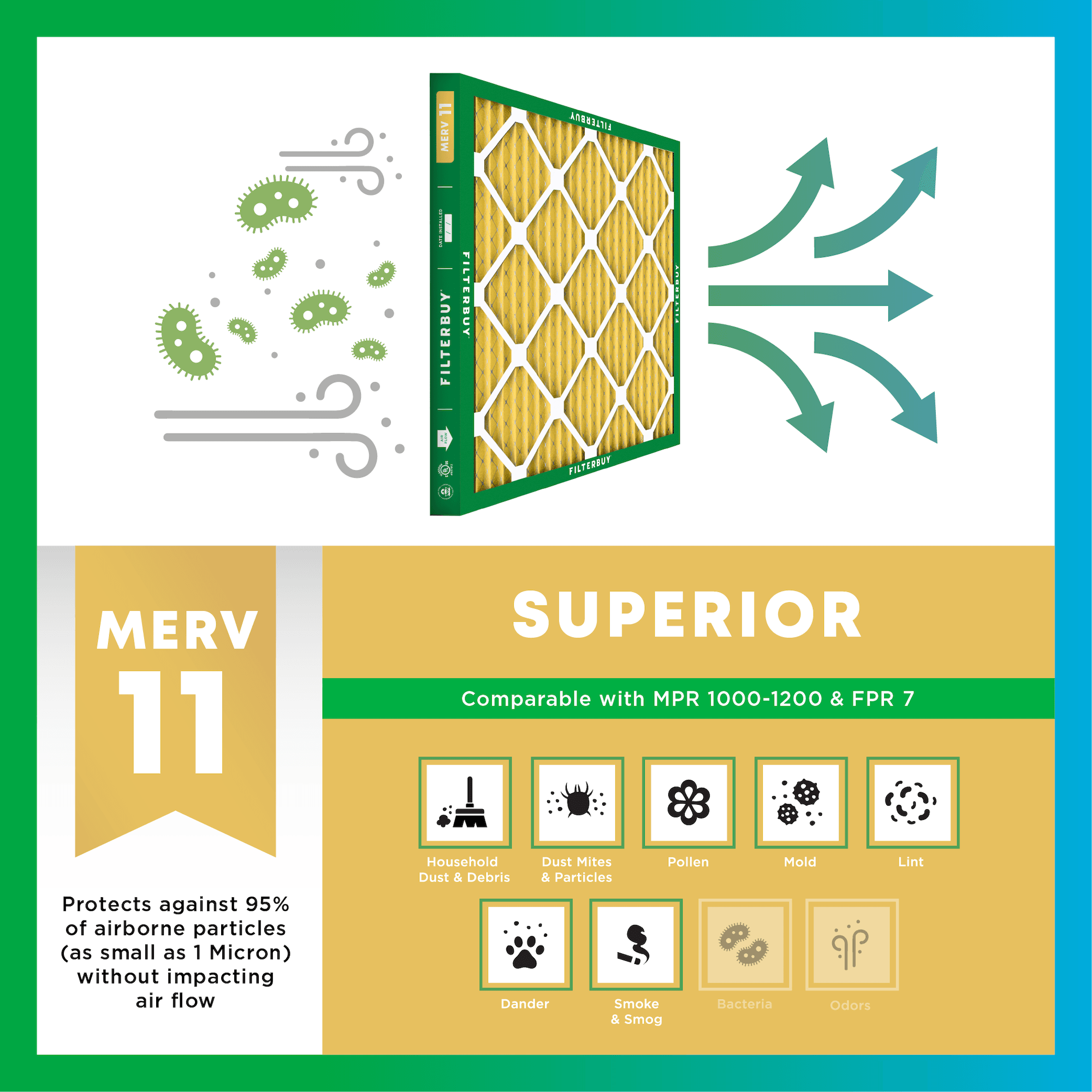
MERV stands for Minimum Efficiency Reporting Value—but don't let the technical name fool you. It's just a way to rate how well an air filter traps stuff like dust, pollen, pet dander, and smoke. The higher the MERV number, the more particles it catches—and the cleaner your air will be.

Comparable to:FPR: 4-7
MPR: 600-1000
 Dust & Debris
 Dust Mites & Particles
 Pollen
 Mold
Mold Lint
Lint Dander
Comparable to:FPR: 6-9
MPR: 1200-1550
Dust & DebrisDust Mites & ParticlesPollenMoldLintDander Smoke & Smog


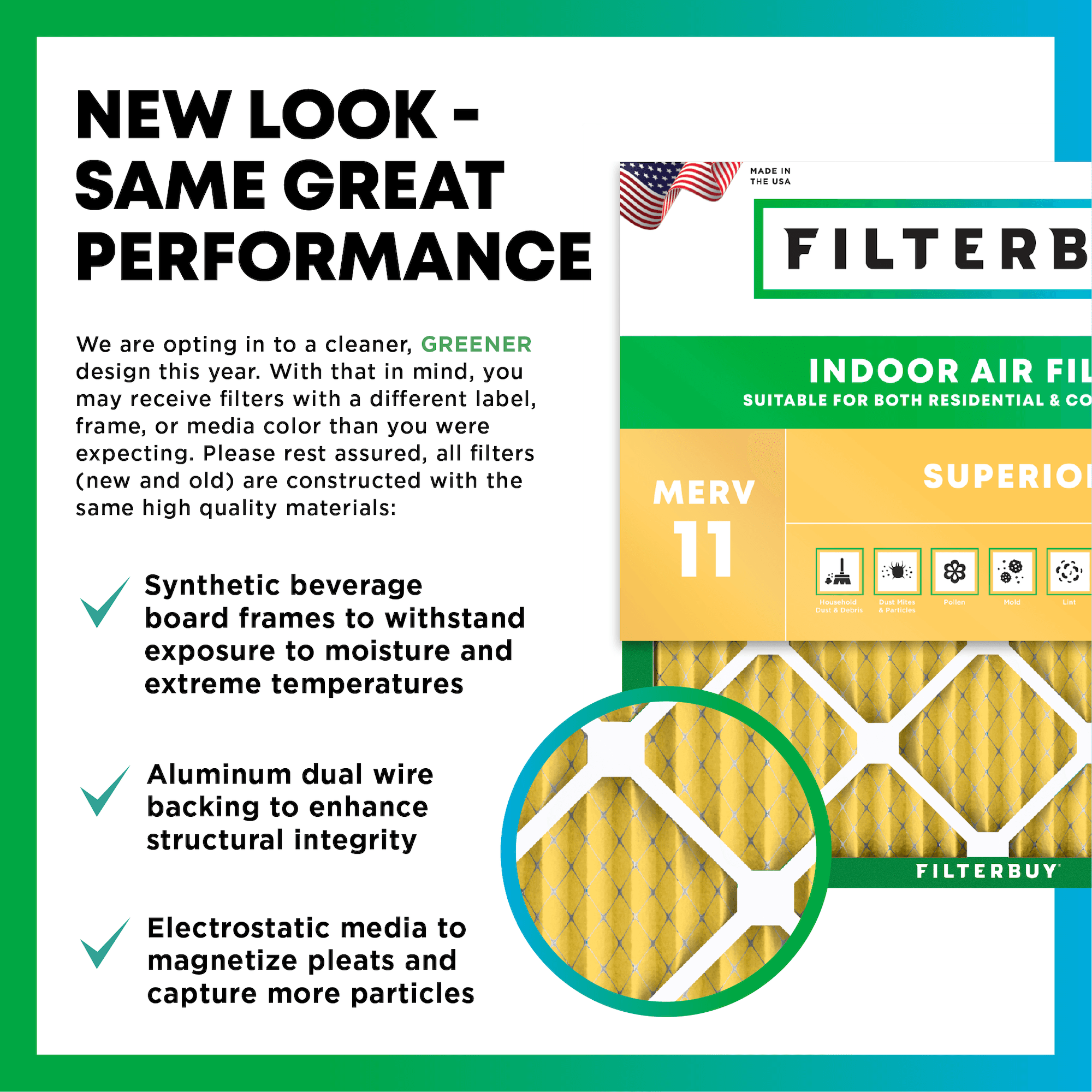
We build every Filterbuy filter to deliver reliable 90-day performance—thanks to smart design and premium materials that do the heavy lifting. Here's what makes the difference:
More pleats = more surface area to capture dust and debris, keeping your air cleaner longer.
Pleats are magnetized to attract and trap microscopic particles—like pet dander, pollen, and smoke.
Engineered to resist warping in extreme temperatures and high humidity.

A layer of metal reinforcement keeps pleats evenly spaced and structurally sound—no sagging, even at high airflow.
Assembled with care. Built to perform. Ships fast, free, and reliably from our U.S. facilities.

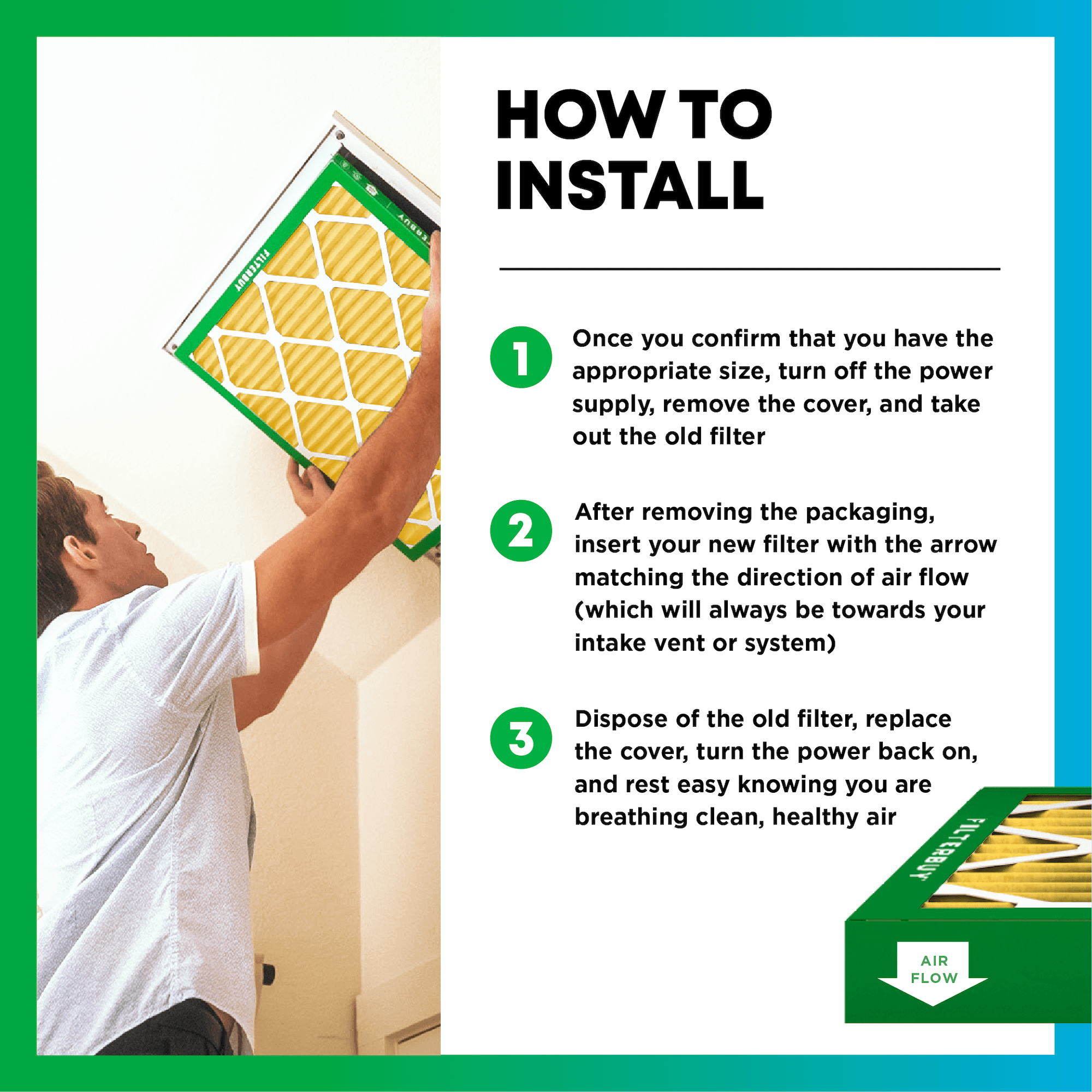
Turn Off Your HVAC SystemSafety first.

Remove The Old FilterLook for the airflow arrow and make note of the direction.

Slide In Your New FilterArrow should point toward the system (same direction as before).

Turn Your System Back OnAnd enjoy the fresh, clean air.

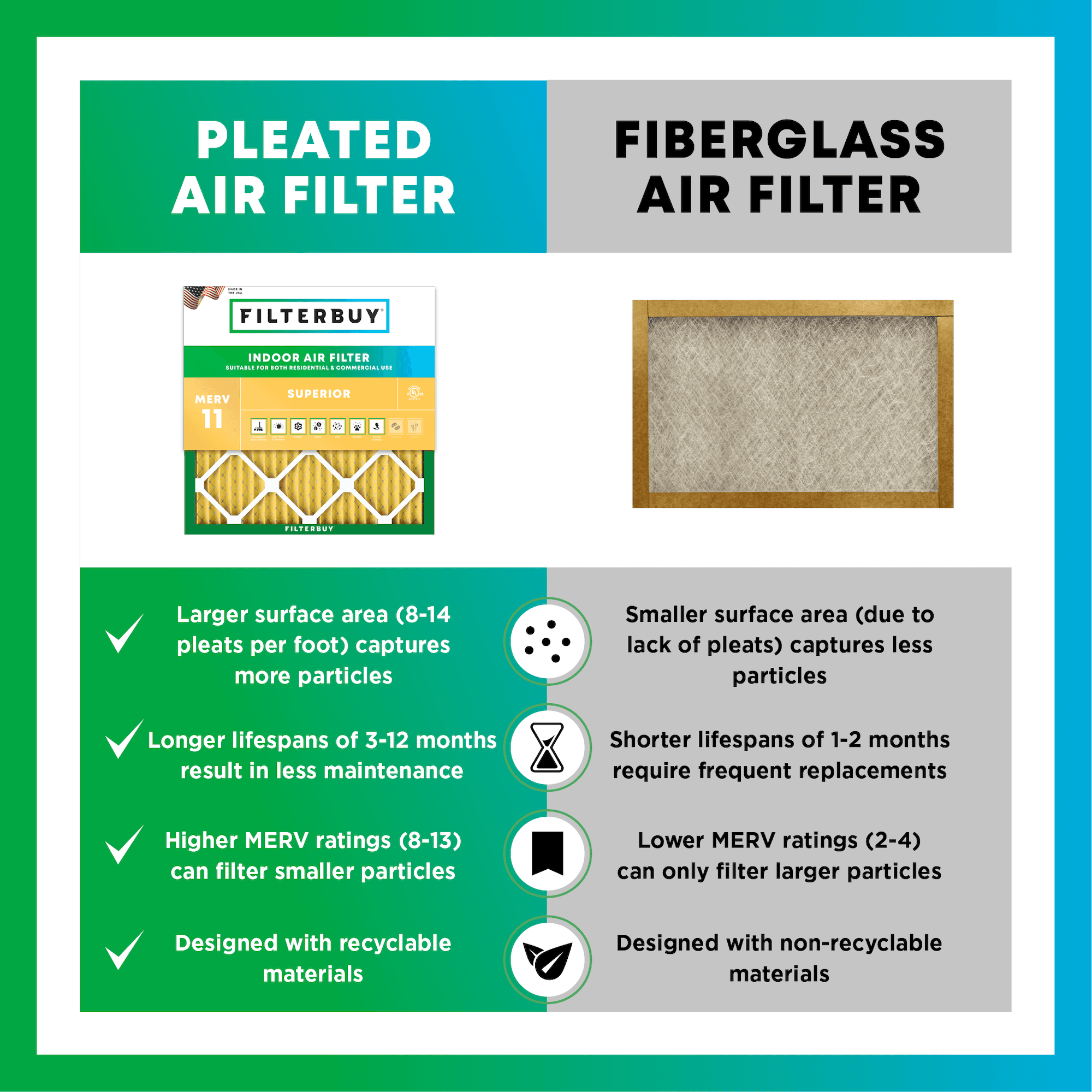
Not all air filters are created equal. Pleated filters don't just last longer—they actually clean your air better. Here's how they stack up:

Efficiency:
High (MERV 8–13) – Traps more particles
Lifespan:
90 days – Long-lasting performance
Air Quality:
Excellent – Cleaner, healthier air
Materials:
Recyclable and durable

Efficiency:
Low (MERV 4 or less) – Misses small stuff
Lifespan:
30 days or less – Replace often
Air Quality:
Minimal – Basic protection only
Materials:
Thin, flimsy, and not recyclable
Pleated filters are a no-brainer—more protection, less hassle, and better air for your home.
Changing your filter on time keeps your HVAC system running efficiently—and helps protect your lungs from dust, allergens, and airborne irritants. Here's how often to swap it out based on your needs:

For most homes without pets or special air quality concerns. Great for general upkeep and energy efficiency.

Shedding fur, dander, and allergy triggers can build up fast. Changing your filter every two months helps keep the air fresher and symptoms at bay.

For households affected by smoke, pollution, or respiratory conditions, monthly changes ensure maximum protection.

| Nominal Size | 20 x 20 x 5 inches |
| Actual Size | 20.75 x 20.25 x 5.25" inches |
| Filter Type | Pleated |
| Media | Electrostatically Charged |
| Frame | Beverage Board |
| MERV Ratings Available | 8, 11 |
| Lifespan | Up to 12 Months |
| Origin | Made in USA |
Most homeowners replace their Day and Night filter because a thermostat reminder told them to, not because they've thought carefully about what's building up in the media. After manufacturing filters for over a decade and serving over two million households, we've found that the gap between what people assume their filter catches and what it genuinely captures is where most indoor air quality problems quietly take hold.
Standard fiberglass filters grab what you can see: large dust clumps and obvious debris. The particles that matter most for respiratory health are far smaller, and most basic filters let them pass. Pet dander, mold spores, dust mite waste, and fine particulate matter from outdoor traffic all fall below the capture range of low-rated filtration. Your MERV 11 20x20x5 Day and Night air filter is rated and built specifically to stop them.
Your Day and Night furnace filter lives inside a 5-inch media cabinet designed to hold denser filtration for longer run cycles, which is exactly the format MERV 11 requires to perform without restricting airflow. If you've noticed your filters darkening faster than expected, the cause is usually straightforward. Homes with pets, high foot traffic, and systems running eight or more hours daily push considerably more particulate through the media, and understanding why air filters get dirty so fast in certain households helps you set a smarter replacement schedule and get more protection out of every filter you install.
Knowing what your filter captures, why this size matters specifically for Day and Night systems, and when to replace it are questions with clearer answers than most product pages give you. Here's what we know from manufacturing the filter that's already working inside your system.
The MERV 11 20x20x5 is a 5-inch media air filter designed for Day and Night HVAC systems, rated to capture 85 percent of airborne particles in the 3.0–10.0 micron range and 65 percent of particles in the 1.0–3.0 micron range — the size bands where pet dander, mold spores, pollen, and dust mite waste operate.
What it captures: Dust, pet dander, pollen, mold spores, dust mite waste, smog particles, and auto emissions entering through your HVAC system
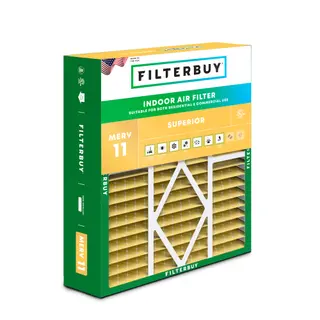
Actual size: 20.75" x 20.25" x 5.25" (nominal size: 20x20x5)
Compatible system: Day and Night 5-inch media cabinet — part of the Carrier family of HVAC brands
Filter life: 90 days for most households; inspect at 60 days in homes with pets or high dust loads
MERV 11 equivalent ratings: MPR 1000/1200 (3M Filtrete) and FPR 7 (The Home Depot)
Why the 5-inch depth matters: Greater pleat surface area allows MERV 11 filtration without restricting airflow — lasting three times longer than 1-inch alternatives at the same rating
Best for: Homes with pets, seasonal allergy sufferers, or any household where the HVAC system runs for extended daily cycles
Your MERV 11 20x20x5 Day and Night air filter captures seven categories of airborne particles that directly affect respiratory health, including pet dander, pollen, mold spores, and fine particulate matter.
The 5-inch depth gives this filter significantly more surface area than 1-inch alternatives, which is why it lasts up to 90 days without restricting airflow at a MERV 11 rating.
The actual dimensions of this filter are 20.75" x 20.25" x 5.25", not 20" x 20" x 5". Ordering by nominal size is correct for Filterbuy; the actual size fits Day and Night 5-inch media cabinet systems properly.
MERV 11 is comparable to MPR 1000/1200 and FPR 7, so if you've used those rating systems before, you already know what this level of filtration delivers.
According to the EPA, Americans spend approximately 90 percent of their time indoors, where pollutant levels are frequently two to five times higher than outdoor levels. Your filter is your primary defense against those pollutants at home.
Replacing your Day and Night MERV 11 filter on schedule protects both your family's health and your HVAC system. A clogged filter forces the blower motor to work harder, driving up energy costs and wearing the system faster.
Filterbuy MERV 11 20x20x5 filters are manufactured in the United States with electrostatically charged pleated media and dual wire backing, construction details that directly affect how long the filter holds its shape and captures particles under pressure.
The Minimum Efficiency Reporting Value, or MERV, is the standardized scale ASHRAE uses to measure how well an air filter removes particles from moving air. It runs from 1 to 16 for residential and commercial applications, with MERV 1 stopping large visible fibers and MERV 16 approaching surgical-grade filtration. MERV 11 sits in the upper tier of what residential HVAC systems can support without airflow problems.
In practice, MERV 11 captures a minimum of 85 percent of particles in the 3.0–10.0 micron range and approximately 65 percent of particles in the 1.0–3.0 micron range, as established by the air filtration standards ASHRAE developed for this purpose. In household terms, that maps directly to the particles that affect your family most. Pet dander averages 2.5–10 microns, pollen runs 10–100 microns, mold spores fall between 3 and 40 microns, and dust mite waste particles range from 10 to 24 microns.
None of those particles are visible without magnification. They accumulate in your HVAC system, on your evaporator coil, inside your ductwork, and in the air your family breathes every day. Your MERV 11 filter is the barrier between those particles and your living spaces, and the rating tells you exactly how well it holds that line.
Day and Night HVAC equipment, part of the Carrier family of brands, uses a 5-inch media cabinet in many of its central air and heat pump configurations. This cabinet holds a filter with a nominal size of 20x20x5, which carries an actual size of 20.75" x 20.25" x 5.25". That extra quarter to three-quarter inch of actual dimension compared to the nominal size is intentional: it creates a sealed fit inside the cabinet so no air bypasses the filter media.
The 5-inch depth is the critical performance advantage. More depth creates more pleats, and more pleats mean more surface area for particles to contact the filter media. A standard 1-inch MERV 11 filter with 8 pleats per foot works much harder to capture particles before it clogs, and it saturates faster. The 20x20x5 format handles the same MERV 11 rating with far less restriction to airflow, which is why it lasts three times longer than 1-inch alternatives under normal operating conditions.
For Day and Night systems running longer daily cycles, common in climates with extreme heat or cold, that filter life advantage is real. A filter lasting 90 days in a moderate-use home may last 60 to 75 days in a system running eight to twelve hours daily. Monitoring the filter visually is smarter than strict calendar replacement for households in high-use conditions.
A clean, properly rated filter does two things at once: it protects the air your family breathes and protects the mechanical components of your HVAC system. Those two functions connect directly. When a filter is overloaded or rated too low to capture fine particles, those particles migrate into your system.
Dust accumulation on an evaporator coil reduces its ability to transfer heat. Pet dander and mold spores that pass through a low-rated filter settle in your ductwork and recirculate every time your system runs. A clogged filter restricts airflow and forces the blower motor to work against increased resistance. Both scenarios drive up energy costs and shorten system life.
MERV 11 filtration at the 20x20x5 size hits the right balance for most Day and Night systems, capturing the particles that matter without restricting the airflow your equipment needs to run efficiently. For most households, that balance is exactly where it should be.
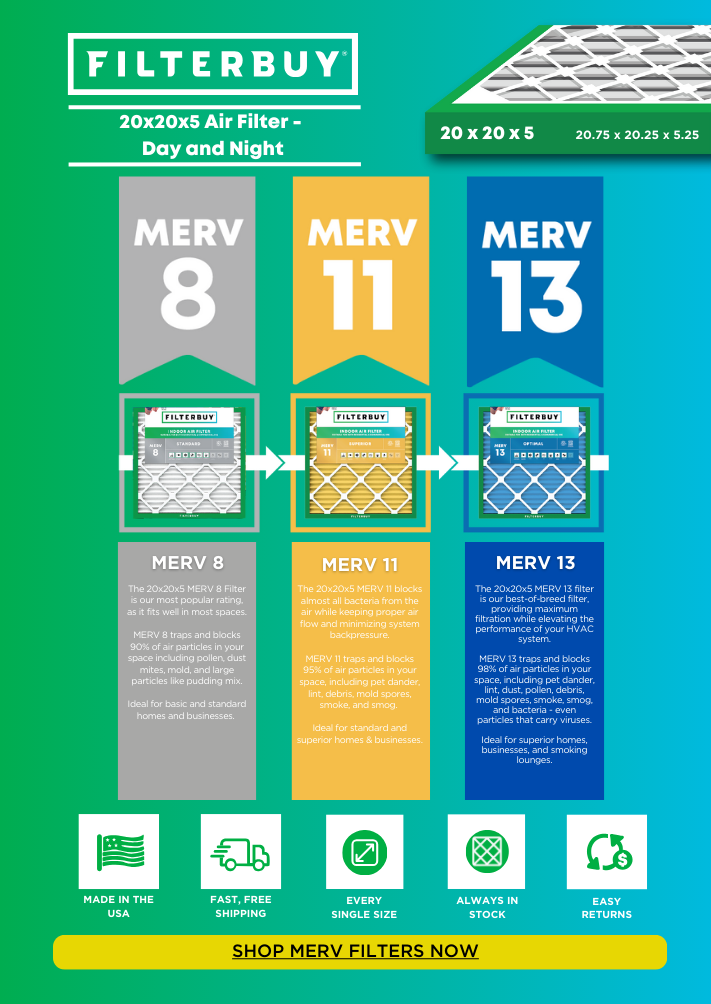
A MERV 8 filter captures particles down to about 3.0 microns effectively, handling household dust and larger debris well. It misses most pet dander below 3 microns, a significant portion of mold spores, and the fine particulate matter that aggravates respiratory conditions. For homes without pets and without allergy or asthma concerns, MERV 8 is adequate.
MERV 11 extends that capture range to include 65 percent of particles in the 1.0–3.0 micron range, which is where pet dander, fine mold spores, and the smallest pollen fragments operate. For a home with dogs or cats, a child with allergies, or an adult managing asthma, that difference is real. The filter captures particles that would otherwise recirculate before they reach your living spaces, and the air after each run cycle is measurably cleaner.
MERV 13 is the next step up, capturing particles down to 0.3 microns, including smoke, bacteria, and submicron combustion byproducts. It's the right choice for households dealing with wildfire smoke, severe respiratory conditions, or proximity to industrial pollution. For most suburban and rural households, MERV 11 delivers better air quality than MERV 8 without the airflow restriction that high-rated filters impose on systems not built to handle them.
"In our experience manufacturing 5-inch media filters, the depth advantage is the most underappreciated performance factor homeowners overlook. A MERV 11 rating in a 20x20x5 format achieves finer particle capture than a 1-inch MERV 11 simply because the media has room to do its job without choking airflow, and that translates directly into a filter your Day and Night system can run for a full 90 days without working harder than it should."
— Filterbuy Team
If you're researching the MERV 11 20x20x5 Day and Night air filter, these seven resources from U.S. government agencies and leading public health organizations give you the factual foundation to make a confident, informed decision about what's in your air and what your filter is doing about it.
The EPA's consumer guide to residential air cleaners covers how MERV ratings compare across filter types, what each rating captures, and what the research shows about upgrading your furnace filter. It directly addresses the question most homeowners have when deciding between a MERV 8 and a MERV 11.
Source: https://www.epa.gov/indoor-air-quality-iaq/guide-air-cleaners-home
ASHRAE Standard 52.2 is the industry methodology that produces every MERV number on every filter box in the market. This ASHRAE FAQ explains what the rating measures, how filters are tested for particle size efficiency, and what the capture percentages at each rating level — including MERV 11's 85 percent efficiency for particles 3.0–10.0 microns — actually mean in a residential system.
Source: https://www.ashrae.org/technical-resources/filtration-and-disinfection-faq
This EPA resource identifies the specific indoor activities and conditions producing airborne particulate matter in residential environments, from cooking and combustion to biological sources like mold, pet dander, and dust mites. Understanding where the particles come from helps homeowners evaluate filter load and set a smarter replacement schedule for their Day and Night system.
Source: https://www.epa.gov/indoor-air-quality-iaq/sources-indoor-particulate-matter-pm
The EPA's resource on particle pollution health effects explains the clinical significance of the 1.0–10.0 micron capture range, where pet dander, mold spores, dust mite waste, and fine combustion particles operate. It documents the cardiovascular and respiratory conditions linked to ongoing particulate matter exposure, putting MERV 11 filtration directly in health context.
Source: https://www.epa.gov/pm-pollution/health-and-environmental-effects-particulate-matter-pm
The Asthma and Allergy Foundation of America documents that eight out of ten Americans are regularly exposed to dust mites and six out of ten are exposed to cat or dog dander. This resource identifies the specific household allergens MERV 11 filtration is rated to capture and explains why air filtration is a recommended first-line control measure for allergy and asthma sufferers.
Source: https://aafa.org/allergies/prevent-allergies/control-indoor-allergens/
The U.S. Department of Energy establishes the direct connection between filter maintenance and HVAC efficiency. A clogged filter reduces airflow, forces the blower motor to work harder, allows debris to accumulate on the evaporator coil, and can raise energy consumption by 5 to 15 percent. For Day and Night system owners, this resource makes the economic case for timely filter replacement as plainly as the health case.
Source: https://www.energy.gov/energysaver/air-conditioner-maintenance
The CDC's asthma control guidance identifies dust mites, mold, and pet dander as the primary documented triggers for residential asthma attacks and allergic episodes, and positions air filtration among the recommended household interventions for reducing exposure. This resource gives homeowners the clinical context for what a MERV 11 filter is working against every hour their Day and Night system runs.
Source: https://www.cdc.gov/asthma/control/index.html
Americans spend approximately 90 percent of their time indoors, where levels of pollutants frequently can exceed those found outdoors — meaning the air inside your home is the air that matters most to your family's health.
Source: https://www.epa.gov/air-research/indoor-air-quality-exposure-and-characterization-research
Indoor concentrations of some pollutants are often two to five times higher than typical outdoor concentrations, and in some cases more than 100 times higher, making effective home air filtration one of the most impactful steps a family can take for respiratory health.
Source: https://www.epa.gov/iaq-schools/why-indoor-air-quality-important-schools
Household dust mites, mold, pet dander, and cockroach allergens are among the most documented asthma triggers in residential environments, and reducing exposure to these particles through filtration is a clinically recognized strategy for managing asthma symptoms.
Source: https://www.cdc.gov/asthma/community-health/
MERV 11 is the right filtration rating for most households running a Day and Night 5-inch media system. That conclusion comes from over a decade of manufacturing experience and feedback from millions of households across every climate zone in the country, and we stand behind it.
The homes where MERV 11 makes the clearest difference over a lower-rated filter share a few common traits: at least one pet, at least one family member managing seasonal allergies, or an HVAC system running for extended periods daily. In those households, the gap between MERV 8 and MERV 11 shows up not just in air quality measurements but in how often people reach for allergy medication, how frequently ductwork needs cleaning, and how clean the evaporator coil looks at the next service visit.
The 20x20x5 format earns our confidence because it removes the airflow penalty that makes people hesitant to step up from MERV 8. When homeowners try a higher-rated 1-inch filter and notice their system struggling, they step back down. The 5-inch depth changes that equation. Your Day and Night system was built to accept this filter format, and MERV 11 in this size performs the way higher filtration should, without asking your blower motor to compensate.
The one situation where we'd recommend a conversation about MERV 13 is a household managing asthma with confirmed triggers, living in an area with recurring wildfire smoke, or where a family member has a documented sensitivity to submicron particles. For everyone else, MERV 11 in a 20x20x5 format is a straightforward decision.
Here's how to move from reading to protecting your home's air.
Confirm your filter slot size. Pull your current filter and check its actual dimensions, not just the number printed on the frame. Your Day and Night 5-inch media cabinet needs a filter with an actual size of 20.75" x 20.25" x 5.25". If you're replacing a filter already in the system, those actual dimensions confirm the fit.
Order by nominal size. Search and order using the nominal size: 20x20x5. Filterbuy lists filters by nominal size. The actual size ships at 20.75" x 20.25" x 5.25" to fit Day and Night cabinet systems correctly.
Check the airflow arrow before installation. Every Filterbuy filter has an airflow direction arrow printed on the frame. That arrow points toward the blower motor, away from the return air duct. Installing a filter backward dramatically reduces its effectiveness and can damage your system over time.
Set a replacement reminder. Mark 90 days from your installation date on your calendar or set a phone reminder. Homes with pets or high dust loads should do a visual check at 60 days. A filter that looks gray or dark on the intake side before 90 days is doing its job. Replace it.
Consider a multi-pack for consistent protection. Ordering a 2, 3, or 4-pack reduces the per-filter cost and removes the friction of reordering every quarter. Clean air shouldn't depend on remembering to place an order at the right time.
A: Not always. The nominal size 20x20x5 is consistent, but actual dimensions vary by brand and cabinet system. The Day and Night 20x20x5 filter has an actual size of 20.75" x 20.25" x 5.25". Filters made for Honeywell or Lennox 20x20x5 cabinets may carry slightly different actual dimensions. Always verify your cabinet's tolerance before substituting a filter from another brand's lineup.
A: Every 90 days is the standard interval for most households. Adjust based on your home's conditions:
Homes with one or more pets: inspect at 60 days; replace by 75–90 days
Homes with allergy or asthma sufferers: inspect monthly; replace as needed
Homes near wildfire smoke zones or heavy traffic: check monthly
Vacation or low-occupancy homes: the filter may last beyond 90 days, but inspect before resuming full occupancy
A: In a 20x20x5 format, MERV 11 filtration does not meaningfully restrict airflow in Day and Night systems designed for 5-inch media cabinets. The 5-inch depth provides enough pleated surface area to maintain healthy airflow at this rating. The airflow restriction concern primarily applies to 1-inch MERV 11 or higher-rated filters in systems with low static pressure tolerance. With the correct actual size installed in a 5-inch cabinet, airflow restriction should not be a concern.
A: Not exactly the same, but comparable. MPR, or Microparticle Performance Rating, is a proprietary rating system used by 3M Filtrete. MPR 1000 and MPR 1200 are generally considered equivalent in performance to MERV 11 across the particle size ranges most relevant to residential air quality. FPR 7, used by The Home Depot, is similarly comparable. When you see MPR 1000/1200 or FPR 7 on competing products, you're looking at approximately the same filtration level as MERV 11 on a standardized scale.
A: A filter that's too small allows air to bypass the media entirely, sending particles through your system unfiltered. A filter that's too large won't seat properly in the cabinet. The frame may bow or the filter may not seal against the cabinet edges, allowing bypass either way. Both scenarios reduce filtration effectiveness and allow debris to accumulate on your evaporator coil. Always install a filter matching your cabinet's required actual dimensions, not just the nominal size printed on a previous filter's frame.
Your Day and Night system deserves a filter built to keep up with everything moving through your air. Shop Filterbuy's MERV 11 20x20x5 replacement at filterbuy.com and see why over two million households count on it, with free shipping and quantity discounts on every multi-pack purchase. After more than a decade of American manufacturing, we build every filter to protect what matters most.

