The moment a wildfire starts near you, you'll get an instant alert and simple tips to reduce your smoke exposure.
30xSmaller than a human hair
Fine enough to reach deep into the lungs. A MERV 13 is built to capture it.
It Doesn't Stay Local
Smoke rides the wind far downwind — you can get smoky air with no fire nearby.
Simple steps to reduce indoor exposure.
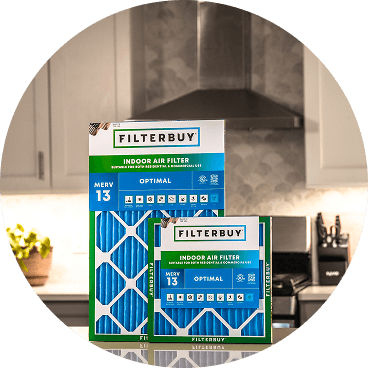
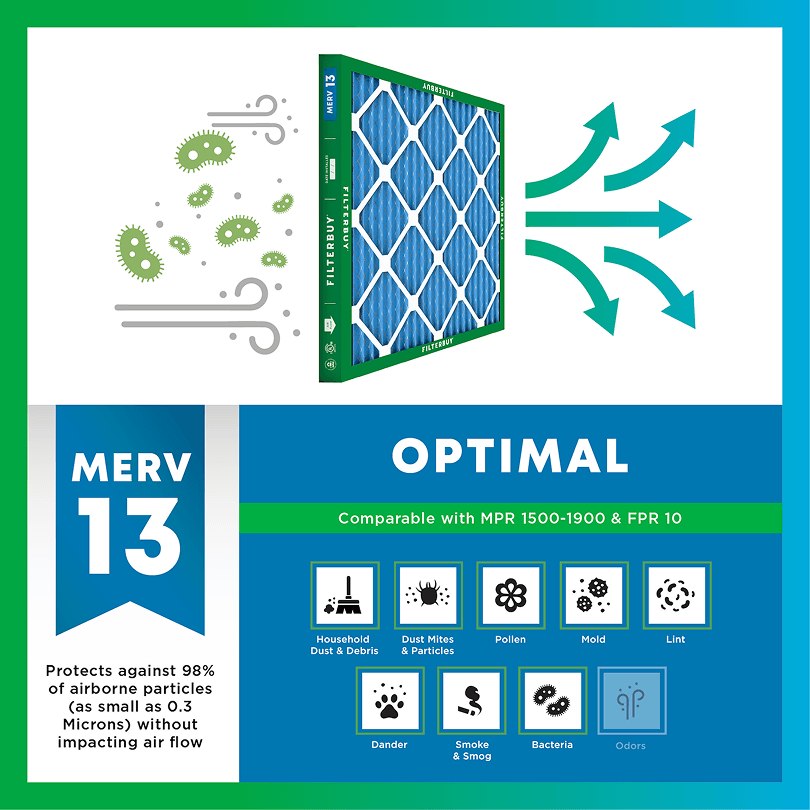
During smoke events, the EPA recommends upgrading to a MERV 13 filter — or the highest-rated filter your system can handle — to help reduce the fine particles smoke brings indoors. MERV 13 is the level most home HVAC systems can run while still capturing PM2.5, the fine particulate that makes up the bulk of wildfire smoke.

Over 70,000 wildfires burn in the U.S. every year.
Wildfire smoke can travel 1,000+ miles, affecting states that aren't even near the blaze.
Exposure to wildfire smoke can worsen asthma, trigger heart issues, and lead to ER visits.
Indoor air can hold more fine particles during wildfire events unless it's properly filtered.
The EPA advises using MERV 13 filters or portable HEPA air cleaners during wildfire smoke events.
Use the live wildfire smoke tracker and upgrade your air filters today to protect your lungs and your home.
Shop Filters For Smoke Protection
By Michelle Wan, Brand Manager & Air Quality Writer · Reviewed by David Clark, Licensed HVAC Technician · Published August 15, 2026 · Updated August 15, 2026
Irving does have forest, and it seldom burns. The bottomland hardwoods along the Elm Fork and West Fork of the Trinity grow in an active floodplain that keeps them too wet to carry crown fire, so the haze over Las Colinas was made somewhere else. The live map above shows your current AQI, and the Texas A&M Forest Service incident viewer shows whether anything is burning statewide.
One caveat matters more here than in most suburbs: the regulatory monitor nearest Irving, Dallas Hinton St. C401, was deactivated February 24, 2025. Read nearby AirNow sensors before trusting a single number.
Filterbuy researches these city pages one at a time rather than running a template over a list of place names. Irving shifted ours twice: we expected to write that there is no forest here and found genuine bottomland woodland inside the city limits, then went to cite the nearest monitor and found it switched off.
Irving's forest is flood-prone bottomland hardwood, not the dry timber that carries wildfire. Nearly all smoke here is imported from Panhandle and Oklahoma grass fires, spring burning in Mexico, or Canadian wildfires. Below AQI 50, carry on. From 51 to 100, sensitive groups should ease off outdoor exertion. Above 100, close the house, run the fan continuously, and fit a clean MERV 13.
Irving's woodland sits in an active floodplain. The city closes those Trinity River parks for flooding, not fire.
Texas wildfire season peaks January through May. Since 1988, 90% of the state's 30 largest wildfires fell in that window.
Irving's baseline particle load is aviation and freeway traffic, with DFW Airport on the western edge and four highways running through town.
About 62% of Irving households rent, so the standard "close your fresh-air damper" advice does not fit most of the city.
Irving has genuine woodland, but it is riparian bottomland hardwood in an active floodplain, among the least fire-prone forest types in Texas. Campion Trail runs 22 miles along the Elm Fork and West Fork of the Trinity, past California Crossing Park and Mountain Creek Preserve, and what makes it fire-resistant is what makes it inconvenient: it floods, and Irving closes those parks when the river rises. Wet soil and high live fuel moisture leave crown fire with nothing to work with.
Texas's pine forests lie 150 miles east, so a Piney Woods crown fire is an Irving air quality event two days later, not an evacuation. The fuel forecasters watch here is grass, which is why Texas A&M Forest Service flagged exceptional grass loading in the Cross Timbers heading into 2026.
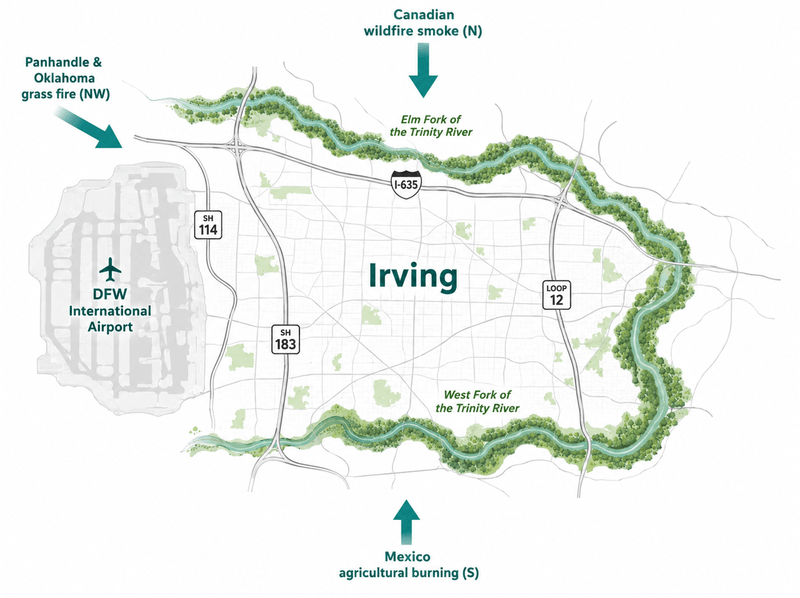
Irving smoke comes from three places, and a fourth thing that is not smoke gets mistaken for it. Building live smoke maps across North America has taught the Filterbuy air quality team that a hazy day is never one condition. Traffic and aviation are the Irving difference: DFW International Airport sits on the western boundary, and four highways converge through town, so the particle floor never settles to suburban levels.
Source: Filterbuy analysis of North Texas smoke regimes, drawing on Texas A&M Forest Service seasonality data and TCEQ forecasts.
In a quieter suburb, a sensor spike usually means smoke. Here the smell and the sky tell you more than the number alone. Grass fire smoke clears within a day or two, and a clean filter handles it, while transported haze lingers and loads that filter as it goes. Ozone is the one thing filtration cannot touch.
Every fire season we hear the same question: there is no fire near me, so why does my house smell like a campfire? People move here from Colorado or California and go looking for a perimeter. In Irving, the fire is usually four hundred miles away, and it started in February. Wind direction tells you more than any perimeter map.
Michelle Wan, Brand Manager & Air Quality Writer, Filterbuy
Irving has two bad-air seasons, and neither follows the western fire calendar. Since 1988, 90% of the 30 largest wildfires in Texas history occurred between January and May, running on freeze-cured grass and dry cold-front wind. Ozone traces the opposite curve, peaking on hot, still afternoons that also trap whatever smoke is overhead.
Source: Texas A&M Forest Service fire seasonality data; TCEQ North Texas ozone season, March 1 – November 30.
Once the AQI passes 100, close the house and run filtered air. That is when conditions turn unhealthy for sensitive groups: children, older adults, and anyone with asthma or heart disease.
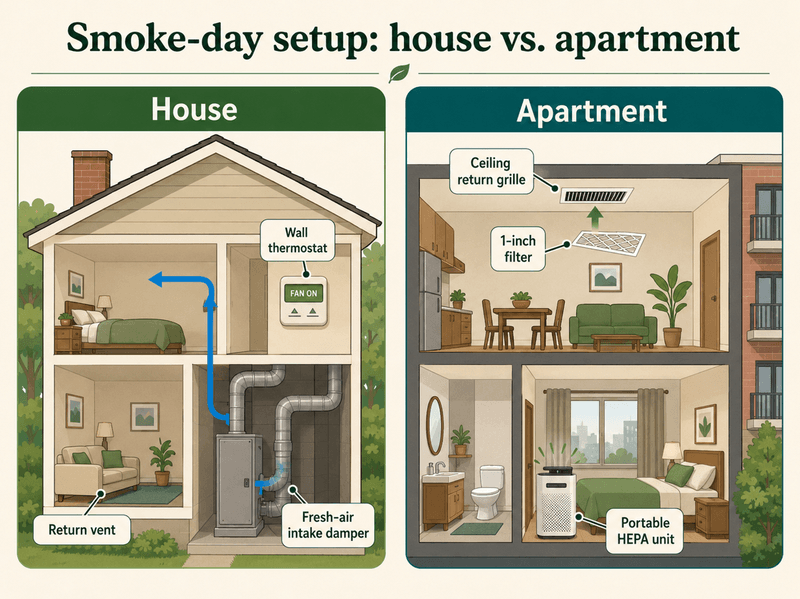
If you own a home, shut windows and doors. In newer builds, find the fresh-air intake, a round insulated duct running into the return plenum, and turn its damper lever crosswise. Run the HVAC fan continuously rather than on "auto." Then check the filter and replace it with a correctly sized MERV 13 if the media has gone gray.
If you rent, which describes most of Irving, the advice changes. Irving's homeownership rate was 38.1% in 2024, so roughly 62% of households rent, and most smoke guidance assumes a homeowner with a furnace closet. You probably have no damper to close, so sealing windows and doors is the whole job. Your filter is likely a 1-inch builder-grade panel behind a ceiling grille, and a 1-inch MERV 13 drops straight in. A portable HEPA earns more in an apartment, where one bedroom is a larger share of your space.
Either way, keep one room shut as a clean room, skip the vacuum and candles, and recheck the AQI before reopening.
On a smoke day, the worst air many Irving residents breathe is inside their own car. California Air Resources Board studies found particle levels inside vehicles and along the roadside ran far higher than at the nearest ambient monitoring station, the same blind spot as the deactivated Hinton St. monitor.
Three fixes. Press recirculate, which stops your vents from drawing roadway air in. Check the cabin filter behind your glovebox, which most drivers have never changed. Replace it sooner than the 12,000 to 15,000 miles manufacturers suggest, because smoke loads it faster. Filterbuy makes HEPA-grade cabin filters cut to OEM fit, and fit matters more than media grade, because unfiltered air slips around a loose filter.
A MERV 13 filter is the right choice for wildfire smoke in a residential HVAC system. Smoke's health risk is PM2.5, particles fine enough to reach deep lung tissue, and MERV 13 is the highest rating most residential systems handle without airflow trouble. Under ASHRAE 52.2, it captures at least 50% of particles from 0.3 to 1.0 micron, 85% from 1.0 to 3.0, and 90% from 3.0 to 10. Filterbuy MERV 13 media is rated to trap 98% of airborne particles, and a 4-inch filter lasts longer under smoke.
Two limits most filter pages skip. No HVAC filter removes carbon monoxide, so if a fire is close enough for CO to matter, you need working detectors and evacuation guidance. Pleated filters leave ozone untouched, which is Irving's chronic problem. For the smell that lingers after particles clear, an activated carbon filter such as the Filterbuy Odor Eliminator adsorbs what pleated media passes through.
These four cover the chain from "is something burning" to "what do I do."
AirNow Fire and Smoke Map: fires and plumes over live PM2.5 readings.
Texas A&M Forest Service incident viewer: active Texas fires, acreage, containment, and county burn bans.
City of Irving iAlert: the only resource that contacts you, with opt-in air quality notifications.
EPA clean room guide: sealing and filtering a single room.
Nine times out of ten, when somebody cannot find the fresh-air damper, the house does not have one. Anything built before the mid-2000s usually has no outside-air intake at all. If you have looked and it is not there, you are already sealed.
David Clark, Licensed HVAC Technician
EPA reports that indoor PM2.5 typically runs at 55% to 60% of outdoor levels during smoke events in homes with windows shut and no air cleaner running.
Source: EPA, Strategies to Reduce Exposure Indoors
California Air Resources Board testing across a range of driving conditions found the filter already in most cars does less than half the work a better one would.
Source: California Air Resources Board
EPA reclassified Dallas–Fort Worth to severe effective November 7, 2022, with an attainment deadline of July 20, 2027.
Source: TCEQ
Yes. A clean MERV 13 filter with the fan running continuously is among the most effective indoor steps, provided you close any fresh-air intake to recirculate.
Above 100 is unhealthy for sensitive groups and above 150 for everyone. Children, older adults, and anyone with asthma or heart conditions should move activity indoors past 100.
Usually, yes, since a 1-inch filter behind a return grille is tenant-accessible and MERV 13 is a direct swap. Check your lease first.
Go by the AQI, not the sky. From 101 to 150, shorten hard efforts and add breaks. At 151 and above, move practice indoors. North Texas coaches hit this most in early fall, when ozone and smoke overlap.
The HVAC filter does more, because it treats every room. A portable HEPA still earns its place in one bedroom on heavy smoke days. We compare both: MERV 13 vs. HEPA for wildfire smoke.
The map shows what is heading toward Irving; the filter in your return decides how much of it your family breathes. Pull yours out and look at it today, then find your size and fit a MERV 13 or set up auto-delivery so the next plume never catches you with a loaded filter. Questions on sizing: (855) 345-8289.
Michelle Wan, Author. Writes about indoor air quality for Filterbuy, drawing on a decade of manufacturing filters and on what homeowners report each fire season.
David Clark, Licensed HVAC Technician, Reviewer. Checked the airflow, filter fit, and fresh-air intake guidance for accuracy.
Subscribe to wildfire smoke alerts for Irving, TX, to get a heads-up before the next event reaches your area.