The moment a wildfire starts near you, you'll get an instant alert and simple tips to reduce your smoke exposure.
30xSmaller than a human hair
Fine enough to reach deep into the lungs. A MERV 13 is built to capture it.
It Doesn't Stay Local
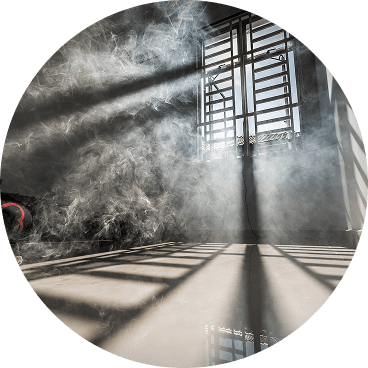
Smoke rides the wind far downwind — you can get smoky air with no fire nearby.
Simple steps to reduce indoor exposure.
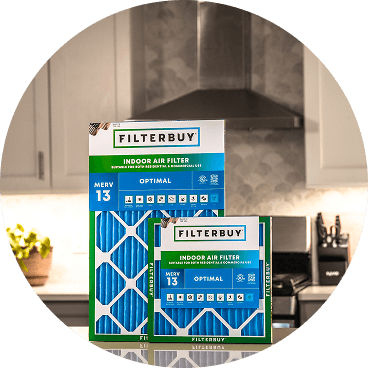
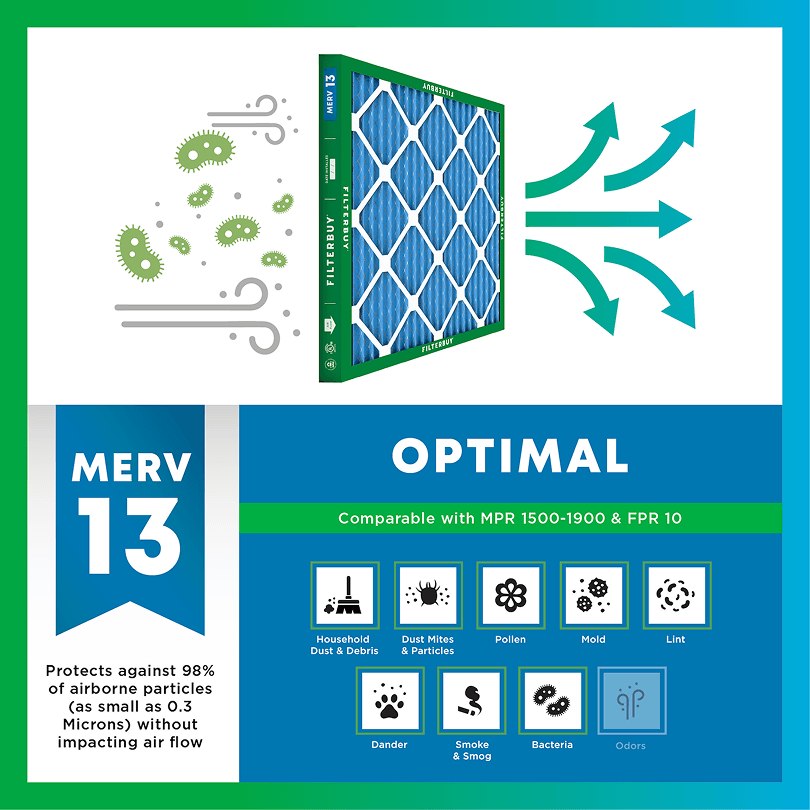
During smoke events, the EPA recommends upgrading to a MERV 13 filter — or the highest-rated filter your system can handle — to help reduce the fine particles smoke brings indoors. MERV 13 is the level most home HVAC systems can run while still capturing PM2.5, the fine particulate that makes up the bulk of wildfire smoke.
Over 70,000 wildfires burn in the U.S. every year.
Wildfire smoke can travel 1,000+ miles, affecting states that aren't even near the blaze.
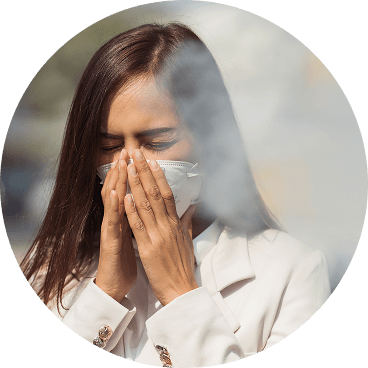
Exposure to wildfire smoke can worsen asthma, trigger heart issues, and lead to ER visits.
Indoor air can hold more fine particles during wildfire events unless it's properly filtered.
The EPA advises using MERV 13 filters or portable HEPA air cleaners during wildfire smoke events.
Use the live wildfire smoke tracker and upgrade your air filters today to protect your lungs and your home.
Shop Filters For Smoke Protection
By Michelle Wan · Technically reviewed by David Clark, Licensed HVAC Technician
Published: August 15, 2026 · Updated: August 15, 2026
Almost every wildfire smoke guide online was written for the western US, where fire season means summer. North Carolina peaks February through May and again October through early December, so the months those guides tell you to prepare are the Triad’s quietest. Build your filter schedule around March and October.
Forsyth County runs its own air quality program. One of only three North Carolina counties forecasting independently of the state, its daily Triad forecast is better local data than any national app gives you.
North Carolina’s fire calendar is inverted from the one most smoke advice assumes. Follow national guidance, and you will change your filter about four months late, twice a year.
Both of Winston-Salem’s Code Red particle days on record came from wildfire smoke: Canada in 2023, the Evans Road fire in 2008.
A filter solves only half of Winston-Salem’s Code Orange days. Smoke is particles, which a MERV 13 captures. Ozone is a gas, and no filter removes it.
Read it in two passes. First the fire icons, which show where something is burning and how far away. Then the AQI color under your ZIP code, the only number reflecting what you are actually breathing. Distance alone misleads: a fire 200 miles upwind can matter more than one 30 miles away, depending on wind and plume height.
Smoke does not travel in a straight line. It rides upper-level winds, sinks when the atmosphere is stable, and pools overnight, which is why the city can look clear at noon and smell like a campfire by seven the next morning.
The layers often disagree. Green with fires showing means the plume has not reached ground level; orange or red with no fires nearby means it came from far off. Either way, the indoor response is the same. Confirm any fire against the North Carolina Wildfire Public Viewer or the N.C. Forest Service situation report.
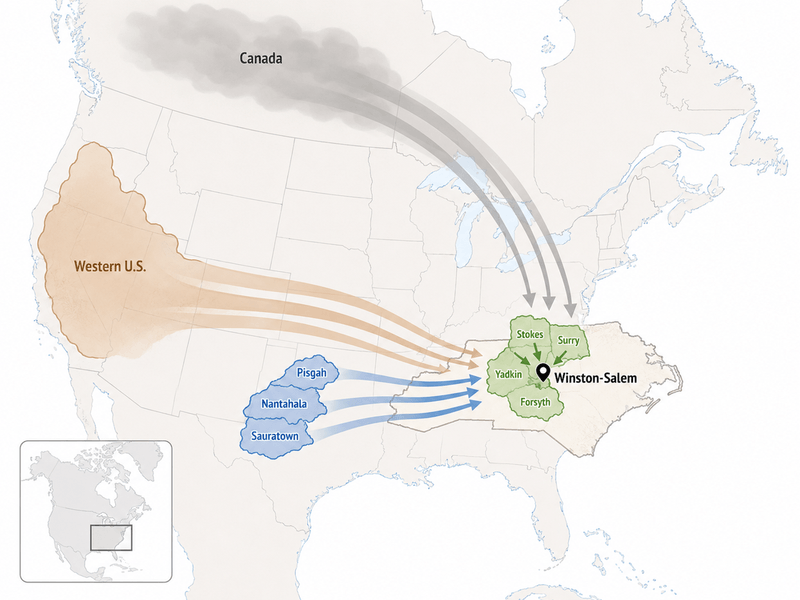
Smoke reaches Winston-Salem from three source regions, each on its own schedule and with its own warning time. The N.C. Forest Service situation report logs in-state activity daily.
Warning time is the typical gap between ignition or plume detection and measurable PM2.5 at Forsyth County monitors. Local debris fires give the least notice.
November 2021 showed how little warning that first category gives. The Grindstone Fire at Pilot Mountain State Park burned 1,050 acres 25 miles northwest of the city, and Stokes County’s Sauratown Mountain Fire took 16 days to contain. Both began as escaped campfires.
Most wildfire smoke advice is wrong for Winston-Salem because it assumes fire season means summer. That is true in California and Oregon, where most of this guidance is written. North Carolina peaks in late winter and again in fall, so the standard calendar is off by four months in both directions. Two consequences follow.
Your filter schedule should hinge on March and October, not June. A filter installed in May for smoke season has already missed the spring peak, and it will be pollen-loaded before fall. Put a fresh MERV 13 in ahead of March and again ahead of October, then treat summer as the transport window.
The smoke you get warned about is not the smoke that catches you. Canadian plumes are forecast days and lead the news, while a debris burn escaping in Stokes or Yadkin County gives you hours and often no advisory at all.
The AQI is a 0 to 500 scale for daily air pollution. Cross-check against AirNow.
AQI categories are set by the U.S. EPA. Code advisories for the Triad are issued by the Forsyth County Office of Environmental Assistance and Protection, whose daily forecast lists ozone and PM2.5 separately. An HVAC filter only helps with the PM2.5 number.
Winston-Salem gets Code Orange days from two pollutants, and a filter solves one of them. Most smoke pages skip this.
Wildfire smoke is PM2.5, the fine fraction a MERV 13 captures. Ozone is a gas, and the EPA notes that filters remove either particles or gases, with gas-phase media rarely used in homes. A pleated furnace filter, at any rating, does nothing for ozone, essentially.
Ozone typically drives the Triad’s alert April through September; particles drive it during smoke episodes and cooler months. Both can run high at once, as in June 2023.
So check the pollutant, not just the color. The Forsyth County forecast publishes ozone and PM2.5 separately, alongside a written discussion from the county forecaster explaining why today reads the way it does. Almost nobody reads it, and it is the most useful air quality information a Winston-Salem resident can get.
If PM2.5 is driving the code, run the HVAC fan continuously with a MERV 13 and expect roughly a 50% cut in indoor particles.
If ozone is driving it, a filter upgrade will not help. Shift exertion to the morning, keep windows shut through the afternoon peak, and wait it out.
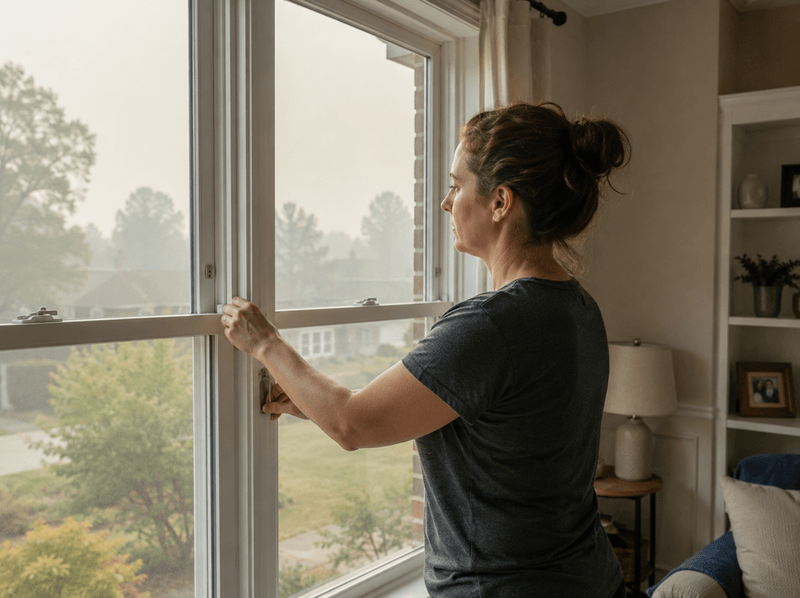
Your HVAC filter, not the outdoor air, sets your indoor exposure. Smoke enters through open windows, leaky ducts, and fresh-air intakes, then recirculates until something captures it. Five steps, in order of impact.
Install a MERV 13 filter and leave the fan on. The EPA recommends MERV 13 or higher during smoky periods, and switching the thermostat fan from AUTO to ON is what makes it work. Unsure of the rating? See Filterbuy’s guide to the best MERV filter for wildfire smoke.
Check the filter weekly during smoke. Replace it once the media looks dark brown or black, often well before the date on the box. That is why Filterbuy sets auto-delivery by size and schedule rather than a fixed calendar.
Close up and recirculate. Shut the windows and the fresh-air intake, and skip candles, frying, and vacuuming while the smoke lasts.
Create one clean room. Follow the EPA’s clean room instructions and put a portable HEPA cleaner in the bedroom, avoiding anything that produces ozone. MERV 13 vs HEPA explains why HEPA belongs in a room unit.
Keep filtering after the sky clears. Particles settle into carpet and upholstery, then lift back into the air for days.
Winston-Salem’s smoke risk peaks twice a year: February through May, and October through early December. Dry leaf litter and high winds drive the first; fuels cured by cold fronts drive the second. Before any debris burn, get a state burn permit.
Seasonal pattern based on N.C. Forest Service wildfire activity data. North Carolina peaks in late winter/spring and again in fall, the reverse of the western US cycle.
Smoke loads a filter far faster than dust does. I’ve pulled filters after a few weeks of smoke that were darker than a normal filter at the end of its life. Hold it up to a light. If light doesn’t pass through, it’s already choking your airflow, and the date on the box doesn’t matter.
David Clark, Licensed HVAC Technician
A high-efficiency HVAC filter cuts indoor PM2.5 by roughly half when the fan runs continuously. A low-efficiency filter still takes out about 24% if the fan stays on.
Source: EPA guidance on reducing wildfire smoke exposure indoors
Asthma-related emergency visits ran that much above expected levels nationally across the 19 wildfire smoke days of 2023.
Source: CDC study on asthma ER visits during the 2023 wildfire smoke episodes
Human activity causes nearly every wildfire in North Carolina, and escaped yard debris burns cause close to half. The N.C. Forest Service handled almost 5,600 between July 2024 and June 2025.
Source: N.C. Forest Service on preparing for and preventing wildfire
Long-range transport. Smoke from Canadian or western fires rides the upper atmosphere for days, then mixes down. On June 29, 2023, that pushed Winston-Salem to a Code Red particle day, its first since 2008.
No. MERV 8 is built for lint and larger pollen. Smoke is PM2.5, and the EPA recommends MERV 13 or higher. Filterbuy’s wildfire smoke filter comparison compares the ratings side by side.
Only an N95 or similar NIOSH-approved respirator filters fine particles; cloth and surgical masks do not. The EPA advises keeping a supply on hand before fire season, and notes people with heart or lung conditions should ask a doctor first, since respirators make breathing harder.
Most modern systems can. Older units with PSC blower motors may struggle with the added resistance. Have a licensed technician test static pressure. See Filterbuy’s HEPA vs MERV 13 comparison for compatibility guidance.
The Forsyth County Office of Environmental Assistance and Protection, one of three local air programs in North Carolina, issues the daily forecast and Code Orange/Code Red advisories for Forsyth, Guilford, Alamance, Davidson, Randolph, Rockingham, Caswell, Davie and Stokes counties. Sign up for EnviroFlash alerts to get it by email.
For statewide context, check Filterbuy’s live AQI map for North Carolina. Better Air For All™ starts with the filter in your system right now. Filterbuy builds in the USA in 600+ sizes and auto-delivers on the schedule the Triad needs: March and October.
Shop MERV 13 filters for smoke protection →
Set up auto-delivery before fall fire season →
PM2.5: Fine particles 2.5 micrometers or smaller. What wildfire smoke is made of, and what a filter can capture.
Ozone: A gas, not a particle. The Triad’s other Code Orange driver, roughly April–September. Filters do not remove it.
MERV 13: The EPA’s recommended filter rating for smoke, and the practical ceiling for most home systems.
HEPA: Captures at least 99.97% of 0.3-micron particles. Belongs in a portable room cleaner, not a furnace slot.
Code Orange / Code Red: Advisories for AQI 101–150 and 151–200.
Subscribe to wildfire smoke alerts for Winston-Salem, NC, to get a heads-up before the next event reaches your area.