The moment a wildfire starts near you, you'll get an instant alert and simple tips to reduce your smoke exposure.
30xSmaller than a human hair
Fine enough to reach deep into the lungs. A MERV 13 is built to capture it.
It Doesn't Stay Local
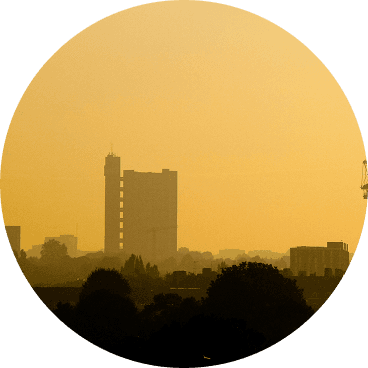
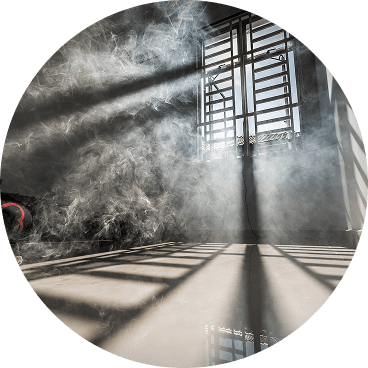
Smoke rides the wind far downwind — you can get smoky air with no fire nearby.
Simple steps to reduce indoor exposure.
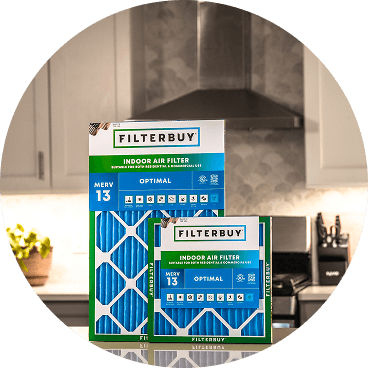
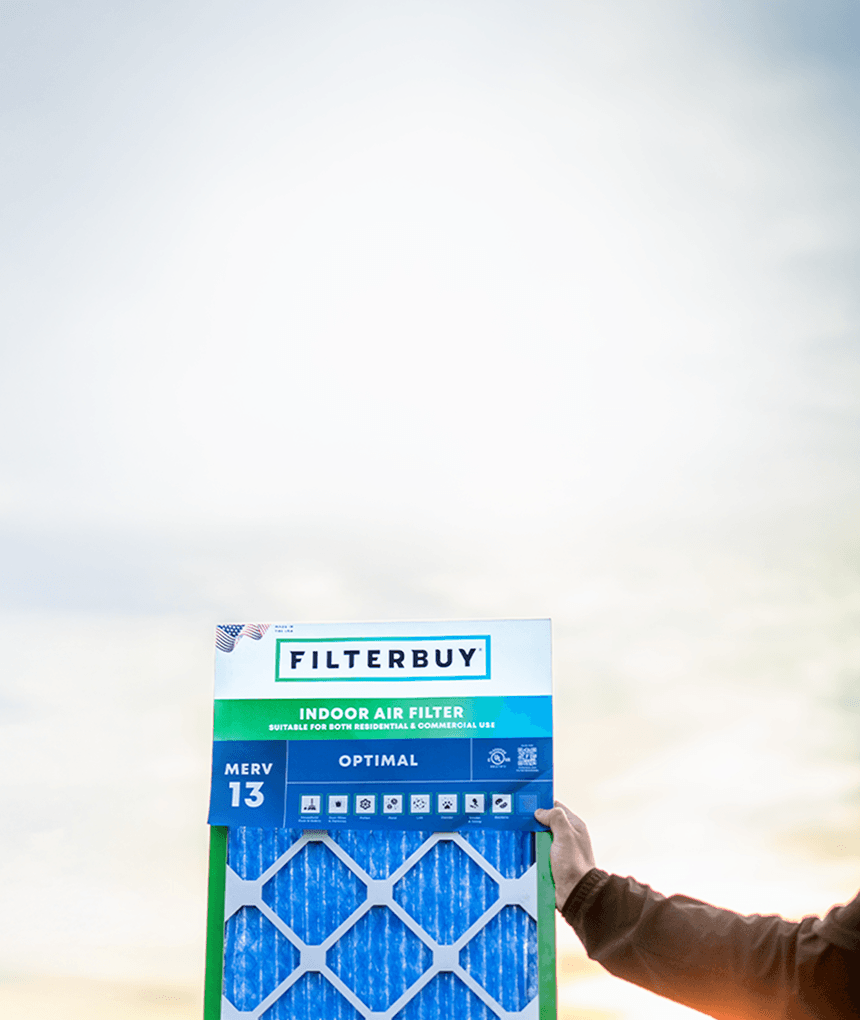
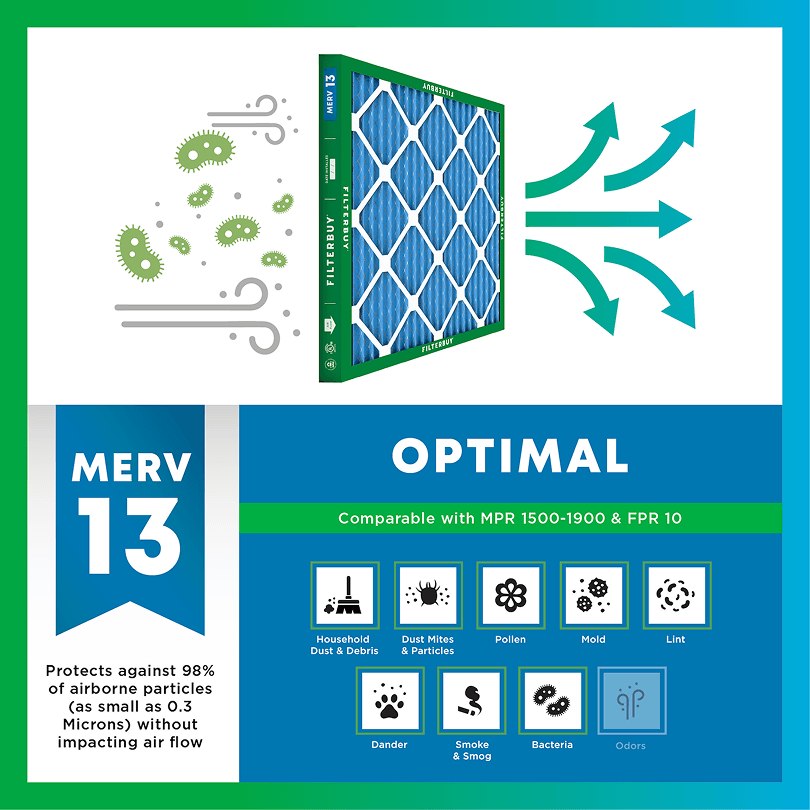
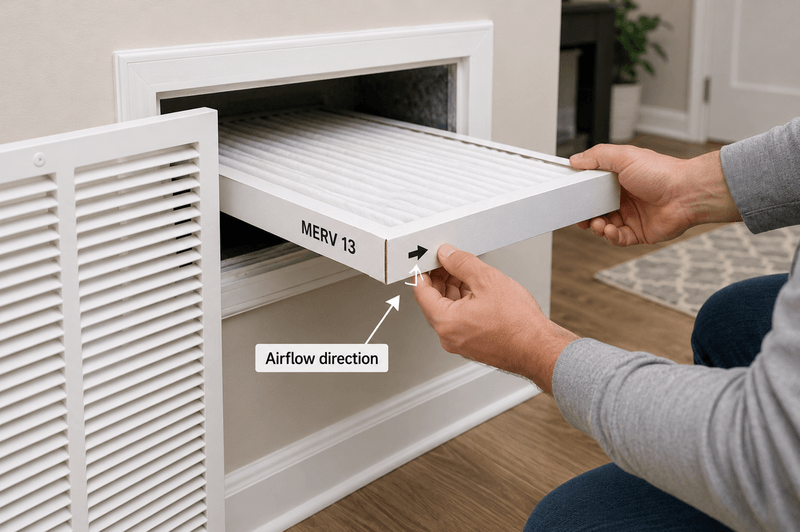
During smoke events, the EPA recommends upgrading to a MERV 13 filter — or the highest-rated filter your system can handle — to help reduce the fine particles smoke brings indoors. MERV 13 is the level most home HVAC systems can run while still capturing PM2.5, the fine particulate that makes up the bulk of wildfire smoke.
Over 70,000 wildfires burn in the U.S. every year.
Wildfire smoke can travel 1,000+ miles, affecting states that aren't even near the blaze.
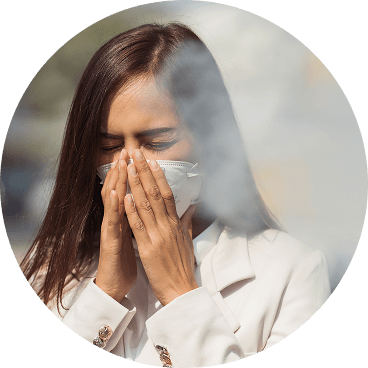
Exposure to wildfire smoke can worsen asthma, trigger heart issues, and lead to ER visits.
Indoor air can hold more fine particles during wildfire events unless it's properly filtered.
The EPA advises using MERV 13 filters or portable HEPA air cleaners during wildfire smoke events.
Use the live wildfire smoke tracker and upgrade your air filters today to protect your lungs and your home.
Shop Filters For Smoke Protection
Author: Michelle Wan, Brand Manager and Air Quality Writer, filterbuy.com/author/michelle-wan
Reviewed By: David Clark, Licensed HVAC Technician
Published: August 1, 2026 Last Updated: August 1, 2026
Greensboro households smell smoke before they can locate the fire, and the fire is rarely burning in North Carolina. Canadian and western plumes sink over the Piedmont behind a passing front and arrive as particles nobody can see. We build pleated filters in Talladega, Alabama, and we rate our MERV 13 media against particles down to 0.3 microns, which is the size range wildfire smoke occupies. Greensboro also loses summer days to ozone, which no filter touches, and on those days we would rather you skip the upgrade. The map here tells you which one you have.
Greensboro rarely sits next to a burning forest. The haze reaching Guilford County usually starts hundreds of miles away, and the live Filterbuy map below shows the fires and the smoke drifting downwind. On hot summer afternoons, ozone rather than smoke often drives the AQI, and no pleated filter removes ozone.
North Carolina wildfire activity peaks mid-March through mid-April and late September through October, so summer haze in Greensboro is usually transported smoke.
The Forsyth County Office of Environmental Assistance and Protection issues Greensboro’s daily air quality forecast, not the N.C. Division of Air Quality.
Wildfire PM2.5 raises respiratory hospitalization risk more than PM2.5 from other sources, per a 2021 Nature Communications study.
The CDC recommends MERV 13 or higher in central systems during smoke events when the equipment accepts it.
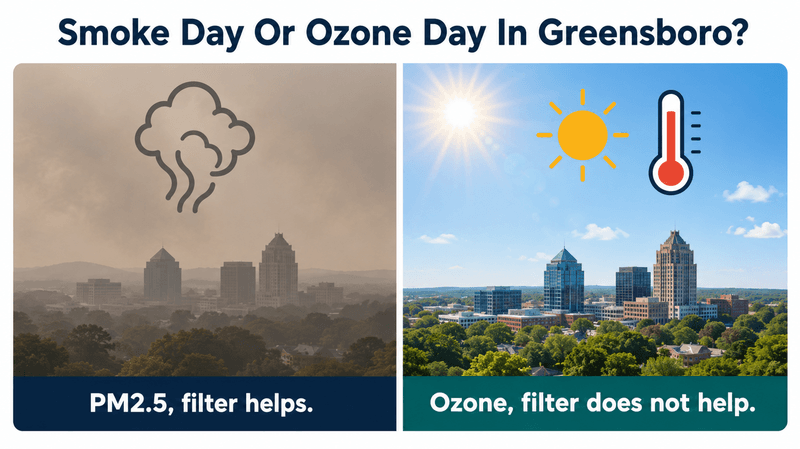
A pleated MERV filter captures smoke particles and does nothing for ozone gas, the more frequent summer driver of a high Triad AQI.
The map below layers fire detections and smoke plumes over ground-level PM2.5 readings. Red icons mark fires. Gray shading marks smoke. Colored circles show what nearby monitors measure this hour. Tap the circle closest to your address.
Gray shading means smoke sits in the air column above Greensboro. A green or yellow circle beneath it means the smoke has not mixed to breathing level. Orange or red circles under a plume mean exposure has begun.
The Greensboro real-time AQI tracker breaks today’s index down by ozone and particle pollution.
Guilford County rarely has an active wildfire in summer. North Carolina fire activity peaks in spring and fall, and summer fires cluster in the coastal plain roughly 250 miles southeast of Greensboro. The N.C. Forest Service publishes a statewide count each weekday through a database it calls Signal 14.
On July 23, 2026, the N.C. Forest Service reported 6 wildfires burning 19.3 acres statewide. Recent summer activity centered on Brunswick, Bladen, Duplin, and Onslow counties, far enough southeast that their smoke rarely reaches the Piedmont.
Greensboro smoke episodes behave differently from Asheville or Wilmington ones, since the smoke arrives on the wind. The Filterbuy national wildfire and smoke map shows how far a plume travels before reaching the Triad.
Greensboro faces two summer air quality problems, and only one responds to filtration. Ground-level ozone forms on hot, sunny, low-wind afternoons and drives many Code Orange days across the Triad from April through September. Wildfire smoke arrives as fine particulate matter, often overnight behind a front.
Greensboro air quality forecasts are issued by the Forsyth County Office of Environmental Assistance and Protection.
We built this table for Triad conditions rather than Western fire seasons. A household that upgrades filtration on an ozone day spends money without reducing exposure, and we would rather say so than sell a filter that cannot help that week.
The Forsyth County Office of Environmental Assistance and Protection forecasts air quality for Greensboro, not the state agency most residents expect. Its meteorologists use Forsyth County and Triad monitors to publish a daily ozone and particle forecast, and they issue the Code Orange Air Quality Action Days the National Weather Service relays. The N.C. Division of Air Quality forecasts 91 other counties.
A Greensboro parent checking a statewide page may see a different color than the Triad forecast that covers Guilford County. Read the Triad forecast first.
Take five actions once surface PM2.5 in Guilford County reaches orange.
Close windows and exterior doors, including window unit vents that pull outside air in.
Switch the system to recirculate and close the fresh-air intake if your equipment has one.
Run the fan continuously rather than on auto, because filtration happens only when air moves.
Install the highest MERV rating your equipment manufacturer allows, checking static pressure before jumping several ratings.
Stop indoor combustion. Candles, gas ranges, wood stoves, and incense add particles to air you are cleaning.
People with asthma, COPD, heart disease, diabetes, or chronic kidney disease, plus children, older adults, and anyone pregnant, should follow local guidance closely and contact a clinician about new or worsening symptoms.
Most wildfire smoke guidance was written for the dry West, where sealing a house costs nothing. Greensboro smoke days arrive inside July heat. Closing windows and switching to recirculate works only while the cooling system runs, so a home that cannot stay cool while sealed faces two problems at once. If cooling fails during a smoke event, a cooled public building is the safer choice. No national smoke checklist mentions this tradeoff, the one Piedmont households face.
MERV 13 is the rating public health agencies point to for smoke. The CDC advises central air conditioning households to use high-efficiency filters, preferably MERV 13 or higher when the system accepts it.
Filterbuy makes them in Talladega, Alabama, in more than 600 sizes, so most Greensboro filter slots have a MERV 13 match without a special order. Three ratings cover Triad conditions:
MERV 8 air filters capture 90 percent of airborne particles and handle everyday dust and pollen.
MERV 11 air filters capture 95 percent and add finer dust and pet dander for moderate pollution days.
MERV 13 air filters capture 98 percent, down to 0.3 microns, and belong in the system before smoke season.
Buy the smoke-season filter early, because filters sell out once an event makes local news, and an air filter subscription keeps a spare in the closet. A pleated filter does not remove ozone or seal a leaky house, and it will not fully clear odor.
After manufacturing filters for over a decade and serving more than two million households, the pattern we see is that the filter decision comes too late. A Greensboro family smells smoke, finds a map, then finds a MERV 8 in the return grille. Install before the season, and the map becomes information, not an emergency.
David Heacock, Founder and Chief Executive Officer, Filterbuy
The question I get every smoke season is whether closing the windows is enough. It is not. A house exchanges air whether you want it to or not, and whatever is outside cycles through the return. In Greensboro, that matters twice over, since one July week can bring a smoke day and an ozone day, and only one is a filter problem.
Michelle Wan, Brand Manager and Air Quality Writer, Filterbuy
Filterbuy recommends bookmarking these free, authoritative tools before smoke season.
How to read the fire icons and PM2.5 dials.
Source: airnow.gov/fasm-v4/how-to-use
Daily statewide wildfire counts, plus the North Carolina Wildfire Public Viewer.
Source: ncagr.gov/divisions/nc-forest-service/fire-control-and-prevention/sit-report
The daily forecast that officially covers Greensboro.
Source: co.forsyth.nc.us/eap/air_quality/forecast.aspx
Statewide forecast hub covering 91 counties.
Source: deq.nc.gov/about/divisions/air-quality/outreach-education-engagement/air-quality-forecasts
Federal guidance on clean rooms and central-system filtration.
Source: cdc.gov/wildfires/safety/how-to-safely-stay-safe-during-a-wildfire.html
Lung-health direction for sensitive groups.
Source: lung.org/clean-air/emergencies-and-natural-disasters/wildfires
FEMA guidance on alerts and evacuation planning.
Source: ready.gov/wildfires
Aguilera and colleagues found respiratory hospitalizations rose 1.3 to 10 percent per 10 micrograms of wildfire PM2.5, against 0.67 to 1.3 percent for other PM2.5.
Source: pmc.ncbi.nlm.nih.gov/articles/PMC7935892
The EPA describes PM2.5 as particles 2.5 micrometers and smaller, against an average human hair near 70 micrometers.
Source: epa.gov/pm-pollution/particulate-matter-pm-basics
The 2020 Residential Energy Consumption Survey found 93 percent of South Census Region households use air conditioning, which means roughly one Southern home in fourteen has none during a smoke event.
Usually no. North Carolina summer fires concentrate in southeastern coastal counties. Check the map above for red icons near the Triad, then confirm against the N.C. Forest Service report.
Wildfire smoke travels hundreds to thousands of miles downwind. A passing front can push a Canadian or western plume to the surface over Greensboro overnight.
Children and other sensitive groups should limit outdoor exertion once the AQI reaches Code Orange, 101 to 150. Above 150, the general population should cut prolonged outdoor activity.
Partly. A MERV 13 filter captures the fine particles carrying much of the smell, and it does not remove the gas-phase compounds behind the rest. Filterbuy odor eliminator filters address odor specifically.
The Forsyth County Office of Environmental Assistance and Protection, covering the Triad including Greensboro. The National Weather Service relays its alerts by county zone.
The map above shows when smoke reaches Greensboro. The filter in your return grille decides how much your family breathes indoors. Find your size at Filterbuy and install a MERV 13 before the next plume crosses Guilford County.
AQI (Air Quality Index): The U.S. 0 to 500 index converting pollutant levels into color-coded categories.
PM2.5: Fine inhalable particles 2.5 micrometers or smaller, the health concern in wildfire smoke.
MERV (Minimum Efficiency Reporting Value): The 1 to 16 scale rating how efficiently a filter captures airborne particles.
Ground-Level Ozone: A gas formed when heat and sunlight react with vehicle and industrial emissions.
Code Orange: AQI 101 to 150, Unhealthy for Sensitive Groups, triggering Triad Air Quality Action Days.
Signal 14: The N.C. Forest Service database of daily wildfire occurrence.
Piedmont Triad: The north-central region containing Greensboro, Winston-Salem, and High Point.
HVAC: Heating, ventilation, and air conditioning, the system whose filter and fan determine indoor smoke removal.
Sensitive Groups: Children, older adults, pregnant people, and anyone with asthma, COPD, heart, or kidney disease.
Subscribe to wildfire smoke alerts for Greensboro, NC, to get a heads-up before the next event reaches your area.