The moment a wildfire starts near you, you'll get an instant alert and simple tips to reduce your smoke exposure.
30xSmaller than a human hair
Fine enough to reach deep into the lungs. A MERV 13 is built to capture it.
It Doesn't Stay Local
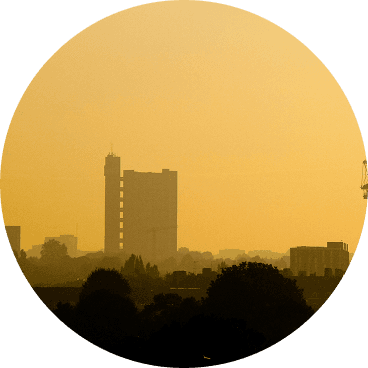
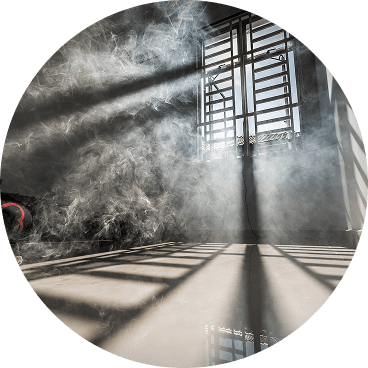
Smoke rides the wind far downwind — you can get smoky air with no fire nearby.
Simple steps to reduce indoor exposure.
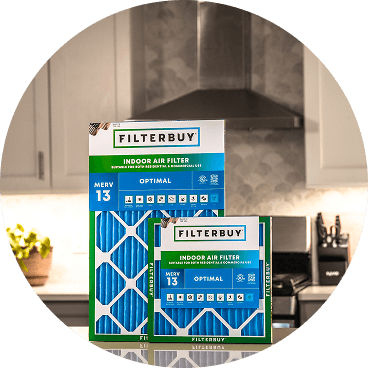
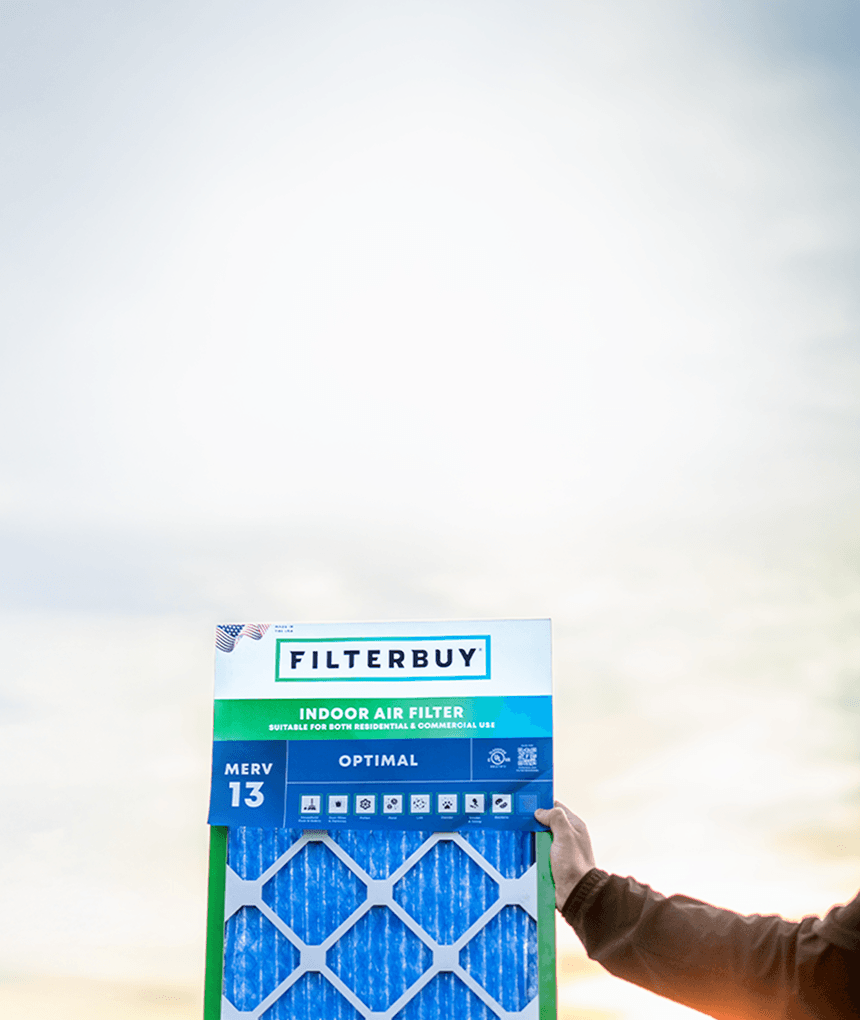
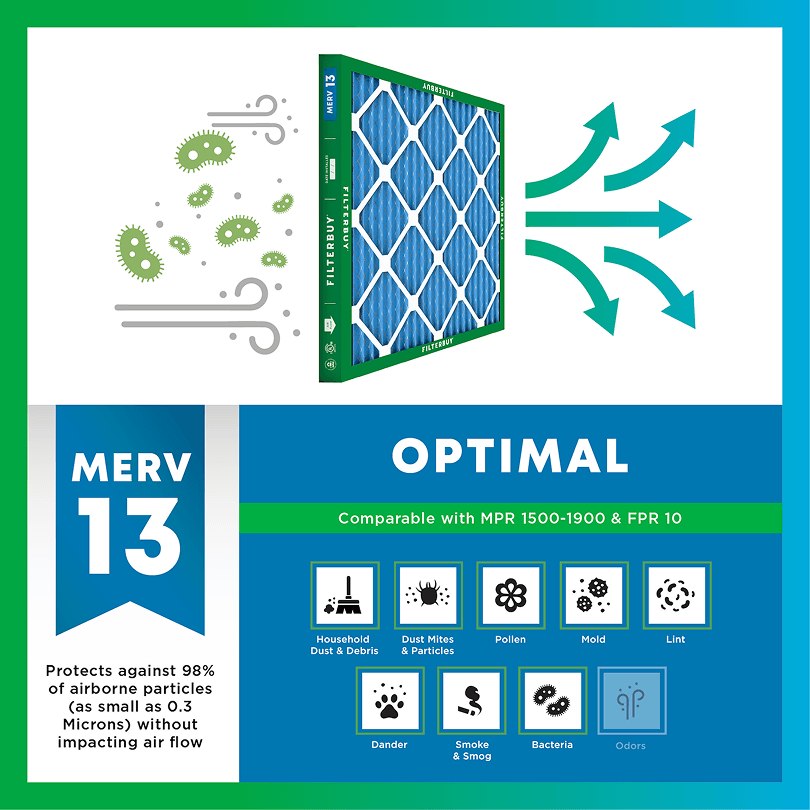
During smoke events, the EPA recommends upgrading to a MERV 13 filter — or the highest-rated filter your system can handle — to help reduce the fine particles smoke brings indoors. MERV 13 is the level most home HVAC systems can run while still capturing PM2.5, the fine particulate that makes up the bulk of wildfire smoke.
Over 70,000 wildfires burn in the U.S. every year.
Wildfire smoke can travel 1,000+ miles, affecting states that aren't even near the blaze.
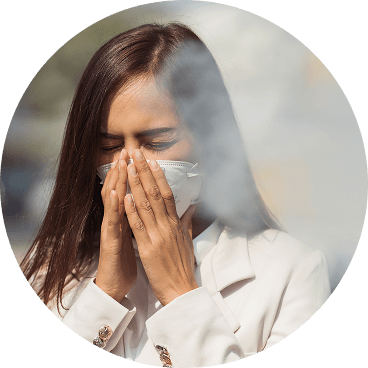
Exposure to wildfire smoke can worsen asthma, trigger heart issues, and lead to ER visits.
Indoor air can hold more fine particles during wildfire events unless it's properly filtered.
The EPA advises using MERV 13 filters or portable HEPA air cleaners during wildfire smoke events.
Use the live wildfire smoke tracker and upgrade your air filters today to protect your lungs and your home.
Shop Filters For Smoke Protection
By Michelle Wan, Air Quality Writer at Filterbuy. Reviewed by David Clark, Licensed HVAC Technician. Published August 22, 2026. Updated August 22, 2026.
Baton Rouge rarely sits inside a wildfire perimeter, but it regularly sits under smoke. Three official tools answer fastest: the AirNow Fire and Smoke Map for satellite-detected fires, the Louisiana Department of Environmental Quality network for hourly particle readings, and the state forestry burn ban map for your parish. Whatever is overhead, indoor filtration is the part of your exposure you control.
Smoke reaching Baton Rouge comes from four sources, and only one is a nearby forest wildfire.
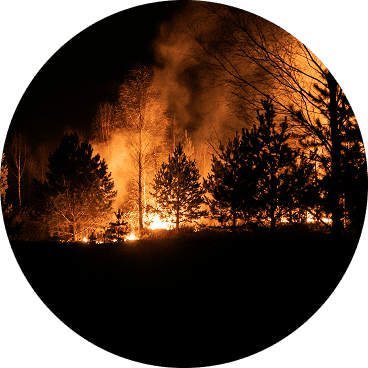
Ash on your car means a local burn. Most ash falls within three to five miles.
Sugarcane preharvest burning runs October through January, a source no national wildfire map tracks.
Cane smoke spikes in the afternoon and thins overnight. Transported smoke can persist for days.
A MERV 13 filter with the fan set to On is the highest-value indoor step for most homes.
Open the AirNow Fire and Smoke Map to see whether a satellite-detected fire or plume overlaps Baton Rouge, then check the state monitoring network for particle concentration near you. The two answer different questions. A plume means smoke is overhead. A monitor reading means it reached breathing level, and they often disagree.
Smoke at 10,000 feet can turn the sky orange while ground readings hold at Good. The reverse happens too, since the five-parish area already carries a petrochemical and traffic baseline.
Update cadences follow each agency published refresh schedule. Confirm at the source during an active smoke event.
Four smoke sources reach Baton Rouge, each on its own calendar, and national wildfire maps track only one reliably. The other three explain most days when residents smell smoke, see ash, or watch readings spike. Most live wildfire pages treat Baton Rouge as a smaller Sacramento, and that framing fails here.
Agricultural burning windows follow the Louisiana Smoke Management Guidelines for Agriculture, LSU AgCenter and Louisiana Department of Agriculture and Forestry.
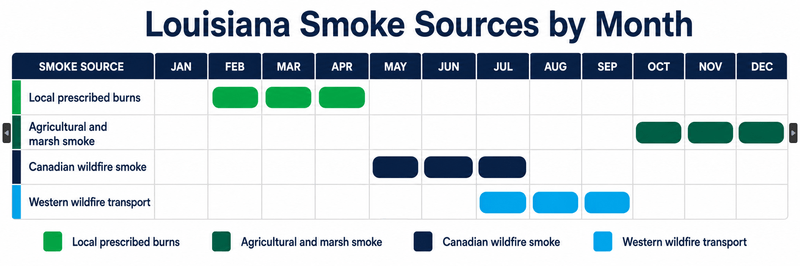
National smoke advice misses one consequence. Cane burning peaks October through January, exactly when Louisiana households start running heat, so the months that load a filter fastest are the months the blower runs most. The state forestry office posts current fire conditions and parish burn bans as they change.
Ash on your car is the strongest clue, because ash does not travel the way smoke does. The Louisiana smoke management guidelines for agriculture put most ash fallout within three to five miles of a burn site, with less falling for another fifteen to twenty miles. Visible ash means a burn near your parish. Haze with no ash and no nearby hotspot means smoke that traveled from elsewhere.
Timing gives a second clue and tells you how long to expect it. Growers burn between roughly 10 a.m. and 4 p.m. and avoid late afternoon, when an evening inversion keeps smoke from rising and pushes it sideways across roads and neighborhoods.
The Air Quality Index converts pollutant concentrations into a 0 to 500 scale, where 100 marks the national health-based standard. During a smoke event, PM2.5 drives the number; these fine particles are 2.5 micrometers or smaller and travel deepest into lung tissue. Federal guidance on protecting yourself from heat and smoke identifies children, older adults, pregnant people, and anyone with heart or lung disease as most at risk.
Air Quality Index categories and ranges as published by the U.S. Environmental Protection Agency. Indoor responses are Filterbuy guidance, not EPA text.
The Louisiana Department of Environmental Quality publishes hourly readings from its Baton Rouge area monitors, with a caveat: continuous PM2.5 values are not quality-reviewed in real time and not comparable to the federal standard. Read them as an operational signal.
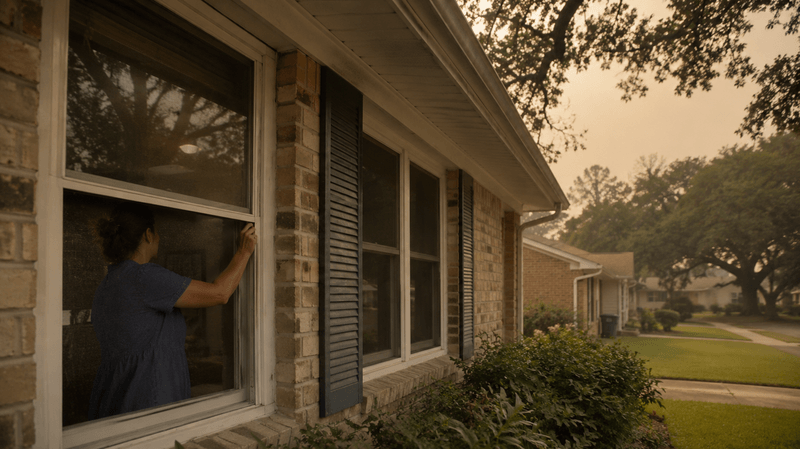
Close windows and exterior doors, switch the thermostat fan from Auto to On so the system filters continuously, set any fresh-air intake to recirculate, and avoid indoor combustion. Candles, gas ranges, frying, and vacuuming push particle counts up exactly when you want them down. The CDC explains how wildfire smoke affects the body.
Continuous fan operation is the step most households skip, and EPA has measured it. Its guidance on strategies for reducing smoke exposure indoors reports that running a central system continuously can cut indoor particle concentrations by about 24 percent even with a low-efficiency filter. That describes the weakest filter tested, so treat it as a floor.
Watch indoor humidity while the fan runs. With the compressor off, house air passes over a wet evaporator coil and re-evaporates the condensate the system just removed, driving humidity back up. EPA recommends keeping indoor relative humidity below 60 percent. If a hygrometer reads past that, return the fan to Auto so the cooling cycle handles moisture, and carry filtration with a portable air cleaner. Our guidance on running an air purifier during wildfire season covers sizing.
The Environmental Protection Agency recommends MERV 13 or higher during smoky periods and notes most residential systems handle it without equipment problems if the filter is replaced often. MERV, or Minimum Efficiency Reporting Value, rates how well a filter captures particles by size. Filterbuy breaks down how the MERV scale is structured and shows what each tier catches.
MERV 13 is the practical ceiling for most homes, and it is not True HEPA. No pleated furnace filter is, because HEPA media belongs in portable air cleaners built for that resistance, as our comparison of MERV 13 relative to HEPA media sets out.
In this market, the filter seldom fails because someone picked the wrong MERV. It fails because it is three weeks past due during cane season and nobody looked at it. Check the media, not the calendar. Hold it up to a light, and if you cannot see white through the pleats, the blower is already working harder than it should.
David Clark, Licensed HVAC Technician, technical reviewer for Filterbuy
44 percent of Americans, 152.3 million people, live in counties graded failing for unhealthy ozone or particle pollution, with wildfire smoke named among the drivers.
Source: State of the Air 2026 key findings from the American Lung Association.
77 percent of Louisiana was in Moderate to Extreme Drought as of May 21, 2026, with rainfall 13.3 inches below average over nine months and increased fire risk among the impacts.
Source: the NOAA drought status update for Louisiana and the Lower Mississippi states.
Americans spend roughly 90 percent of their time indoors, where some pollutants run 2 to 5 times higher than outdoors, which is why filtration determines most of your smoke exposure.
Source: the EPA Report on the Environment indoor air quality findings.
Check the AirNow Fire and Smoke Map for satellite fire detections around East Baton Rouge Parish. Large wildfires are uncommon in the metro, where high humidity and developed land cover work against them.
Check the Louisiana Department of Agriculture and Forestry burn ban map, the authoritative source for parish orders. A burn ban and an end to cane smoke are not the same thing. In September 2023, the state modified a statewide ban to let agricultural burning resume while keeping standing sugarcane prohibited. Read the specific order rather than assuming a ban covers every source.
Only partly. Fine particles infiltrate through envelope gaps even with the windows shut, so closing up is a first step, not a complete answer. Sealing works best when a high-efficiency filter runs behind it, and the blower stays on.
Most modern residential systems can. Older Louisiana homes with limited blower capacity may struggle against the added resistance of a MERV 13, or Minimum Efficiency Reporting Value 13, filter, so comparing filter resistance across MERV tiers shows where that trade-off starts. A licensed HVAC technician can measure static pressure and confirm the highest efficiency your system supports.
Smoke season rewards preparation over reaction. Filterbuy is a family-owned American manufacturer making air filters domestically since 2013, including MERV 13 pleated filters made in the USA in more than 600 sizes. Check the size printed on your filter frame and order a spare before the next plume reaches East Baton Rouge Parish.
AQI, Air Quality Index: A 0 to 500 scale from the U.S. Environmental Protection Agency turning pollutant concentrations into a color-coded health signal, where 100 marks the national standard.
PM2.5: Fine particulate matter 2.5 micrometers or smaller. PM2.5 governs readings during smoke events because it penetrates deep lung tissue.
MERV: Minimum Efficiency Reporting Value, the ASHRAE-defined 1 to 16 scale rating how effectively an HVAC filter captures particles by size.
HEPA: High Efficiency Particulate Air, a standard requiring capture of at least 99.97 percent of 0.3 micrometer particles. HEPA suits portable air cleaners, not furnace slots.
Baton Rouge Area: The LDEQ reporting region: Ascension, East Baton Rouge, Iberville, Livingston, and West Baton Rouge parishes.
Preharvest Burning: Burning sugarcane leaf residue before harvest, common in the river parishes from October through January.
Subscribe to wildfire smoke alerts for Baton Rouge, LA, to get a heads-up before the next event reaches your area.