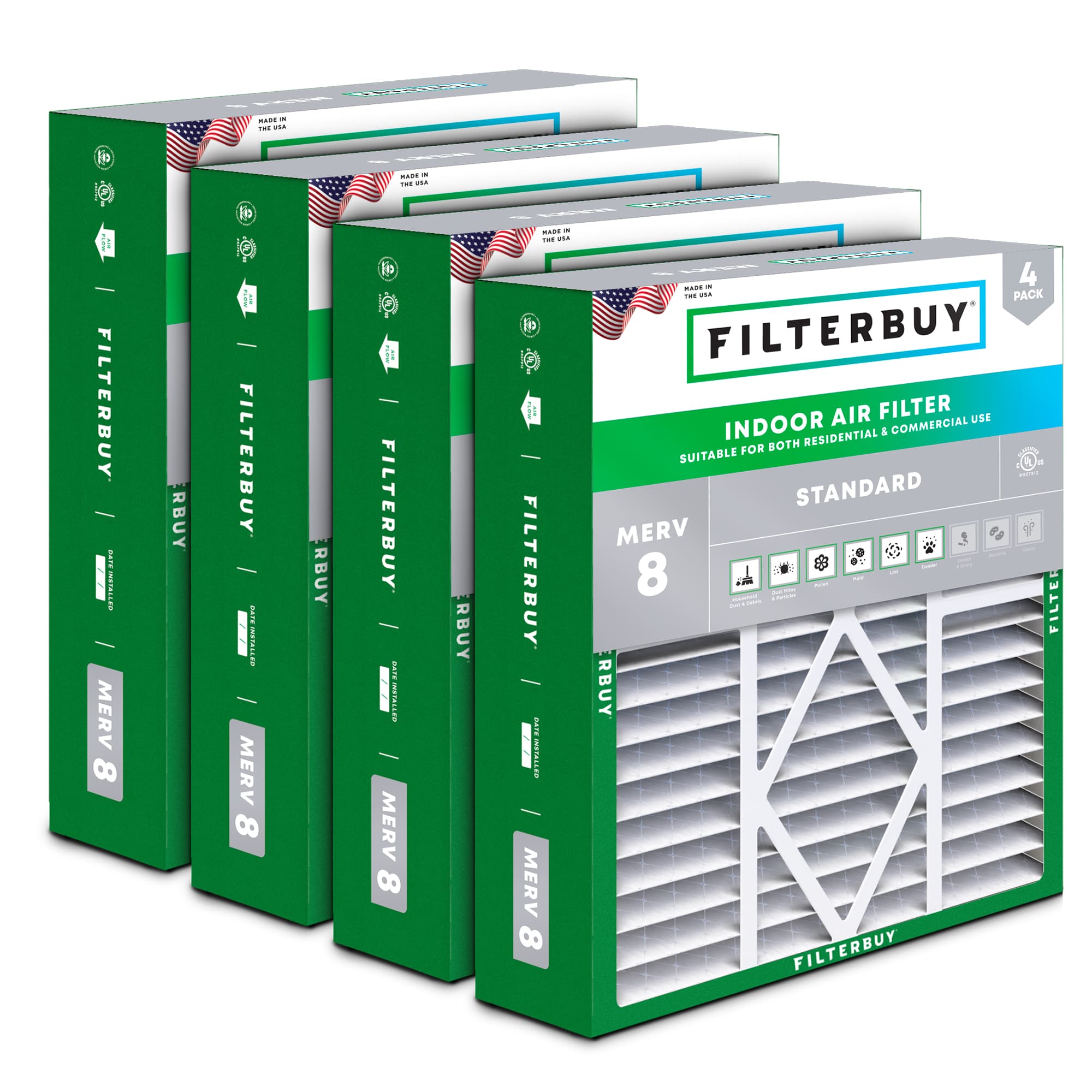
Tip: Ensure you buy the exact air filter size for your system. Certain brands have precise dimensions that only fit their specific models. See related filters
Actual Size: 20.19x25.31x5.25
 Free Delivery
  Factory-Direct Low Prices, Made in the USA
 Hassle-Free Returns & Free Exchanges
RESIDENTIAL AND/OR COMMERCIAL USE
Change Every 3 Months
Tip: Ensure you buy the exact air filter size for your system. Certain brands have precise dimensions that only fit their specific models. See related filters
Actual Size: 20.19x25.31x5.25
Free Delivery Factory-Direct Low Prices, Made in the USAHassle-Free Returns & Free ExchangesRESIDENTIAL AND/OR COMMERCIAL USE
Change Every 3 Months
Tip: Ensure you buy the exact air filter size for your system. Certain brands have precise dimensions that only fit their specific models. See related filters
Actual Size: 20.19x25.31x5.25
Free Delivery Factory-Direct Low Prices, Made in the USAHassle-Free Returns & Free ExchangesRESIDENTIAL AND/OR COMMERCIAL USE
Change Every 3 Months
Many HVAC brands have unique trimmed sizes of their 20x25x5 filters.
For example, a 20x25x5 made for Honeywell systems will not fit other brand systems.
⚠️ This quick step can save you from ordering the wrong size. ⚠️
Find Your Exact Match By Choosing Your Brand Below:
Find Your Exact Match By Choosing the Actual Size (Also known as the trimmed size):
At Filterbuy, we don't cut corners—we craft high-quality air filters right here in the USA and ship them to your doorstep for free. No delays, no gimmicks—just clean air, made easy. With thousands of five-star reviews and filters built for real life & every HVAC system, it's no wonder why over 4 million families trust Filterbuy.

Proudly Made In The USA

Fast, Free Shipping on Every Order

Premium Materials That Go The Distance

85,000+ 5-Star Reviews From Happy Customers

Save Up to 70% Per Filter with Packs


Measure length × width × depth with a tape measure to find the actual size.

Round up each dimension to the nearest whole number to get the nominal size. Example: 20.19x25.31x5.25 in → 20x25x5 nominal.

Search by nominal size on our site for the best fit.


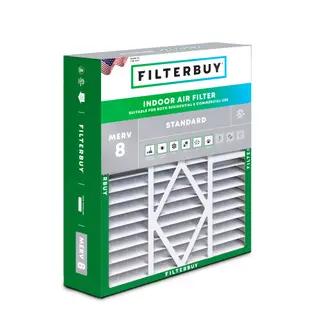
5″ filters give you maximum filtration with minimal maintenance — lasting up to 12 months while handling higher MERV ratings without restricting airflow.
Sizing note:

If the filter you buy doesn't fit, we'll send you a better size.
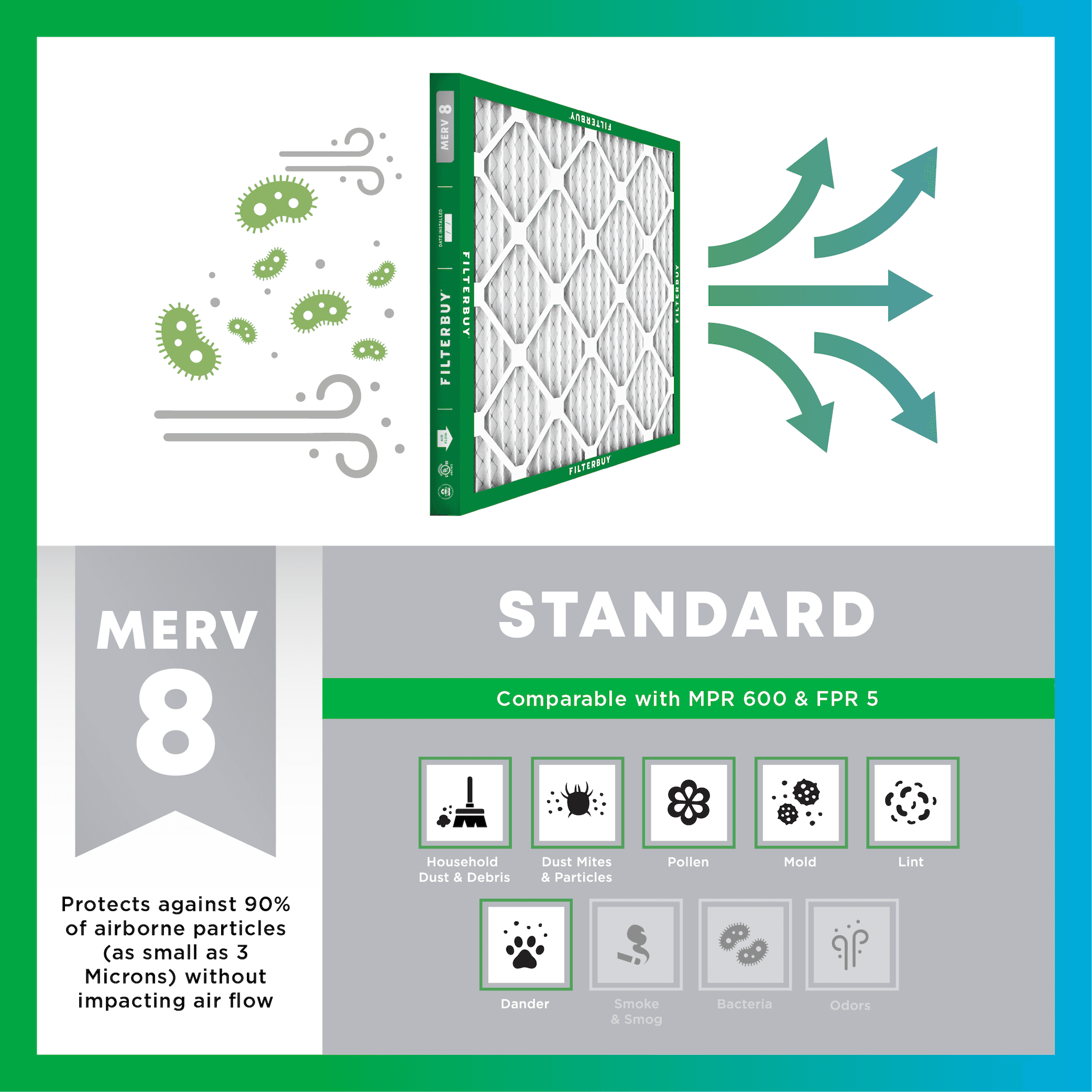
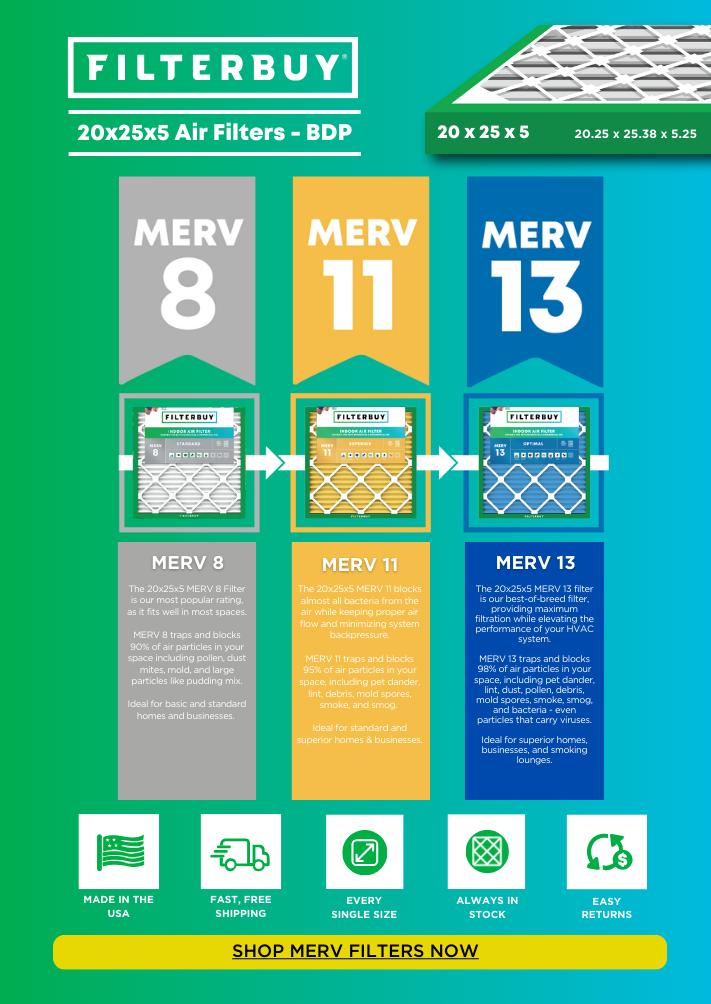
MERV stands for Minimum Efficiency Reporting Value—but don't let the technical name fool you. It's just a way to rate how well an air filter traps stuff like dust, pollen, pet dander, and smoke. The higher the MERV number, the more particles it catches—and the cleaner your air will be.

Comparable to:FPR: 4-7
MPR: 600-1000
 Dust & Debris
 Dust Mites & Particles
 Pollen
 Mold
Mold Lint
Lint Dander
Comparable to:FPR: 6-9
MPR: 1200-1550
Dust & DebrisDust Mites & ParticlesPollenMoldLintDander Smoke & Smog
Comparable to:FPR: 10
MPR: 1900-2800
Dust & DebrisDust Mites & ParticlesPollenMoldLintDanderSmoke & Smog Bacteria


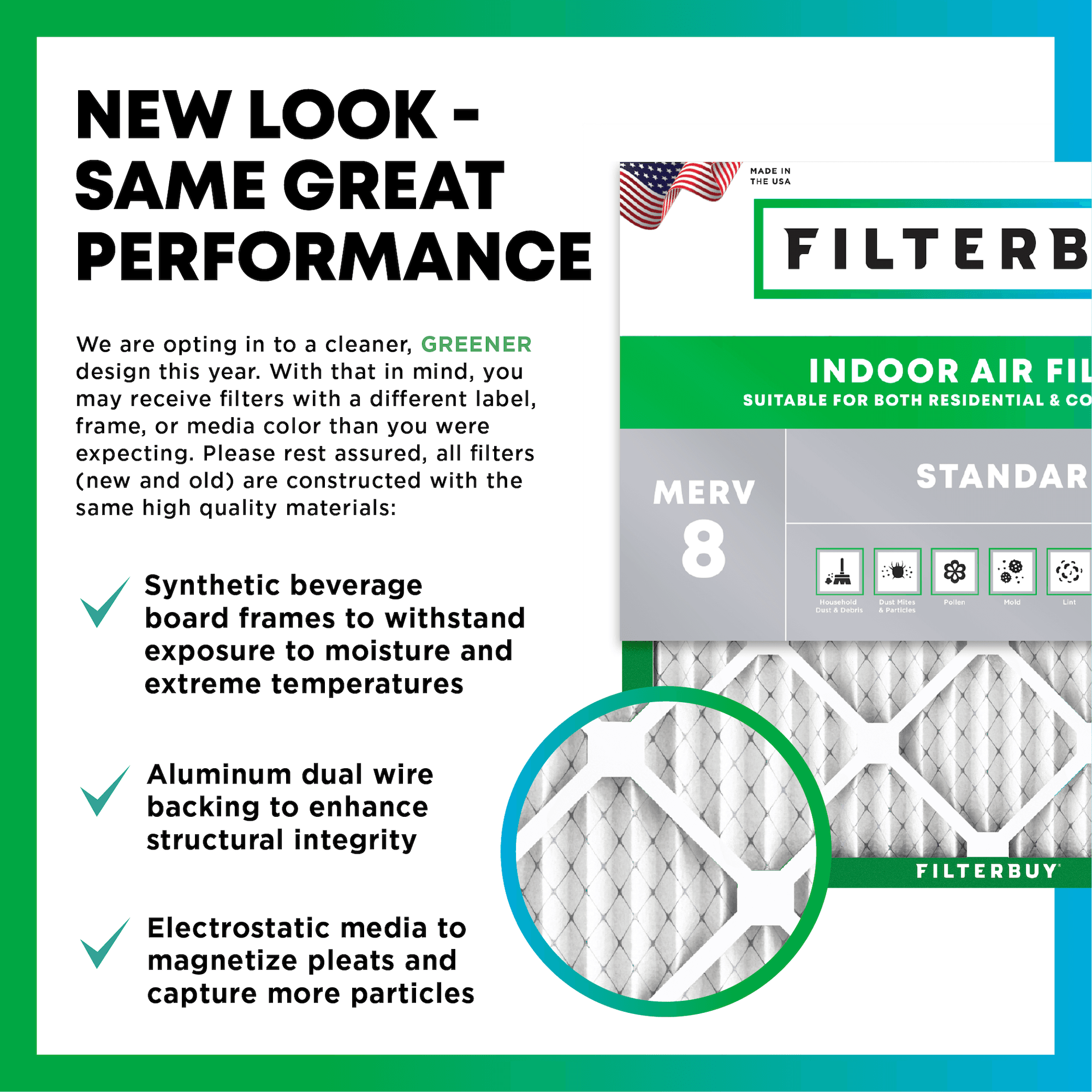
We build every Filterbuy filter to deliver reliable 90-day performance—thanks to smart design and premium materials that do the heavy lifting. Here's what makes the difference:
More pleats = more surface area to capture dust and debris, keeping your air cleaner longer.
Pleats are magnetized to attract and trap microscopic particles—like pet dander, pollen, and smoke.
Engineered to resist warping in extreme temperatures and high humidity.

A layer of metal reinforcement keeps pleats evenly spaced and structurally sound—no sagging, even at high airflow.
Assembled with care. Built to perform. Ships fast, free, and reliably from our U.S. facilities.

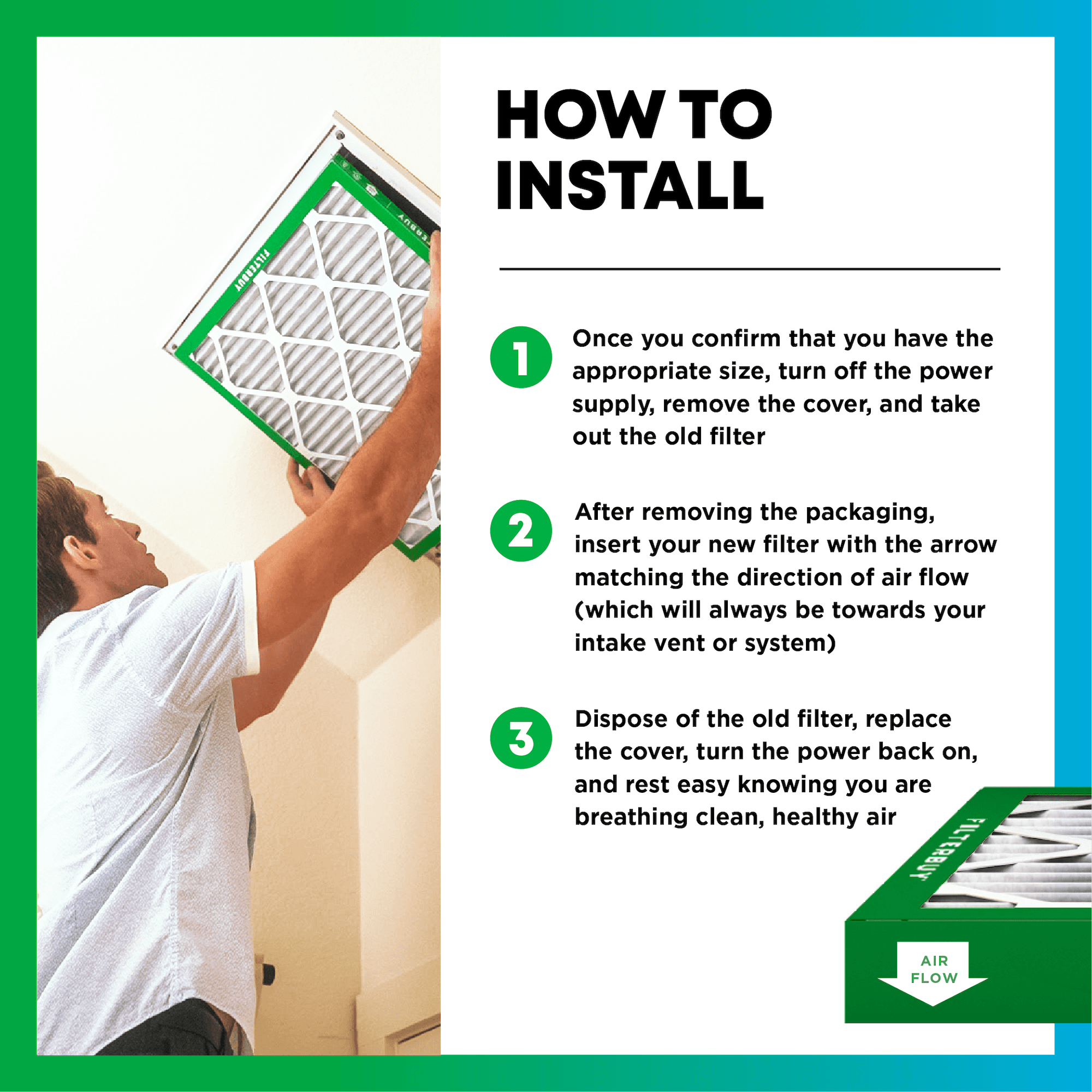
Turn Off Your HVAC SystemSafety first.

Remove The Old FilterLook for the airflow arrow and make note of the direction.

Slide In Your New FilterArrow should point toward the system (same direction as before).

Turn Your System Back OnAnd enjoy the fresh, clean air.

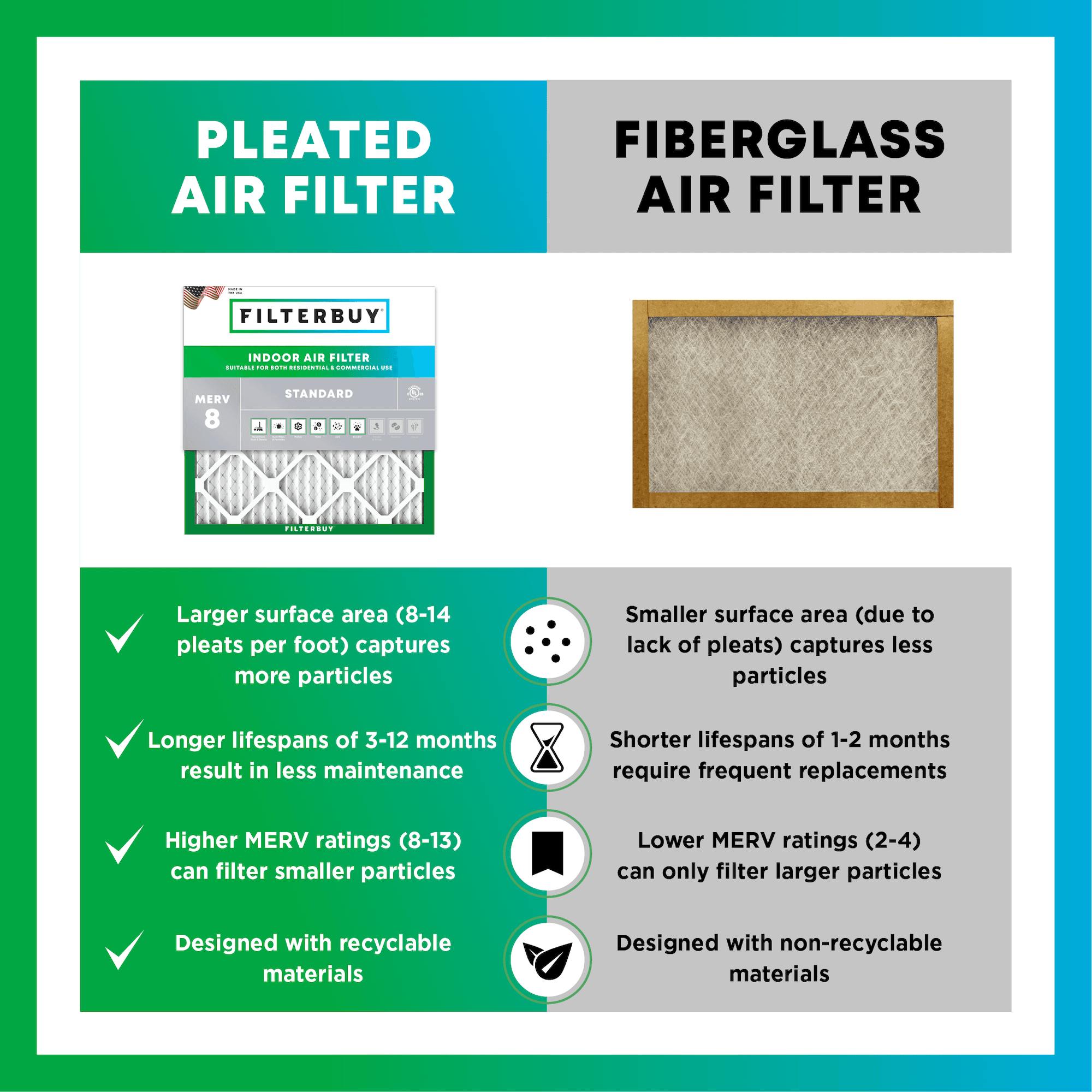
Not all air filters are created equal. Pleated filters don't just last longer—they actually clean your air better. Here's how they stack up:

Efficiency:
High (MERV 8–13) – Traps more particles
Lifespan:
90 days – Long-lasting performance
Air Quality:
Excellent – Cleaner, healthier air
Materials:
Recyclable and durable

Efficiency:
Low (MERV 4 or less) – Misses small stuff
Lifespan:
30 days or less – Replace often
Air Quality:
Minimal – Basic protection only
Materials:
Thin, flimsy, and not recyclable
Pleated filters are a no-brainer—more protection, less hassle, and better air for your home.
Changing your filter on time keeps your HVAC system running efficiently—and helps protect your lungs from dust, allergens, and airborne irritants. Here's how often to swap it out based on your needs:

For most homes without pets or special air quality concerns. Great for general upkeep and energy efficiency.

Shedding fur, dander, and allergy triggers can build up fast. Changing your filter every two months helps keep the air fresher and symptoms at bay.

For households affected by smoke, pollution, or respiratory conditions, monthly changes ensure maximum protection.

| Nominal Size | 20 x 25 x 5 inches |
| Actual Size | 20.19 x 25.31 x 5.25 inches |
| Filter Type | Pleated |
| Media | Electrostatically Charged |
| Frame | Beverage Board |
| MERV Ratings Available | 8, 11, 13 |
| Lifespan | Up to 12 Months |
| Origin | Made in USA |
Pull your 20x25x5 BDP filter out of the cabinet and hold it up to the light. If the media looks dark, compressed, or matted, your HVAC system has been compensating for a failing filter for weeks. Your family has been breathing what slipped through. That's what a quiet failure looks like, and most homeowners never catch it until something breaks or the energy bill climbs for the third month in a row.
After manufacturing thick media air filters for over a decade and serving more than two million households, we've learned something that most filter guides don't bother to say: these filters don't fail all at once. Performance drops quietly, over weeks and months. One day your energy bill is higher. Your HVAC runs longer. The air your family breathes carries more of what the filter was built to stop. By then, you're already behind.
This guide walks you through the specific, observable signs that your MERV 8 20x25x5 filter is still doing its job, and the clear signals that it's time to act. Checking takes 30 seconds. The knowledge to do it right is right here.
A MERV 8 20x25x5 BDP air filter is a 5-inch thick media replacement filter built for BDP HVAC systems that use a 20x25x5 media cabinet. It captures airborne particles between 3 and 10 microns — including dust mite debris, mold spores, pet dander, pollen, and lint — with at least 70% efficiency per pass, while maintaining the airflow your system needs to run correctly.
The 5-inch depth gives it a significant advantage over 1-inch filters at the same MERV rating: more media surface area means the filter loads gradually over time rather than restricting airflow prematurely. Most 20x25x5 filters last 6 to 12 months under normal residential conditions. A 1-inch MERV 8 filter typically needs replacement every 30 to 90 days.
MERV 8 is the filtration level ASHRAE Standard 62.1 requires upstream of cooling coils in mechanically ventilated buildings. For most residential BDP systems, it's the right balance — high enough to protect your family's air, low enough to protect your system's airflow.
At a glance:
Filter type: Thick media, whole home air filter
Compatible systems: BDP HVAC with 20x25x5 media cabinet
Particle capture range: 3–10 microns (dust mite debris, mold spores, pet dander, pollen, lint)
Capture efficiency: 70%+ per pass at MERV 8
Actual dimensions: 19.88" x 24.75" x 4.38"
Typical service life: 6–12 months
Industry standard: Meets ASHRAE Standard 62.1 minimum filtration requirement
A MERV 8 20x25x5 BDP air filter captures particles between 3 and 10 microns, including dust mite debris, mold spores, pet dander, and lint, while keeping airflow balanced across your entire HVAC system.
A working filter shows consistent airflow at every vent, no unusual odors from registers, normal HVAC cycle times, and stable energy bills month to month.
Your filter is overdue when the face is dark and compressed, airflow feels noticeably weaker, musty odors are coming from registers, or utility bills rise without any other explanation.
Most 5-inch thick media filters last 6 to 12 months, significantly longer than thinner alternatives, because the greater media depth allows the filter to load gradually rather than restrict airflow prematurely.
MERV 8 gives most residential BDP systems the right balance: high enough to capture the particles that matter, low enough to preserve the airflow your system was built to handle.
Most people know air filters catch dust. Fewer understand why this specific filter — a MERV 8 rating inside a 5-inch thick media design — is built to do far more than that, and why the depth is what separates it from the thin filters most homes replace every month.
A MERV 8 rating, as defined by ASHRAE Standard 52.2, means the filter captures particles in the 3 to 10 micron size range with at least 70% efficiency. For reference: a human hair runs about 70 microns across. The particles this filter intercepts — dust mite debris, mold spores, pet dander, pollen, and lint — are between 3 and 10 microns. Completely invisible. Constantly circulating. If you're unsure whether MERV 8 is the right fit for your system, our guide on choosing the right MERV rating for your home walks through every level with plain-language explanations.
The 5-inch depth is a performance advantage, not just a sizing requirement. In our experience manufacturing thick media air filters at our American facilities, the 5-inch design consistently outperforms thinner options for whole home filtration. More media depth means more surface area for particles to stick to, which lets the filter load gradually over time rather than reaching capacity and restricting airflow. A 1-inch MERV 8 filter may need replacement every 30 to 90 days. The 20x25x5 furnace filter with the same MERV rating can last 6 to 12 months.
For BDP systems with a media cabinet built for a 20x25x5 filter, this is the exact replacement dimension your system was built to accept. An undersized or wrong-depth filter creates bypass gaps that let unfiltered air flow around the media entirely, which defeats the point of having a whole home air filter.
A working filter doesn't announce itself. Here's what to look for:
Consistent airflow at every vent. Air moves evenly and at normal pressure throughout your home. No room feels noticeably weaker, and the system reaches your set temperature within its usual cycle time.
Light, even dust coating on the filter face. A thin, uniform layer of dust across the pleated media means the filter is capturing what it should. The face should be evenly coated, not dark, compressed, or matted.
Normal HVAC cycle times. Your system heats or cools to the set temperature without running extended cycles. That's a sign airflow is unobstructed and the blower motor is running under expected load.
Stable energy bills. Month-over-month utility costs stay consistent with seasonal norms. A standard air filter MERV 8 that's working correctly doesn't restrict airflow, so your system doesn't have to run longer to compensate.
Clean-feeling air throughout the home. Family members with allergies or asthma aren't reporting increased symptoms. Surfaces don't collect visible dust faster than usual. The air simply feels clean, because it is.
We've seen it across millions of filter replacements: homeowners who wait for a visible signal often push past the optimal change date by 30 to 60 days, especially in homes with pets or multiple occupants. By the time something looks wrong, the filter has already been underperforming for weeks. Watch for these:
Filter face is dark and compressed. When a 5-inch air filter looks uniformly gray or brown instead of white or light gray, the media is saturated and airflow restriction is already happening.
Reduced airflow from vents. A clogged whole home air filter forces your HVAC blower motor to pull harder through saturated media. Rooms start to feel like they're not conditioning properly, even with the thermostat set correctly.
Musty or stale odors from vents. Saturated filters trap organic material including mold spores, pet dander, and biological debris. When air is forced through a saturated filter, that material starts to off-gas. Musty odors from your registers are a direct signal your HVAC filter replacement is overdue.
Higher utility bills without another explanation. A restricted filter is one of the most common and most overlooked causes of unexplained energy cost increases. Your system runs longer cycles at higher load to compensate. Before you call for a service visit, check the filter.
Faster dust accumulation on surfaces. When a standard air filter MERV 8 stops capturing particles effectively, those particles recirculate and settle on furniture, floors, and counters. If you're cleaning more often without a clear reason, the filter is worth pulling.
A 20x25x5 BDP air filter typically lasts 6 to 12 months under normal residential conditions. That's a wide range, and the right answer for your home depends on real-world variables.
Factors that shorten filter lifespan:
Homes with one or more pets (pet dander and hair load the filter faster)
High-occupancy households (more activity means more airborne particles)
Residents with allergies or asthma (higher sensitivity to degraded filtration)
High outdoor pollen seasons or nearby wildfire smoke events
Older HVAC systems with less airtight ductwork that let in more particles
Factors that extend filter lifespan:
Single-occupant homes with no pets
Minimal foot traffic and low in-home activity levels
Sealed windows during high-pollen periods
Newer, well-sealed ductwork that limits particle infiltration
The practical rule: check the filter every 3 months, regardless of your expected replacement schedule. Pull the filter from the cabinet, hold it up to light, and look at the face. If the media carries a light, even gray coating and still holds its shape, put it back and set the next reminder. If it's dark, matted, or compressed, replace it today.
Unlike 1-inch filters that may need monthly replacement, thick media air filters are built for extended service intervals because of their greater media surface area. The 5-inch depth isn't just about physical fit. It's a built-in performance advantage that makes this the most cost-effective long-term choice for whole home filtration.
There's a persistent misconception that a higher MERV rating is always better. It isn't, and the distinction matters for your BDP system.
MERV ratings measure filtration efficiency, but they also correlate directly with airflow resistance. A denser filter captures more particles per pass, but it also requires more force to pull air through the media. HVAC systems are built to operate within a specific static pressure range. A filter with higher resistance than the system was designed for makes the blower work harder, reduces airflow to conditioned spaces, and can accelerate wear over time.
After working with more than two million HVAC configurations across our customer base, we've found that MERV 8 consistently hits the right balance for residential forced-air systems: high enough to capture the particles that matter most, including dust mite debris, mold spores, pet dander, and pollen, and low enough to maintain the airflow your BDP HVAC compatible filter was built to deliver.
Higher MERV ratings (11 to 13) make sense for systems specifically rated for higher-resistance media, and for households where severe allergy or asthma concerns justify the tradeoff. For the vast majority of residential BDP systems under normal conditions, MERV 8 isn't a compromise. It's the correct specification.
"A 5-inch media filter like the MERV 8 20x25x5 doesn't fail suddenly. It fails gradually. In our manufacturing process, we've measured the performance curve of thick media filters from new to end-of-life, and the pattern is consistent: the last 20% of a filter's service life delivers dramatically less protection than the first 80%. The visible indicators of failure — reduced airflow, dark compressed media, odors at the register — are lagging signals. By the time you see them, the filter has already been underperforming for weeks. Inspect on a schedule, not on symptoms."
— The Filterbuy Manufacturing Team
You've got the signs. Here are the tools and references to take the next step, whether you need to compare filtration options, pick the right replacement, or put a system in place so you never have to think about it again.
If this page confirms MERV 8 is right for you, you're ready to act. If you want to compare filtration levels before buying, our guide covers every MERV rating with plain-language explanations of what each level captures, what it misses, and what systems it fits.
Source: Filterbuy MERV Rating Guide
When you're ready to replace, Filterbuy manufactures 20x25x5 MERV 8 filters to exact dimensions at our American facility, available in single-pack or multi-pack options.
Source: MERV 8 20x25x5 Filters at Filterbuy
New to air filtration? The Wikipedia entry on air filters gives a solid, neutral overview of how filtration works, the types available, and the history of the MERV rating system. A useful foundation before you start comparing products.
The EPA's core resource on indoor air pollution covers the most common indoor pollutants, why indoor air can be more concentrated than outdoor air, and what homeowners can do to reduce their exposure.
Source: EPA's Indoor Air Quality Guide
The EPA's summary page covers the key data on pollutant concentrations, the populations most at risk, and the primary drivers of indoor air quality problems, including inadequate filtration.
Source: EPA Indoor Air Quality Overview
ASHRAE Standard 62.1 is the industry benchmark for ventilation and indoor air quality. The standard requires that particulate matter filters upstream of cooling coils meet a minimum MERV 8 rating, establishing MERV 8 as the recognized baseline for residential and commercial HVAC filtration.
Source: Access ASHRAE Standards & Guidelines
The Department of Energy's HVAC efficiency resource provides the data behind how much of your home's total energy use comes from heating and cooling, and why a clogged filter has a real, measurable cost.
Source: DOE HVAC Efficiency Resource
According to the U.S. Environmental Protection Agency, concentrations of some indoor air pollutants are often 2 to 5 times higher than typical outdoor concentrations, and in some cases more than 100 times higher. The EPA's Total Exposure Assessment Methodology (TEAM) studies confirmed this finding across homes in both rural and highly industrialized areas.
Source: U.S. EPA — Indoor Air Quality
The same EPA research establishes that Americans spend approximately 90% of their time indoors on average. Pair that exposure time with the pollutant concentration data above, and the case for consistent, effective filtration becomes straightforward. A whole home air filter that's working correctly is one of the few home maintenance tasks with a direct, daily impact on what every member of your household breathes.
Source: U.S. EPA — The Inside Story: A Guide to Indoor Air Quality
The U.S. Department of Energy reports that space heating and cooling systems account for 44% of energy consumption in U.S. residences, the single largest share of any home energy end use. A clogged filter adds airflow resistance that forces the blower to run harder and longer, directly increasing the cost of the single biggest line item on your utility bill. Replacing a saturated filter isn't routine maintenance. It's energy cost management.
Source: U.S. DOE — Smart Tools for Efficient HVAC Performance
Here's our honest take, shaped by more than a decade of manufacturing air filters and working with over two million households: the homes with the best indoor air quality aren't the ones with the most expensive HVAC systems. They belong to people who stayed ahead of the simplest maintenance task in the house.
Your MERV 8 20x25x5 BDP air filter is doing real, invisible work every hour it's running. It's catching the particles your family would otherwise breathe. It's protecting the evaporator coil, the blower motor, and the heat exchanger from the kind of gradual fouling that shortens system life. And it does all of that without making a sound, which is exactly why it gets overlooked.
The warning signs in this guide are real, and they're observable. But our strongest recommendation isn't to watch for them. It's to get ahead of them. Set a three-month calendar reminder. Pull the filter. Look at it. Dark and matted means replace it. Light and even means put it back and set the next reminder. That single 30-second check is worth more to your home's air quality and your system's longevity than any upgrade or service contract you could add.
You're the one who keeps your home healthy for your family. The contractor doesn't set the three-month reminder. The thermostat can't pull the filter. You do, because you're the one who checks.
Look for a dark, compressed filter face; reduced airflow from vents; musty or stale odors from registers; or an unexplained spike in your energy bill. On a 5-inch thick media filter, plan to check visually every 3 months even if you're on a 6 to 12 month replacement schedule. If two or more warning signs are present at the same time, replace it immediately.
MERV stands for Minimum Efficiency Reporting Value. A MERV 8 rating means the filter captures at least 70% of airborne particles in the 3 to 10 micron size range per pass, including dust mite debris, mold spores, lint, and pet dander. ASHRAE Standard 62.1 specifies MERV 8 as the minimum required filtration level upstream of cooling coils in mechanically ventilated buildings, making it the recognized residential baseline.
No. Filter depth determines media volume and service life. A 5-inch air filter holds significantly more filtration media than a 1-inch or 4-inch version. That translates directly to a longer service interval: 6 to 12 months versus 1 to 3 months, and more consistent airflow maintenance throughout. Always use the exact depth your HVAC media cabinet was built for. An undersized filter creates bypass gaps that send unfiltered air directly into your system.
A MERV 8 20x25x5 is a BDP HVAC compatible filter for any system with a media cabinet sized for 20x25x5 media. MERV 8 was built to balance air quality protection and airflow for residential forced-air systems. It's the filtration level ASHRAE Standard 62.1 requires upstream of cooling coils, which confirms it as the right technical baseline for BDP's residential product line.
In a typical home without pets, plan for every 9 to 12 months. With pets or allergy sufferers in the household, plan for 6 to 9 months. Check visually every 3 months regardless of your expected schedule. A 30-second inspection is always faster and cheaper than the service call that follows a clogged, neglected filter.
Yes. A clogged filter restricts airflow to the air handler, forcing the blower motor to run under elevated load and exposing the heat exchanger or evaporator coil to temperature extremes they weren't built for. Over time, that accelerates wear, shortens component life, and can result in repair or replacement costs far exceeding the price of a filter. Staying on a replacement schedule is the most cost-effective preventive maintenance step any homeowner can take.
The nominal size printed on the frame is 20x25x5. Filterbuy's 20x25x5 MERV 8 filter measures 19.88 inches by 24.75 inches by 4.38 inches in actual physical dimensions. Nominal dimensions are always rounded up from actual measurements. Confirm your HVAC media cabinet accepts a 20x25x5 nominal before ordering.
Now that you know what to look for, the next step is simple: if your filter is showing warning signs — or it's been six months or more — shop Filterbuy's MERV 8 20x25x5 replacement filters and get the right filter to your door before your system has to work any harder.

