
Air Quality in Wisconsin
Air quality index (AQI⁺) and PM2.5 air pollution in Wisconsin •


Get Alerts For Unhealthy AQI In Your Area
When air quality in your area reaches unhealthy levels, we'll send you a quick alert, along with expert tips on how to reduce your exposure.
Live Air Quality Ratings in Wisconsin
Live Most Polluted City Ranking
Real-time most polluted cities in Wisconsin
Live Cleanest City Ranking
Real-time cleanest cities in Wisconsin
The Right Air Filter For High AQI Days
When outdoor air quality drops, the EPA recommends upgrading to a MERV 13 filter — or the highest-rated filter your HVAC system can handle — to help capture more of the fine particulate (PM2.5) that comes with poor air quality. MERV 13 is the highest rating most residential systems can run without restricting airflow.
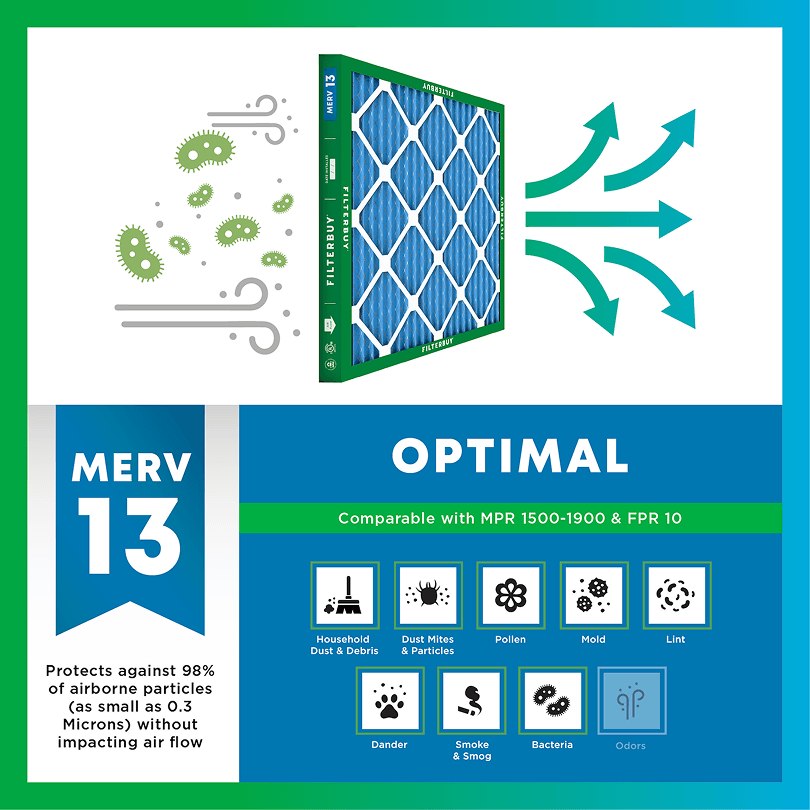

- Captures PM2.5 and other fine particulates
- Filters ash, soot, and smoke particles
- Rated to capture particles as small as 0.3 microns
- Matches the filter rating the EPA suggests during high-AQI and smoke events

AQI FAQs
What is AQI?
AQI stands for Air Quality Index, the EPA's scale for reporting daily air quality. It runs from 0 to 500. The higher the number, the greater the level of air pollution. Values at or below 100 are generally considered satisfactory; values above 100 mean air quality is unhealthy, first for sensitive groups, then for everyone as numbers climb.
What does AQI measure?
The AQI tracks five major pollutants regulated by the Clean Air Act: ground-level ozone, particle pollution (PM2.5 and PM10), carbon monoxide, sulfur dioxide, and nitrogen dioxide. The reported AQI value reflects whichever pollutant is highest at that time — most often ozone or fine particles (PM2.5).
How is AQI calculated?
Monitoring stations measure pollutant concentrations, and the EPA converts each into a standardized 0–500 score using set breakpoints. Each pollutant gets its own sub-index, and the highest sub-index becomes the reported AQI. That's why a single number can represent different pollutants on different days.
What is a good AQI?
An AQI of 0–50 is rated "Good" — air quality poses little or no risk. 51–100 is "Moderate," acceptable for most people though unusually sensitive individuals may want to limit prolonged outdoor exertion. Anything at or below 100 is generally considered satisfactory air quality.
What does an AQI of 100 (or 150) mean?
100 is the dividing line: at or below it, air quality is satisfactory for the general public. From 101–150, air is "Unhealthy for Sensitive Groups" — people with respiratory conditions, older adults, and children. From 151–200, it's "Unhealthy" and everyone may begin to feel effects.
Why is the AQI bad today?
Short-term AQI spikes usually come from wildfire smoke, temperature inversions that trap pollutants near the ground, high-ozone weather (hot, sunny, stagnant days), or heavy traffic and industrial activity. Check a real-time source like the map on this page to see which pollutant is driving today's reading in your area.
What AQI is bad for running or exercise?
Many runners follow the EPA category lines: below 50, no adjustment needed; 51–100, unusually sensitive people may shorten intense workouts; above 100, sensitive groups are advised to reduce prolonged or heavy outdoor exertion; above 150, that advice extends to everyone. Exercise increases how much air you breathe in, which is why thresholds matter more during workouts.
What AQI is safe to open windows?
A common rule of thumb is to keep windows open when the AQI is under 100 and close them when it climbs above, especially during wildfire smoke events when fine particles are elevated. When windows are closed, running your HVAC system with a fresh filter helps capture particles circulating indoors.
Should I wear a mask based on AQI?
Public health agencies generally suggest considering a well-fitted N95-style respirator outdoors when the AQI exceeds 150, particularly during smoke events. Cloth and surgical masks don't filter fine particles effectively. Follow guidance from your local health department, which may adjust recommendations during severe episodes.

Live Air Quality Index AQI Map Wisconsin Today | Filterbuy.com
Here's what most air quality resources don't tell you: Outdoor air directly affects your indoor air. After we started manufacturing over 10 million air filters and servicing over two million households, we've seen firsthand how elevated levels of pollution outdoors affect the load of your air filter and reduce indoor air quality within hours, not days.
The AQI scale ranges from 0, which represents the cleanest air, to 500, representing the most dangerous air. Understanding where your Wisconsin community is on that scale in the present helps to determine what kind of precautions need to be taken today when on the verge of opening windows, and going outside for exercise, and - just as importantly - how much of an extra push that your HVAC system may need to filter the air that is inevitably going to make its way inside.
Use the live map to see what your local conditions are, then continue reading to understand what those numbers actually mean for your family's health and your home's air filtration needs.
TL;DR Quick Answers
What is the live air quality index AQI map now today in Wisconsin?
Wisconsin's live AQI map displays real-time air pollution levels across the state, updated hourly from EPA monitoring stations. Current readings range from 0 (cleanest) to 500 (most hazardous).
To check Wisconsin's AQI right now:
View our live map above for statewide conditions
Find your city or county for localized readings
Note the color code: Green (good), Yellow (moderate), Orange (unhealthy for sensitive groups), Red (unhealthy for all)
Key Wisconsin areas we monitor:
Milwaukee metro
Madison
Green Bay
Fox Valley region
Southeastern Wisconsin
What we've learned serving over two million households: The number you see outside directly impacts your indoor air within hours. When Wisconsin's AQI exceeds 100, your HVAC filter starts working overtime—whether you realize it or not.
Quick action based on today's reading:
AQI 0-50: Open windows and enjoy fresh air
AQI 51-100: Normal activities; sensitive individuals take note
AQI 100+: Close windows, run HVAC fan continuously, check filter condition
Bookmark this page for instant access whenever you need Wisconsin's current air quality conditions.
Top 5 Takeaways
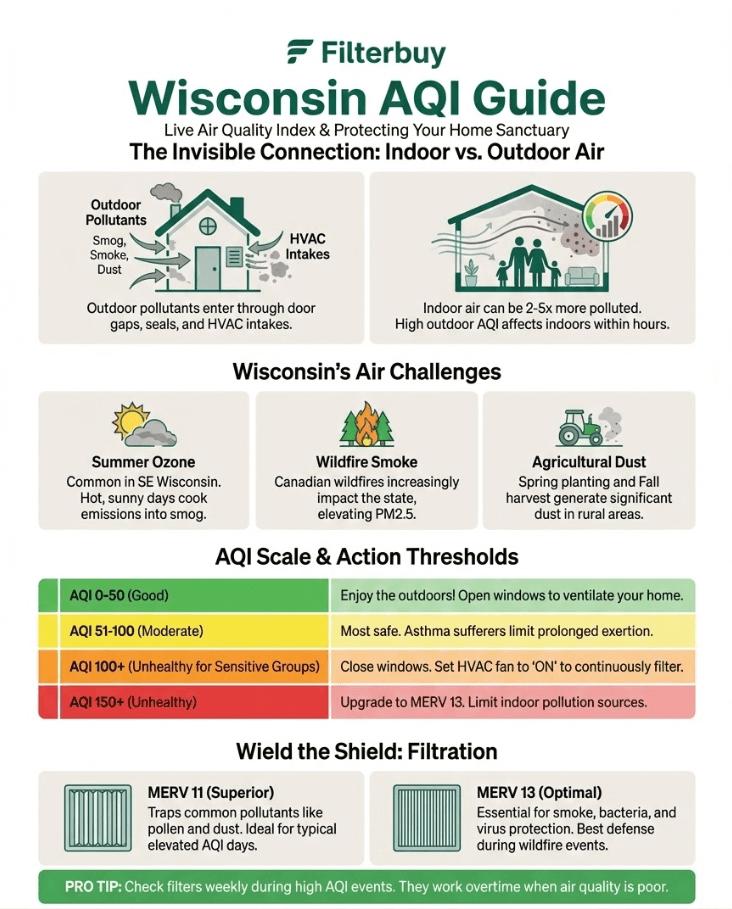
Outdoor AQI impacts indoor air within hours. Homes aren't sealed. Air exchanges 0.5 to 1.0 times per hour through gaps, seals, and HVAC systems. What's outside comes inside.
AQI above 100 = action time. Close windows. Runthe HVAC fan continuously. Check the filter within 48 hours. This threshold is when we see calls spike and filters darken fast.
Wisconsin faces year-round air quality challenges:
Summer: Ozone buildup in southeastern Wisconsin
Warm months: Canadian wildfire smoke infiltration
Spring/Fall: Agricultural dust from planting and harvest
Winter: Temperature inversions trapping pollutants
Match your MERV rating to conditions:
MERV 11 → Typical elevated AQI days
MERV 13 → Wildfire smoke, ozone events, respiratory sensitivities
Proactive beats reactive. Families who monitor AQI and adjust filtration report fewer respiratory complaints, better HVAC performance, and fewer emergency filter replacements.
Understanding the Air Quality Index Scale
This measurement converts complicated air pollution information into an easy-to-understand number that tells you how safe it is to breathe outside.
The following are its ranges and what they mean:
0-50 (Green): Good. Air quality is satisfactory with little to no health risk.
51-100 (Yellow): Moderate. Acceptable for most people, though unusually sensitive individuals may experience minor effects.
101-150 (Orange): Unhealthy for Sensitive Groups. Children, the elderly, and those with respiratory conditions should limit prolonged outdoor exposure.
151-200 (Red): Unhealthy. Everyone may begin experiencing health effects; sensitive groups face more serious risks.
201-300 (Purple): Very Unhealthy. Health alert—everyone should reduce outdoor activity.
301-500 (Maroon): Hazardous. Emergency conditions affect the entire population.
What Affects Wisconsin's Air Quality
Then the state’s air quality changes depending on the area, time of year, and the weather. Understanding these factors can help you know what to expect when air quality index levels may increase in your area.
Seasonal Ozone: Summer months bring high levels, especially in southeastern regions, as well as the Milwaukee metro area. Hot, sunny, stagnant days permit the sunlight to cook the harmful emissions from cars and industry, to create smog.
Wildfire Smoke: Canadian wildfires have been increasingly affecting the air quality in the area, and fire smoke has occasionally driven the levels to unhealthy ranges for days at a time.
Agricultural Activity: The Spring planting and Fall harvest seasons generate an abundance of dust and ratio matters in rural areas.
Temperature Inversions: Because of the region’s frigid winters, there are times when warm air traps pollutants near the ground.
Pollen and Biological Particles: Not included in the official measurement, but the state has problems with tree pollen (spring), grass pollen (early summer), and ragweed (late summer/fall), all of which increase the respiratory stress when combined with rising pollution levels.
Health Recommendations by AQI Level
Your response to AQI readings should scale with the severity and your family's sensitivity levels.
When AQI is 0-50: Enjoy normal outdoor activities. This is an excellent time to ventilate your home by opening windows.
When AQI is 51-100: Most people can continue normal activities. If anyone in your household has asthma or respiratory sensitivities, consider shorter outdoor exercise sessions.
When AQI is 101-150: Keep windows closed and run your HVAC system to filter incoming air. Sensitive individuals should limit prolonged outdoor exertion. This is when we see customers first noticing their filters working harder.
When AQI exceeds 150, Everyone should reduce outdoor exposure. Run your HVAC fan continuously to maximize filtration cycles. Avoid activities that add indoor pollutants, like burning candles or using gas stoves without ventilation.
How Outdoor Air Quality Impacts Your Residential Space
Most people think that by closing windows, bad air is sealed out. What is really happening is complicated.
Your home exchanges air with the outdoors all the time - through the gaps in your doors and the air tightness of your windows, through the electrical outlets and plumbing penetrations in your home, and your home's HVAC's fresh air intake. The average home changes the air 0.5 to 1.0 times per hour, which means that the pollutants from the outdoors have a constant entry to your living space.

Protecting Your Indoor Air When Wisconsin's AQI Rises
Proactive steps during periods of elevated ranges ensure your family is breathing cleaner air indoors.
Check the condition of your filter yourself (more frequently). During prolonged poor air quality events, check it weekly and not monthly. Heavy particulate loading can also restrict air flow and pressurize your heating and cooling system.
Setting your thermostat fan to the "on" and not the "auto" setting will circulate the air through your filter on a constant basis, capturing more of the particles suspended in the air during the course of a day.
MERV 11 filtration traps the most common pollutants. However, MERV 13 filters offer better protection from small particles such as smoke and some bacteria - important in wildfire smoke events.
Wisconsin Air Quality Resources
For detailed forecasts and historical data, these resources complement our live map:
The Wisconsin DNR Air Quality Program monitors conditions statewide and issues health advisories
AirNow.gov provides the EPA's official AQI data and forecasts for Wisconsin communities
The National Weather Service Milwaukee/Green Bay includes air quality information in weather forecasts during significant events.
"After analyzing filter returns during the 2023 wildfire season, we found that customers in regions experiencing sustained AQI levels above 100 were replacing filters 30-40% sooner than normal—clear evidence that what's happening outside your home directly impacts the air your family breathes inside."
— Filterbuy Air Quality Team
7 Essential Wisconsin Air Quality Resources to Help You Protect What Matters Most
Don't take your indoor air for granted—and that starts with understanding what's happening outside. We're obsessed with helping you breathe easier, which means connecting you with the best tools available. These resources complement our live AQI map and give you everything needed to make smart decisions for your family, your home, and your HVAC system.
1. Get Official Real-Time AQI Data — AirNow.gov
This is where we start every morning at Filterbuy headquarters. The EPA's primary monitoring platform delivers certified air quality readings you can trust for Wisconsin communities statewide. When customers call asking about current conditions, this is the source we reference.
Source: https://www.airnow.gov/
2. Stay Ahead with Wisconsin-Specific Alerts — Wisconsin DNR Air Quality Program
Your state's environmental experts issue localized advisories before conditions become problematic. Signing up for alerts means you'll know when to close windows and give your HVAC system extra support—often hours before you'd notice symptoms yourself.
Source: https://dnr.wisconsin.gov/topic/AirQuality
3. Compare Conditions Across Wisconsin Communities — IQAir Wisconsin
Planning outdoor activities in Madison this weekend? Visiting family in Green Bay? This resource lets you compare air quality city-by-city so you can plan accordingly. We've found it particularly helpful for customers managing allergies or asthma across multiple locations.
Source: https://www.iqair.com/us/usa/wisconsin
4. See What's Happening in Your Actual Neighborhood — PurpleAir
Here's something most people don't realize: air quality can vary dramatically within just a few miles. During the 2023 wildfire smoke events, we heard from customers whose official AQI readings showed "moderate" while their neighborhood was visibly hazy. PurpleAir's crowdsourced sensors fill those gaps with hyperlocal data.
Source: https://map.purpleair.com/
5. Understand Exactly What Those Numbers Mean — EPA AQI Basics
Numbers without context don't help you protect your family. This guide translates AQI readings into clear action steps—when sensitive family members should stay inside, when to limit outdoor exercise, and when conditions are safe for everyone. Knowledge is power, and this resource puts you in control.
Source: https://www.airnow.gov/aqi/aqi-basics/
6. Know Your County's Long-Term Air Quality Grade — American Lung Association
Does the air improve or deteriorate with time in your community? This annual report provides a card of every county in Wisconsin showing trends that will aid in making an informed choice on the levels of filtration and long-term plans on air quality in the home. We use these grades to assist customers to select right MERV ratings.
Source: https://www.lung.org/research/sota
7. Access Trusted Health Guidance for Your Whole Family — CDC Air Quality and Health
Children, grandparents, and family members with asthma - different people are affected by poor air quality. The CDC offers evidence-based approaches to protect people from highly vulnerable groups, so that you can be the informed protector your household needs you to be.
Source: https://www.cdc.gov/air-quality/
Supporting Statistics: What the Research Confirms—And What We've Seen Firsthand
After manufacturing over 10 million air filters and serving more than two million households, we've developed a unique perspective on how outdoor air quality affects indoor environments. These statistics from authoritative sources align with patterns we observe daily.
1. Indoor Pollutant Levels Can Be 2-5 Times Higher Than Outdoor Levels
Americans spend approximately 90% of their time indoors—yet indoor air is often significantly more polluted than outdoor air.
What We've Learned:
Customers assume closed windows protect them during poor AQI days. They don't.
Returned filters from high-AQI regions show accelerated particulate loading regardless of window status.
Homes exchange air constantly through door gaps, ductwork, and natural ventilation.
During extended poor air quality events, we recommend weekly filter checks instead of monthly.
Source: U.S. Environmental Protection Agency — Report on the Environment: Indoor Air Quality - https://www.epa.gov/report-environment/indoor-air-quality
2. Over 40% of Americans Live in Counties with Failing Air Quality Grades
The American Lung Association's 2024 report found that more than 131 million Americans live in counties receiving failing grades for ozone or particle pollution.
What We've Learned:
This isn't just a big-city problem—our Wisconsin customer data proves it.
We track order spikes from southeastern Wisconsin and the Fox Valley during the summer ozone season.
Customers in chronically affected areas often need higher MERV ratings than initially expected.
"Moderate" AQI in a failing-grade county warrants more robust filtration than the same reading elsewhere.
Key Wisconsin areas of concern:
Southeastern Wisconsin (Milwaukee metro)
Fox Valley region
Areas downwind from agricultural activity
Source: American Lung Association — State of the Air 2024 - https://www.lung.org/research/sota/city-rankings/most-polluted-cities
3. Fine Particulate Matter (PM2.5) Contributes to 100,000+ U.S. Deaths Annually
PM2.5—the primary pollutant during wildfire smoke events—causes premature deaths from cardiovascular and respiratory diseases. Even short-term exposure triggers health effects.
Our Recommendation for Wildfire-Prone Regions:
Upgrade to MERV 13 filtration for enhanced PM2.5 capture.
Run the HVAC fan continuously during smoke events.
Inspect filters weekly—not monthly—when AQI exceeds 100.
Replace immediately if airflow noticeably decreases.
Source: U.S. Centers for Disease Control and Prevention — Air Quality: Particle Pollution - https://www.cdc.gov/air-quality/pollutants/particle-pollution.html
Final Thoughts and Opinion
Monitoring Wisconsin's live AQI isn't just about deciding whether to jog outside today. It's about understanding the invisible connection between the air surrounding your home and the air your family breathes inside it.
What We've Observed:
Homes don't seal out pollution. They slow it down.
Filters work harder when outdoor AQI rises—whether you realize it or not.
Families who monitor conditions proactively report fewer respiratory complaints and better HVAC performance.
The 30-40% faster filter loading during the 2023 wildfire season confirmed what we'd suspected for years.
We want Wisconsin families to understand:
An orange AQI day means your HVAC filter is working overtime
Wildfire haze outside means PM2.5 is infiltrating inside
MERV 13 captures what MERV 8 lets through
Today's outdoor reading predicts tomorrow's indoor air quality
What You Can Control:
You can't control Wisconsin's air quality. Weather patterns, wildfires, ozone formation—these forces operate beyond any individual's influence.
But you can control your response:
Check the live AQI. Takes seconds.
Run your HVAC fan continuously during elevated pollution. Costs almost nothing.
Inspect your filter weekly when the AQI exceeds 100. Minimal effort.
Choose appropriate MERV ratings for your region's challenges. One-time decision, lasting impact.
Next Steps: Protect Your Wisconsin Home Today
Ready to take action? Here's your simple roadmap for staying ahead of air quality challenges.
Start With These Three Actions:
Bookmark this page. Quick access to Wisconsin's live AQI when you need it.
Check your current filter. Note its condition as your baseline.
Know your MERV rating. Find the number printed on your filter's frame.
When AQI Rises Above 100:
Close windows and exterior doors
Set thermostat fan to "on" instead of "auto."
Inspect your filter within 48 hours
Limit indoor pollution sources like candles, aerosol sprays, and gas cooking without ventilation.n
Upgrade Your Protection:
If you're currently using MERV 8 filters in a region that regularly experiences elevated AQI, consider upgrading to MERV 11 for improved particle capture. Households with family members managing allergies or asthma benefit from MERV 13 filtration, which captures finer particles that trigger respiratory symptoms. During wildfire smoke events, MERV 13 is particularly valuable for its ability to trap PM2.5 particles that lower-rated filters miss. And if you've noticed your filter darkening faster than usual, that's your signal to increase inspection frequency rather than waiting for your standard replacement schedule.
Set Up Your Air Quality Alerts:
Wisconsin DNR: Subscribe to statewide advisories
AirNow.gov: Set location-based email notifications
Weather apps: Enable AQI display for your city
Frequently Asked Questions
Q: What is a safe AQI level in Wisconsin?
A: AQI safety breaks down into clear action zones:
0-50 (Green): Safe for all activities. No precautions needed.
51-100 (Yellow): Acceptable for most. Sensitive individuals may notice minor effects.
100+ (Orange and above): Action threshold. Close windows and run HVAC.
Q: Why does Wisconsin's AQI spike during summer months?
A: Two primary culprits affect Wisconsin summers:
1. Ground-Level Ozone
Forms when emissions react with heat and sunlight
Worst in southeastern Wisconsin and the Milwaukee metro
Peak concern: June through August
Stagnant weather traps pollutants near ground level
2. Wildfire Smoke
Canadian fires increasingly impact Wisconsin
Can elevate AQI for days at a time
PM2.5 particles travel hundreds of miles
What we've observed: During the 2023 wildfire season, customer calls from upper Midwest states increased 40%. Many reported visible indoor haze despite closed windows. Summer AQI monitoring isn't optional—it's essential.
Q: How often is Wisconsin AQI data updated?
A: Update frequency varies by source:
Official stations (AirNow.gov, Wisconsin DNR): Hourly updates
Crowdsourced platforms (PurpleAir): Every few minutes
Weather apps: Typically hourly, sometimes delayed
What we've learned from customers: Official readings sometimes lag real-world conditions by an hour or more.
Our recommendation:
Use official sources for baseline data
Cross-reference with PurpleAir for hyperlocal readings
Trust your eyes—if you see haze but AQI shows "moderate," take precautions anyway
Q: Does outdoor AQI affect the air inside my Wisconsin home?
A: Yes. This connection is the most underestimated factor in home air quality.
The reality:
Homes aren't sealed environments
Air exchanges 0.5 to 1.0 times per hour through gaps, seals, and HVAC systems
Outdoor pollutants continuously infiltrate indoor spaces
What our filter data proves:
During the 2023 wildfire season, we analyzed returns from high-AQI regions and found:
Filters showed weeks of accumulation in just days
Customers replaced filters 30-40% faster than normal
No changes to household routines—just elevated outdoor AQI
Bottom line: What's happening outside your Wisconsin home today predicts your indoor air quality tomorrow.
Q: What MERV rating filter should I use when Wisconsin's AQI is high?
A: After helping over two million households, here's our straightforward guidance:
MERV 11 — Good for typical elevated AQI days, MERV 13 — Essential for serious air quality events, and use MERV 13 year-round.
What we've seen firsthand: The visual difference between used MERV 8 and MERV 13 filters after a smoke event tells the whole story. One captures what matters. One doesn't. Customers consistently tell us they can feel the difference.
Check Wisconsin's Live AQI Today—Then Protect the Air Inside Your Home
Now that you know what's happening outside, make sure your home's filtration is ready to handle what comes inside. Shop Filterbuy's complete selection of MERV 11 and MERV 13 air filters to keep your Wisconsin family breathing cleaner air—no matter what today's AQI brings.